
 Tap to zoom
Scientific Review of Jelqing Exercises for Penis Enlargement: Risks and Alternatives
- نویسنده
- دکتر مهدی قاضی
- Published on
- June 26, 2026
- Reading time
- 5 min read
- Last updated
- Updated: September 4, 2026
Jelqing exercises are one of the most common methods some men turn to for increasing penile size; they are said to be a natural approach that may enlarge the penis without medication or surgery.
In recent years, as informal content on social media has spread, these exercises have been promoted as a home method for penis enlargement. The reality is that no reliable scientific evidence has yet been published showing that jelqing is effective, and some sources even consider it risky.
Given the extensive advertising around this method, this article reviews its effectiveness from a scientific and balanced perspective. We then discuss user experiences with these exercises, review their possible risks, and introduce more reliable options for penile enlargement.
So if you are wondering what jelqing exercise involves and whether it works, read on.
What Is Jelqing Exercise?
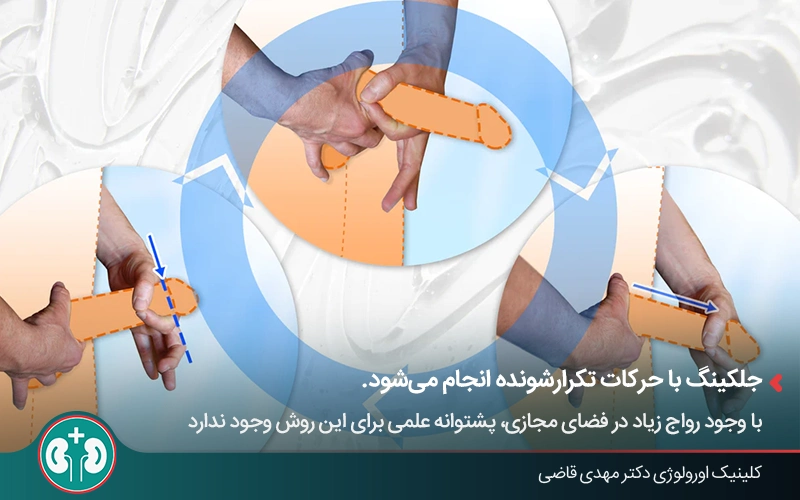
Jelqing exercise, like the Penimor method, is a manual technique and a form of penile massage that was first introduced by Brian Richards. He presented it as a home method for penile growth; in recent years, this exercise has attracted considerable attention on social media and the internet.
Supporters of this technique believe that jelqing increases blood flow and creates very small tissue tears (microscopic tears), stimulating the body to form new tissue. They therefore claim that the exercise gradually increases penile size. However, this method is not scientifically supported, and some sources have raised the possibility of injury from the exercise.
How Are Jelqing Exercises Performed?
As noted above, jelqing exercises have no clear scientific basis and may even carry risks. However, because users ask about them frequently, this section describes the technique only for awareness, without any recommendation or endorsement.
The information below is provided only to familiarize you with the jelqing method and has no confirmed scientific basis. Performing these exercises may carry risks such as injury to penile tissue, erectile problems, or Peyronie’s disease. We recommend that you consult a specialist before taking any action. Dr. Mahdi Ghazi’s office does not endorse or recommend this method in any way.
Safety Points Before Starting Jelqing Exercises
Before learning about jelqing exercises, please note these important points:
This exercise should be performed when the penis is semi-erect, not completely flaccid and not fully erect.
If you have a history of skin or vascular disease, be sure to consult a physician before starting.
Using a suitable lubricant, such as jelqing oil, petroleum jelly, or unscented hygiene gels, before massage can help prevent inflammation or friction of the penile skin.
The best time for jelqing exercise is after a warm shower or before sleep at night, because blood flow in the body is higher and the chance of overstimulation is lower.
Detailed Steps for Performing Jelqing Exercises
An important point when performing jelqing exercises is that pressure on the penis should be gentle, even, and controlled. Excessive pressure may damage the blood vessels or delicate nerves in this area, while very light pressure may have no effect.
After the penis becomes erect, follow these steps:
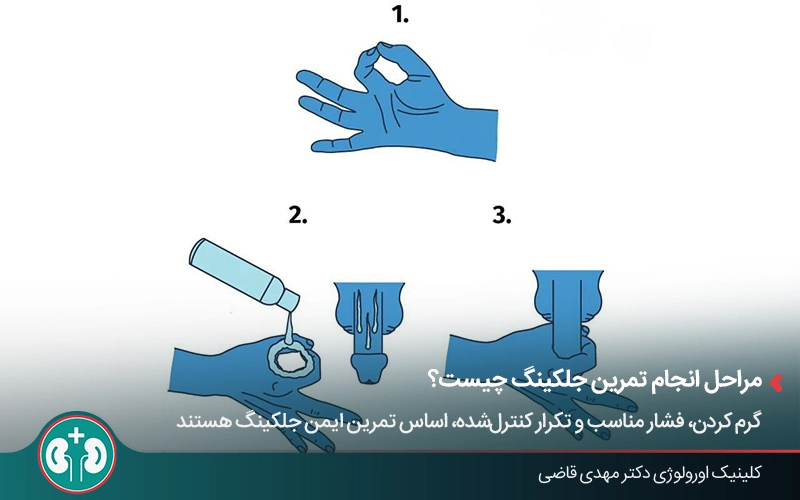
First place a warm, damp towel on the penis for 5 minutes to warm the area.
Place the thumb and index finger in a ring (O) shape at the base of the penis. The ring should be firm but not painful.
Slowly draw the ring from the base toward the head of the penis, so that each smooth stroke takes about 3 to 5 seconds.
After each stroke, return your hand to the base of the penis and repeat the movement.
Jelqing exercises usually last 5 to 20 minutes per day, and some people do them daily or several times a week.
Is Pain During Jelqing a Sign of Progress?
No. Pain during jelqing exercises is never a positive sign. Pain, numbness, bruising, or a change in penile color are warning signs that the pressure is excessive or that the technique has not been performed correctly. If these symptoms occur, stop the exercise immediately and consult a physician if symptoms continue.
Why Do Some People Not Get Results From Jelqing and Penimor?
Because the effectiveness of jelqing and Penimor methods has not been scientifically confirmed, it is natural for many people not to see a noticeable result. The following factors may also contribute to the exercise having no effect:
Incorrect performance of penile stretching techniques
Lack of consistency with the exercises
Applying inappropriate pressure (too much or too little)
Having unrealistic expectations
Differences in each person’s body structure, genetics, and penile tissue type
User Experiences With Jelqing Exercises
User reports and comments online about jelqing exercises vary widely. Some users report an increase of about 0.5 to 2 cm in penile length after several months of exercise. In contrast, many others complain of complications such as bruising, burning, reduced sensation, and no results from the exercise.
It is important to remember that these experiences are individual, cannot be generalized scientifically, and cannot replace specialist medical advice. Some users also later realize that their initial belief that their penis was small was not accurate, and that the main cause of their concern was body anxiety or inappropriate comparisons.
Now, to examine the effect of jelqing more carefully, we turn to scientific evidence and reliable sources.
Is Jelqing Exercise Really Effective? A Scientific Review of Reliable Sources
With the rise of online advertising for jelqing exercise, many people wonder whether this technique can truly increase penile size (penis enlargement).
Scientific Review of the Effectiveness of Jelqing
A review of reliable scientific sources shows that, so far, there is not enough evidence to prove that jelqing exercises enlarge the penis. No clinical study with a valid sample has confirmed a positive effect of this method on increasing penile length or girth.
Most studies have either involved traction exercises or focused on treating conditions such as Peyronie’s disease. For this reason, specialist sources describe this exercise as experimental, unsupported, and potentially risky.
Possible Risks of Jelqing Exercises
Jelqing is a non-medical penile stretching technique that is usually performed without specialist supervision. This exercise can damage the delicate tissues of this area, especially if it is not performed correctly.
As noted in the previous section, there is still no reliable scientific evidence showing that this exercise enlarges the penis. However, many examples of jelqing-related complications have been seen in patients. Before trying this exercise, become familiar with its possible risks and complications:
1. Bruising, Inflammation, Numbness, and Plaque Formation
Excessive pressure and incorrect movements during jelqing may cause bruising and inflammation of the penile skin. Some people also report penile numbness, usually due to injury to superficial nerves.
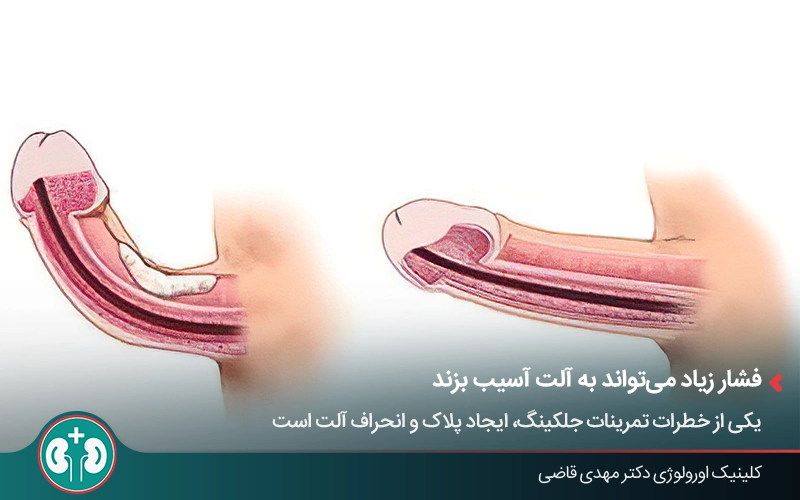
In some cases, tissues under the skin are damaged, and penile plaque may develop as a result. Penile plaque is a condition in which a firm or knot-like area forms in the penis, can be felt by touch, and usually worsens over time.
2. Penile Curvature and Erectile Dysfunction
One serious injury associated with jelqing is penile curvature, which can develop from inappropriate pressure and frequent repetition of this exercise. The curvature may increase over time and make sexual intercourse painful or impossible.
Some people also develop erectile dysfunction because of damage to blood vessels and internal tissues. Erectile dysfunction means the penis does not become firm enough or loses its erection too quickly.
3. Triggering Peyronie’s Disease
Unfortunately, jelqing may set the stage for Peyronie’s disease. This condition occurs when firm, abnormal tissue, such as plaque, forms inside the penis. The result can be severe curvature, pain, and serious erectile problems.
If the Goal Truly Is to Increase Penile Size, Which Methods Are More Scientifically Reliable?
Most common methods for increasing penile size do not have enough scientific support and may even cause harm. However, some options have been studied and supported in scientific research and can have noticeable effects. Below are three more reliable penile enlargement methods:
Increasing Penile Size With Filler Injection (Hyaluronic Acid)
In this method, a filler containing hyaluronic acid is injected under the penile skin. Hyaluronic acid is a biocompatible substance widely used in aesthetic medicine. This injection can temporarily increase penile girth (thickness).
The effect of this method is immediate but temporary and generally lasts 6 to 12 months. After this period, the body gradually absorbs the material, and repeat injection may be needed.
Penile Enlargement With Surgery (in Specific Cases Such as Micropenis)
Penile enlargement surgery is recommended only in certain medical situations, such as true micropenis. Micropenis must be assessed by a specialist; the source describes it here as a flaccid penile length of less than 4 cm.
In one of the most common forms of this surgery, the ligament that connects the penis to the pelvic bone (the suspensory ligament) is cut so that the apparent length of the flaccid penis increases.
However, this method generally does not change the true length of the penis during erection and may have complications such as erection instability, scarring, infection, or reduced penile sensation. For this reason, penile enlargement surgery should be performed only in specific cases and under the direct supervision of a urologist.
Penile Enlargement With Fat Injection
In fat injection for penile enlargement, some fat is taken from the person’s own body and, after preparation, injected under the penile skin. This can increase penile girth in the flaccid state, but it does not affect penile length or sexual function.
The result is visible immediately, but part of the fat is usually absorbed by the body over time. For this reason, the method may sometimes require repeat injection. If the injection is not performed correctly and by a specialist, the shape of the penis may become slightly uneven or lumpy.
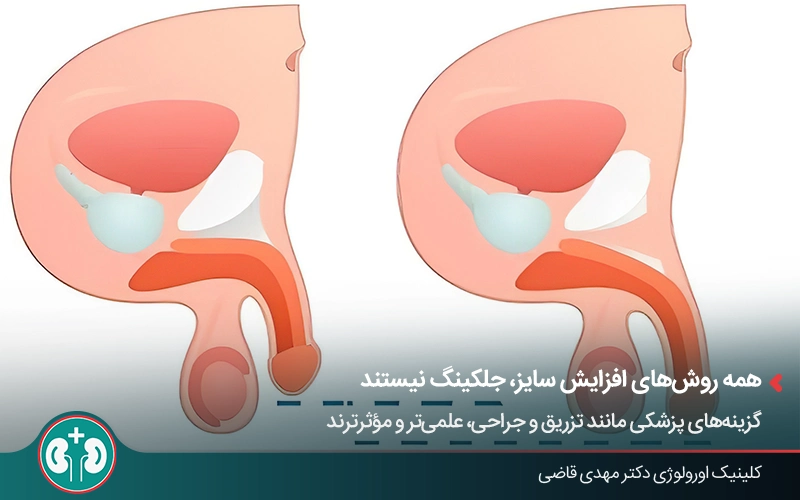
Comparison of Jelqing With Other Penile Enlargement Methods
If you are considering increasing penile size, it is important to understand the advantages and disadvantages of different methods. The table below reviews and compares jelqing exercises with other available methods:
Method | Scientific Evidence | Real Effect | Risk |
|---|---|---|---|
Jelqing (Jelqing) | None | No proven effect | Possibility of serious injury |
Traction devices (Traction Devices) | Limited | No proven effect | Possibility of serious injury |
Fat injection | Reliable | Temporary increase in penile girth | May need repeat fat injection in the future |
Surgery | Reliable | 1-3 cm apparent increase in length | Serious risks (infection, scarring, and dissatisfaction) |
Filler injection | Reliable | Temporary increase in penile girth | May need future filler maintenance |
Doctors’ Final Recommendations About Jelqing Exercises
Although there is widespread advertising online about enlarging the penis with this method, no reliable, high-quality research has confirmed that the exercise is effective. Instead, there are numerous reports of tissue injury, pain, bruising, numbness, and even erectile dysfunction after incorrect or repeated performance of this exercise.
Below, we review specialists’ recommendations about these exercises:
Specialists advise that jelqing exercises have no proven effect on increasing penile size and may damage penile tissue.
Before taking any step to increase penile size, the person’s real need should be assessed by a physician.
Many men who feel that their penis is small are actually within a completely normal range and do not need any method for size increase.
In most cases, the feeling of needing a larger penis comes from a misconception or body anxiety, not from a clinical problem.
Consultation with a psychologist or sex therapist can help significantly reduce anxiety related to penile size.
If you have ongoing and serious concern about penile size, the best step is to consult a urologist so you can make a correct and low-risk decision.
A specialist can suggest safer and more effective options, such as traction devices or alternative treatments.
A rushed decision without specialist evaluation can cause irreversible harm to a person’s health.
Summary
After reviewing all the evidence and reliable sources, we can conclude that jelqing exercises not only lack scientific support for increasing penile size, but can also cause serious harm, including bruising, numbness, penile curvature, and even erectile dysfunction. Many men who try this exercise do not actually have a real problem with penile size and are instead influenced by body anxiety or unrealistic advertising.
If you are still looking for an effective way to increase penile size, it is better to be examined by a urologist first. Specialist medical consultation can help prevent risky decisions and irreversible harm.
Frequently Asked Questions
Actions & related links
Doctors for this topic in Mashhad
See all doctors: Best Men's Genital Health Specialists in Mashhad




About the author

Urologic Surgeon
دکتر مهدی قاضی, Urologic Surgeon in Mashhad. Articles on this site are written and reviewed under the supervision of the Urology Building's physicians.
View profile & bookRelated articles
All articlesWhat Is Polycystic Kidney Disease? (Fetal and Adult PKD)
دکتر مهدی قاضی · June 26, 2026
What Is a Renal Cortical Cyst? Symptoms, Diagnosis, and Treatment
دکتر مهدی قاضی · June 26, 2026
Kidney Transplant: Cost, Blood Type Compatibility, and Surgical Method
دکتر مهدی قاضی · June 26, 2026
What Is Pyelonephritis? Kidney Infection Symptoms, Diagnosis, and Treatment
دکتر مهدی قاضی · June 26, 2026
Comments
0 comments
No comments yet. Be the first to share your thoughts.