
 Tap to zoom
What Is a Digital Rectal Prostate Exam (DRE)? Steps and Key Points
- نویسنده
- دکتر مهدی قاضی
- Published on
- June 26, 2026
- Reading time
- 5 min read
- Last updated
- Updated: June 27, 2026
How is a prostate exam through the rectum performed in men? This question causes concern for many men, because hearing the term digital rectal prostate examination (DRE) is often associated with fear of pain or embarrassment.
The reality is that this test is a short, simple, low-cost examination that helps the doctor diagnose prostate conditions. On its own, this examination is not the main tool for prostate cancer screening, but it can serve as a complementary method alongside PSA testing and imaging to help identify some problems earlier.
In this article, we explain:
Exactly how a digital rectal examination is performed
Whether it is painful or not
When it is recommended
And why you should not be afraid of this simple examination
Why is prostate examination important?
A prostate examination is part of men’s health assessment and can help detect some common prostate diseases earlier.
The prostate is a small gland located below the bladder and around the urethra. Any change in this gland can affect urine flow, sexual function and, in some cases, male fertility.
Many prostate problems, especially in their early stages, may have no symptoms. In that situation, a person may miss the opportunity for timely action and easier treatment. Prostate examination helps with early detection of these problems.
Main reasons for performing a prostate examination
Urologists usually perform a prostate examination based on age, clinical symptoms, and the results of other tests, so they can assess prostate health more accurately alongside methods such as PSA testing, which measures prostate-specific antigen in the blood, and imaging.
1. Evaluation for prostate cancer: Prostate cancer is one of the most common cancers in men. Early diagnosis using a combination of PSA, imaging, and in some cases physical examination can help improve treatment outcomes.
2. Diagnosis of benign prostatic hyperplasia (BPH): This problem is common at older ages and can cause frequent urination, a weak urine stream, and a feeling of incomplete bladder emptying.
3. Identification of prostate inflammation (prostatitis): Prostate inflammation is usually associated with symptoms such as pelvic or perineal pain, burning with urination, and pain during ejaculation.
Digital rectal prostate examination (DRE) and its role in diagnosis
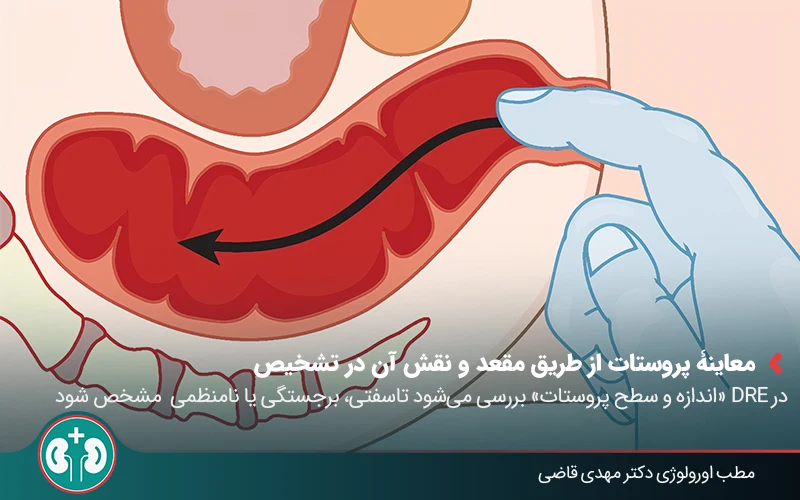
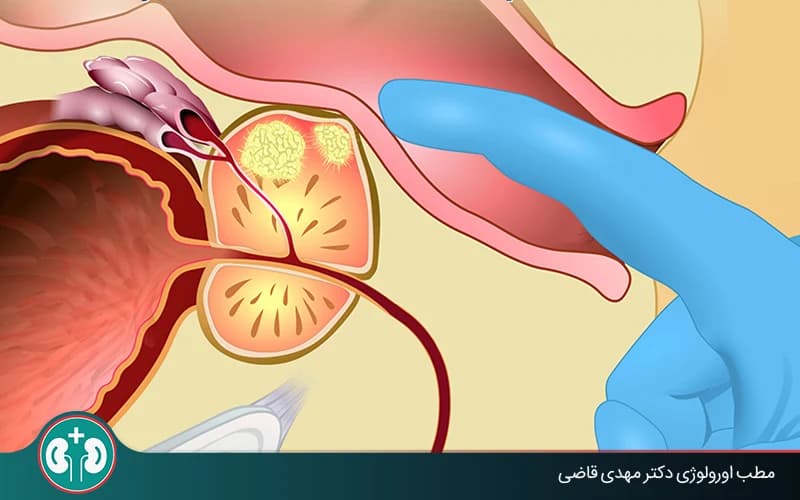
The digital rectal exam, often incorrectly called a “digital rectum test,” is a simple clinical method for physically evaluating the prostate. In this examination, the doctor inserts a gloved finger into the rectum and checks “the size and surface of the prostate” to detect any abnormal firmness, nodules, or surface irregularity.
DRE is a simple and quick method that can give the doctor valuable clinical information about prostate status during the first visit. However, this method alone is not enough for screening and diagnosing prostate cancer and should be used alongside tests such as PSA and other complementary evaluations.
How is a DRE performed?
A DRE is a short outpatient examination that is usually performed in the doctor’s office and does not require special preparation. By palpating the prostate through the rectum, the doctor evaluates the following:
Overall prostate size
Consistency, whether soft, firm, or abnormal
Presence of a nodule, mass, or surface irregularity of the gland
If suspicious findings are seen, the doctor may recommend additional tests.
How DRE differs from other tests for diagnosing prostate problems
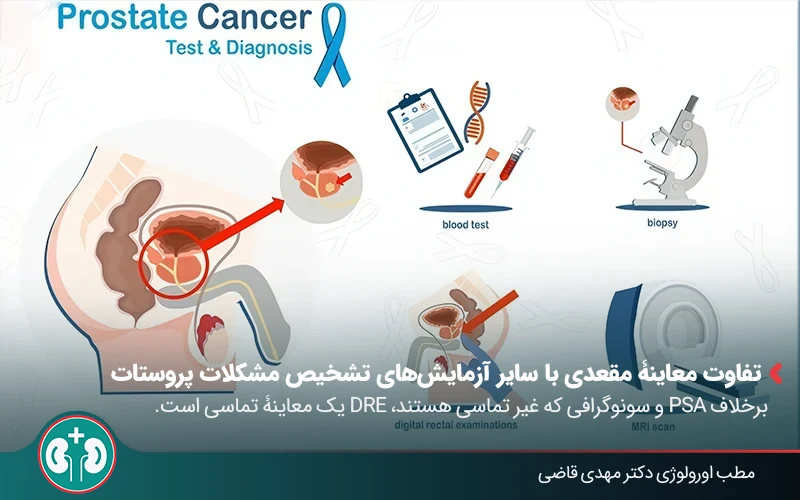
Unlike PSA and prostate ultrasound, which are non-contact tests, DRE is a contact examination. By directly palpating the prostate, the doctor can assess the following:
Suspicious palpable masses;
Abnormal firmness;
Irregularity of the prostate surface.
Next, we briefly review other methods.
1. PSA blood test
The PSA test is a type of blood test. It measures the level of prostate-specific antigen in the blood. PSA can rise for several reasons, including:
Benign prostatic hyperplasia (BPH)
Prostate inflammation or infection
Prostate cancer
The PSA test is the main screening tool, but it can have false-positive or false-negative results.
2. Prostate ultrasound
Prostate ultrasound, especially transrectal ultrasound, is used to assess the size, shape, and structure of the prostate. This method may also be performed through the rectum, but unlike DRE, it provides an image of the prostate and helps diagnose prostate enlargement and some structural changes.
What diseases can DRE help diagnose?
A digital rectal examination can help with the initial identification of some problems, including:
Prostate cancer, if a palpable mass or firmness is present
Benign prostatic hyperplasia (BPH)
Prostatitis, meaning inflammation or infection of the prostate
Hematospermia (blood in semen)
Some rectal problems, such as hemorrhoids or abnormal rectal masses
If suspicious findings are present, additional tests such as PSA, prostate MRI, and, if needed, biopsy are usually performed for a definitive diagnosis.
Who should have a prostate test?
Some prostate diseases may be asymptomatic in their early stages and may only be found with timely assessment. For this reason, many men ask when the best time is to start prostate evaluation.
The decision to perform prostate evaluations depends on several important factors, including:
Age
Family history
Presence of warning symptoms
Genetic risk factors

Age to start prostate assessment and screening
The age to start prostate assessment and screening depends on each person’s risk level, and decisions about timing and type of testing should be made by considering family history, genetic factors, and the doctor’s opinion.
1. Men at average risk
Men at average risk should generally start discussing prostate screening with their doctor from around age 50.
2. High-risk men
People with a family history of prostate cancer in first-degree relatives usually should start evaluation from around age 45.
3. People at very high risk
Those with certain genetic mutations or a strong family history should preferably be evaluated from around age 40 to 45 .
Symptoms you should not ignore
Some symptoms can suggest prostate problems or other urinary tract diseases. If these signs are present, medical evaluation is recommended at any age:
Frequent urination, especially at night
Weak or intermittent urine stream
Pain or burning during urination or ejaculation
Blood in the urine or semen
A feeling of incomplete bladder emptying
The role of family history in the need for prostate evaluation
Family history is one of the strongest risk factors for prostate cancer. Men whose father, brother, or other first-degree relatives developed prostate cancer at younger ages are at higher risk.
Even without symptoms, these people should take periodic evaluations seriously and discuss screening with their doctor at younger ages.
Summary table of recommendations | |
|---|---|
Group | Suggested age to start evaluation |
Men at average risk | Around age 50 |
Men with a first-degree family history | Around age 45 |
People with high genetic risk | Age 40 to 45 |
People with urinary symptoms or blood in urine/semen | At any age (requires evaluation) |
Preparation for digital rectal prostate examination (DRE)
This examination is one of the simplest ways to check prostate health and usually does not require complex preparation. Following a few small points can make the experience more comfortable.
Should you fast or take medication?
Usually there is no need to fast or change medication use.
You can eat and drink as usual.
If other tests such as PSA or biopsy are planned at the same time, the doctor may give specific instructions.
Choosing clothing and having a companion
Wear comfortable, loose clothing so the lower body is easy to access.
No special equipment is needed.
If this is your first time, having a companion present can reduce stress.
Body position during the examination
The most common position is lying on the left side with the knees bent.
Sometimes a standing, bent-over position over the examination table is also used.
Steps, duration, and what the patient feels during a DRE prostate examination
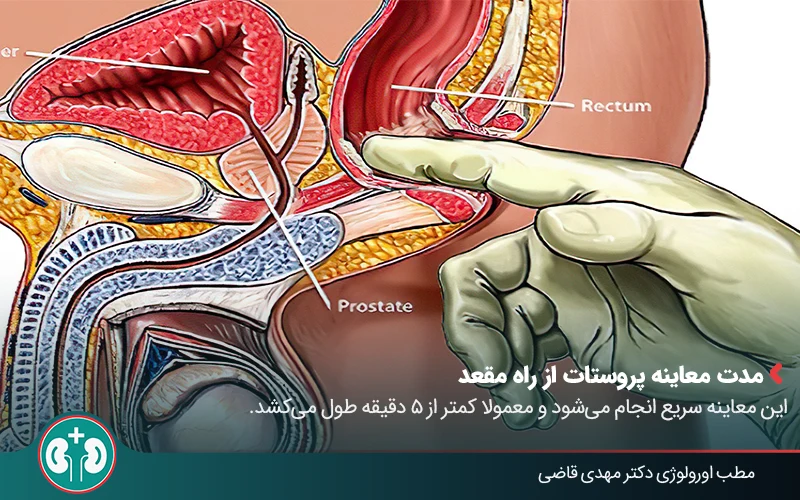
The examination usually takes less than five minutes and has simple steps:
The doctor reviews your condition and asks questions about symptoms.
You remove clothing from the lower body and are covered with a gown or sheet.
The doctor puts on gloves and applies lubricating gel to a finger.
The finger is gently inserted into the rectum so the prostate can be assessed for size, surface, and nodules.
The rectal wall is also palpated to look for abnormal signs.
Is prostate examination painful?
Usually only mild pressure or slight discomfort is felt.
You may feel the need to urinate, which is normal and resolves quickly.
Severe pain is not typical during a routine examination; if it occurs, it is often due to underlying problems such as hemorrhoids or an anal fissure.
Duration of the examination
The entire examination takes less than five minutes.
Most of the time is spent on preparation and the doctor’s explanation; palpating the prostate takes only a few seconds.
Care after DRE and doctor’s recommendations
Most patients have no particular problem after a digital rectal prostate examination (DRE) and can return to daily activities immediately. However, knowing a few simple points can provide more reassurance:
A feeling of pressure or mild discomfort after DRE is usually normal and resolves within a short time.
In people who also have hemorrhoids or an anal fissure, a small spot of blood may be seen on tissue, which is often not concerning.
When should you contact a doctor?
Although these situations are rare, it is better to contact a doctor if the following symptoms occur:
Heavy or prolonged bleeding from the rectum
Severe pain that does not improve after several hours
Fever or possible signs of infection
Overall, complications of DRE prostate examination are very limited, and most people experience no unusual symptoms after this evaluation.
Summary
You now know how digital rectal prostate examination (DRE) is performed in men; DRE is one of the simplest and fastest ways to assess the overall status of the prostate.
This examination can help identify early changes such as benign prostatic hyperplasia, inflammation, or suspicious findings.
Prostate screening is especially important for men over age 50 and people with a family history of prostate cancer. Pain during this examination is usually very mild, and most patients report only slight pressure.
If you are at higher risk or have symptoms such as frequent urination, burning with urination, or blood in the urine, seeing a urologist for a more accurate assessment is recommended.
Frequently Asked Questions
Actions & related links
Doctors for this topic in Mashhad
See all doctors: Best Prostate Specialists in Mashhad




About the author

Urologic Surgeon
دکتر مهدی قاضی, Urologic Surgeon in Mashhad. Articles on this site are written and reviewed under the supervision of the Urology Building's physicians.
View profile & bookRelated articles
All articlesWhat Is Polycystic Kidney Disease? (Fetal and Adult PKD)
دکتر مهدی قاضی · June 26, 2026
What Is a Renal Cortical Cyst? Symptoms, Diagnosis, and Treatment
دکتر مهدی قاضی · June 26, 2026
Kidney Transplant: Cost, Blood Type Compatibility, and Surgical Method
دکتر مهدی قاضی · June 26, 2026
What Is Pyelonephritis? Kidney Infection Symptoms, Diagnosis, and Treatment
دکتر مهدی قاضی · June 26, 2026
Comments
0 comments
No comments yet. Be the first to share your thoughts.