 Tap to zoom
Vasectomy: Types of Surgical Methods
Vasectomy is a permanent male contraception procedure. Learn how it is done, its success rate, recovery care, reversibility, and possible complications.
- نویسنده
- دکتر مهدی قاضی
- Published on
- June 26, 2026
- Reading time
- 5 min read
- Last updated
- Updated: June 27, 2026
Vasectomy is a surgical procedure for men that is performed to prevent pregnancy. Usually vasectomy is performed in a urologist's office (a specialist in the urinary tract and male reproductive system). After vasectomy, the chance of pregnancy is 0.05%, meaning 1 in every 2,000!
What Is Vasectomy?
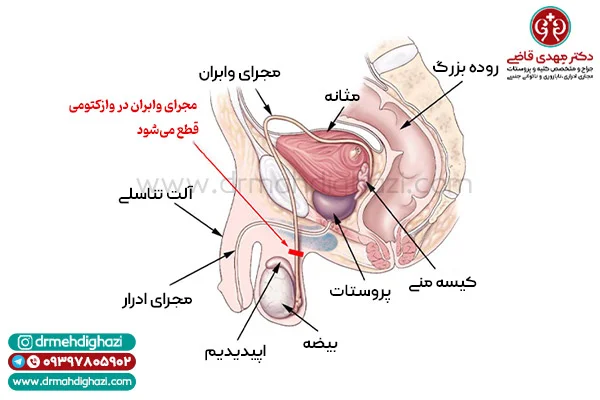
Vasectomy is a permanent method of contraception for men. In this procedure, the vas deferens are cut, divided, and tied, so sperm (the male reproductive cells) cannot enter the semen. It is important to note that after vasectomy, semen is still ejaculated during sexual intercourse, but it does not contain sperm and cannot cause pregnancy.
This surgery is suitable for people who have enough children and are completely sure they will not regret the decision in the future. Otherwise, couples should consider temporary contraceptive methods instead of permanent methods!
If you and your spouse are looking for a permanent method of contraception, vasectomy can be a suitable choice. Below, we explain its success rate in preventing pregnancy.
Vasectomy Surgery Video
https://drmahdighazi.com/wp-content/uploads/2022/05/vasectomy.mp4
Success Rate of Vasectomy in Preventing Pregnancy
In fewer than 1% of people who undergo vasectomy, the procedure may not be successful. This is because, in rare cases, a person may have accessory ducts in addition to the main vas deferens, although these cases are very rare and uncommon. Or the ends of the tubes may reconnect and open again after surgery. (The chance is 1 in 2,000; that is, among every 10,000 couples, only 15 to 20 couples will experience pregnancy.)
The success rate of vasectomy is more than 99.9%.
If live sperm are present in the semen 7 months after vasectomy, it means the vasectomy has not been successful and the procedure may need to be repeated; therefore, it is better to have a semen analysis.

How Is Vasectomy Performed in Men?
As noted, vasectomy is usually performed in the office of a urologist (a specialist in the urinary tract and male reproductive system). First, the surgeon makes sure the patient understands how vasectomy is performed, as well as its benefits and risks. Under Iranian law, written consent from the spouse is not required, but it is better for the man to inform his spouse and obtain her verbal consent. Physicians generally do not perform this surgery on single people or people under 30.
After examination and sterile preparation, a fine local anesthetic needle is injected into the skin at the front of the scrotum. The surgeon starts the procedure, and there should be no pain during surgery, although the person may feel some pressure on the testicles.
What Conditions Are Required for Vasectomy?
First, the person, together with his spouse, should decide whether vasectomy is a suitable choice for them. The decision to have a vasectomy is serious. They should take plenty of time to think about it. Vasectomy can be a suitable method for a person if:
They are sure they do not want more children.
The person's spouse cannot become pregnant for physical reasons.
The person or his spouse has a genetic disease and they do not want to have more children.
On the other hand, vasectomy will not be the right choice if:
The person or his spouse is still not sure whether they want children.
The person is looking for temporary contraceptive methods.
Types of Vasectomy Methods
Vasectomy is performed using two methods, and in both methods it is done with local anesthesia and without the need for general anesthesia:
1. Older method (with a surgical blade): In this method, 1 to 2 cm incisions were made in the scrotal skin to access the vas deferens. In some centers, some physicians use electrocautery of the tube tissue (burning the tube tissue) instead of tying the ends of the tubes; with this method, the risk of complications is higher than with tying the ends of the tubes.
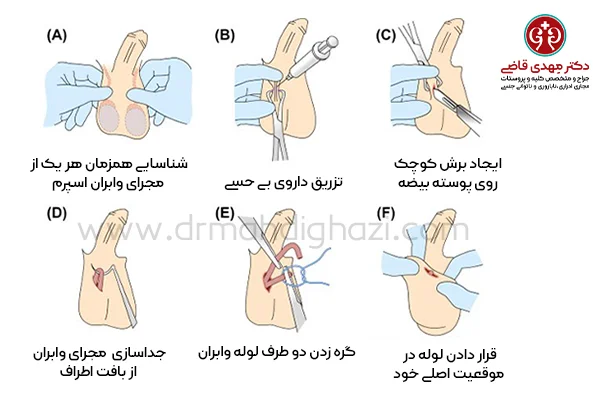
2- Newer method (no-scalpel): In modern methods, a surgical blade is rarely used. Through a small puncture in the scrotal skin, the vas deferens on each side is brought out; the surgeon ties both sides of that tube and cuts the middle, then returns the tube under the scrotal skin.
In this method, the skin is usually not sutured so that fluid and minor bleeding can drain through this opening. The small opening in the scrotal skin usually closes on its own after 3 to 4 days. This method generally takes 15 to 30 minutes. The image below shows the stages of surgery.
What Is Post-Vasectomy Care?
The patient will be ready to go home 10 to 15 minutes after vasectomy, and it is better for an adult companion to accompany him. After vasectomy, the person should not go home by public transportation such as a bus and should avoid driving for 24 hours after the procedure. After vasectomy, it is better for the patient to use tight underwear because it helps reduce bruising or accidental bleeding. In summary, the important points to follow after vasectomy are:
Use tight briefs or scrotal support day and night for at least 72 hours
Shower after 48 hours
Daily activities may be started after 1 to 2 days, but heavy lifting should be avoided during the first 5 days.
If the person's job is physically demanding or requires a lot of driving, he should wait at least 5 days before driving or doing heavy work.
Sports activity is best started two weeks after vasectomy.
Sexual intercourse should be delayed for one week.
After vasectomy, there is a small wound on the scrotum, and its dressing should be changed daily for several days.
How Does Vasectomy Affect Sexual Life?
After the procedure, sexual ability is not affected, hormones do not change, and erection and the quality of sexual intercourse will not change. The only difference compared with before is that, despite intercourse, the person will not be able to cause pregnancy. The volume of semen after vasectomy is generally the same as before, although it may decrease slightly compared with before the procedure.
The testicles continue to produce sperm without change, but the sperm do not exit and are absorbed by the body in the ducts. Complete sterility and absence of sperm in the semen occur at least 3 months after vasectomy.
Is Male Tube Tying Reversible?
Vasectomy can be reversed, but it is better to think of this method as permanent. Vasectomy reversal is often unsuccessful, although other options exist. Because people's lives change over time, there may be a need to reverse this sterilization. If a person wants to reopen the testicular tubes, he can see a urologist for reversal.
For more information on this topic, we suggest reading the article "Is Vasectomy Reversible?".
Reopening the testicular tubes, unlike closing them, is not easy. It may take 4 to 6 hours and is a very difficult procedure.
No physician can guarantee that pregnancy will occur after reopening the tubes, because the inner diameter of the tubes is small. Therefore, when the two tubes are reconnected, the connection site may become blocked after some time and the person may not be fertile again. For this reason, your decision to have a vasectomy should be serious and carefully considered. It should be noted that men who have vasectomy before the age of 40 have the highest likelihood of future regret.
Side Effects and Complications of Vasectomy in Men
If vasectomy is performed by an experienced specialist, complications are very rare. General complications such as bleeding or infection are possible with any surgical procedure. Common complications that may occur after vasectomy include:
About two hours later, some pain may occur when the local anesthetic wears off. To reduce pain, acetaminophen or ibuprofen is usually recommended. In the following days, mild pain may last for about 3 to 5 days, and aspirin should never be taken in the first days to reduce pain.
Some men feel fullness in the testicles during the first 4 to 6 months, which is a natural process. In rare cases, a person may develop chronic testicular pain related to inflammation at the surgical site, which can be treated if inflammation is present.
Bruising or infection may occur after vasectomy. If there is any skin redness, warmth, swelling, discharge from the scrotal wound, or severe tenderness to touch, you should inform the doctor.
Bleeding under the skin that leads to painful swelling and bruising.
A small amount of blood may be seen in the semen during the first ejaculation after vasectomy, which is normal. If this bleeding continues, the person should see a doctor.
Summary
Male vasectomy is a permanent method of contraception for men; however, after undergoing vasectomy in Mashhad, it is better to continue using contraceptive methods such as condoms until the doctor confirms, based on semen analysis results, that there is no sperm in the man's semen. (At least three months.) Usually, 15 to 20 ejaculations are needed before there is no sperm in the semen.
Finally, there are 2 points about this procedure. The first important point is certainty in decision-making. Think carefully before having a vasectomy and consult your spouse because in many cases there is no way back.
As a final point, vasectomy is only a method of contraception for men and eliminates the possibility of fathering a child. This procedure provides no immunity or protection against sexually transmitted infections such as gonorrhea, syphilis, AIDS, genital warts, and others.
Protected sex is necessary to prevent these diseases.
Frequently Asked Questions
Actions & related links
Doctors for this topic in Mashhad
See all doctors: Best Urologists in Mashhad




About the author

Urologic Surgeon
دکتر مهدی قاضی, Urologic Surgeon in Mashhad. Articles on this site are written and reviewed under the supervision of the Urology Building's physicians.
View profile & bookRelated articles
All articlesWhat Is Polycystic Kidney Disease? (Fetal and Adult PKD)
دکتر مهدی قاضی · June 26, 2026
What Is a Renal Cortical Cyst? Symptoms, Diagnosis, and Treatment
دکتر مهدی قاضی · June 26, 2026
Kidney Transplant: Cost, Blood Type Compatibility, and Surgical Method
دکتر مهدی قاضی · June 26, 2026
What Is Pyelonephritis? Kidney Infection Symptoms, Diagnosis, and Treatment
دکتر مهدی قاضی · June 26, 2026
Comments
30 comments