 Tap to zoom
What Is Uroflowmetry?
Uroflowmetry is an outpatient test that measures urine flow rate and helps a urologist assess urinary obstruction, prostate enlargement, or bladder weakness.
- نویسنده
- دکتر مهدی قاضی
- Published on
- June 26, 2026
- Reading time
- 3 min read
- Last updated
- Updated: June 26, 2026
Uroflowmetry is a test that measures the rate of urine flow. This test evaluates how urine flows, including the speed of urination, the amount of urine passed, and the duration of urination. Uroflowmetry is a diagnostic test for assessing urinary tract function. It is generally performed as an outpatient test in a urologist’s office and helps the urologist diagnose problems with urination or urinary tract obstruction.
In people who complain of reduced urine stream pressure, this test can evaluate obstruction at the bladder outlet, such as prostate enlargement, by measuring the average and maximum urine flow rates. Also, when uroflowmetry is combined with a cystometrogram (CMG), it can help identify problems such as bladder weakness.

Preparation for uroflowmetry
To have this test, you should come to the doctor’s office with a relatively full bladder.
The patient is asked to urinate while sitting or standing on a funnel-shaped chair similar to a Western-style toilet. The device records the urine flow electronically and shows the urologist a graph of the flow.
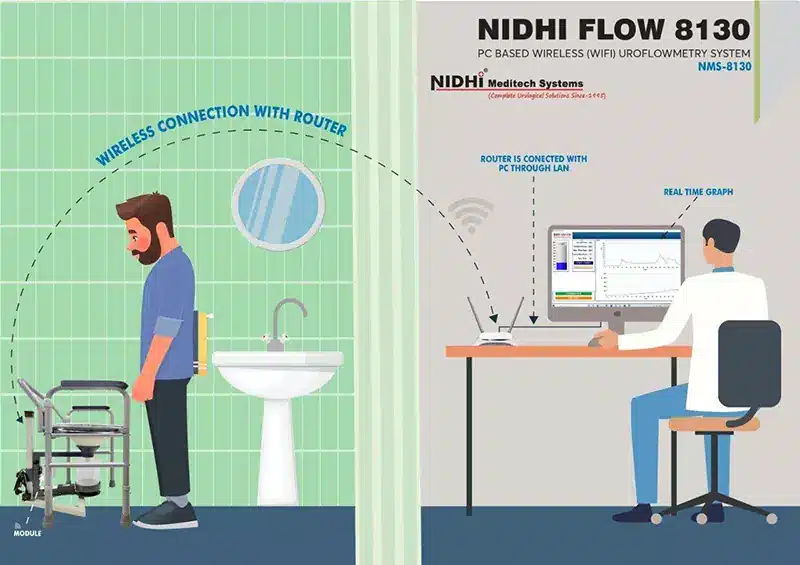
Urine flow rate is calculated as milliliters of urine passed per second. In this test, both the “average flow rate” and the “highest flow rate” are measured.
The highest urine flow rate, also known as Qmax, is used to assess the severity of obstruction.
Average results are determined based on the patient’s age and sex. Typically, urine flow rate ranges from 10 milliliters to 21 milliliters per second. In women, this value is closer to about 15 to 18 milliliters per second.

Uroflowmetry results
Low or reduced flow rate: this may indicate obstruction at the bladder neck or urethra, prostate enlargement, or bladder weakness.
High or increased flow rate: this may indicate weakness of the muscles around the urethra or urinary incontinence problems.
In addition to uroflowmetry for diagnosis and treatment planning, the urologist may also need a complete medical history, physical examination, and other tests. The urologist, a urinary tract specialist, will design a treatment plan for you based on the results of these tests and your medical history.
Questions to ask your doctor:
What do the results of this test show you?
What other tests do I need so that my problem can be fully evaluated?
What next steps should I take after this test?
Actions & related links
Doctors for this topic in Mashhad
See all doctors: Best Prostate Specialists in Mashhad




About the author

Urologic Surgeon
دکتر مهدی قاضی, Urologic Surgeon in Mashhad. Articles on this site are written and reviewed under the supervision of the Urology Building's physicians.
View profile & bookRelated articles
All articlesWhat Is Polycystic Kidney Disease? (Fetal and Adult PKD)
دکتر مهدی قاضی · June 26, 2026
What Is a Renal Cortical Cyst? Symptoms, Diagnosis, and Treatment
دکتر مهدی قاضی · June 26, 2026
Kidney Transplant: Cost, Blood Type Compatibility, and Surgical Method
دکتر مهدی قاضی · June 26, 2026
What Is Pyelonephritis? Kidney Infection Symptoms, Diagnosis, and Treatment
دکتر مهدی قاضی · June 26, 2026
Comments
0 comments
No comments yet. Be the first to share your thoughts.