
 Tap to zoom
Penile Cancer: Causes, Symptoms, and Modern Treatments
Penile cancer is rare and may appear with skin changes, persistent sores, or lumps. Learn about its causes, diagnosis, staging, and treatment options.
- نویسنده
- دکتر مهدی قاضی
- Published on
- June 26, 2026
- Reading time
- 5 min read
- Last updated
- Updated: September 4, 2026
The primary functions of the penis are to remove urine from the body and to transfer sperm during sexual intercourse. Inside the penis there are three tube-like structures: the urethra and two corpora cavernosa.
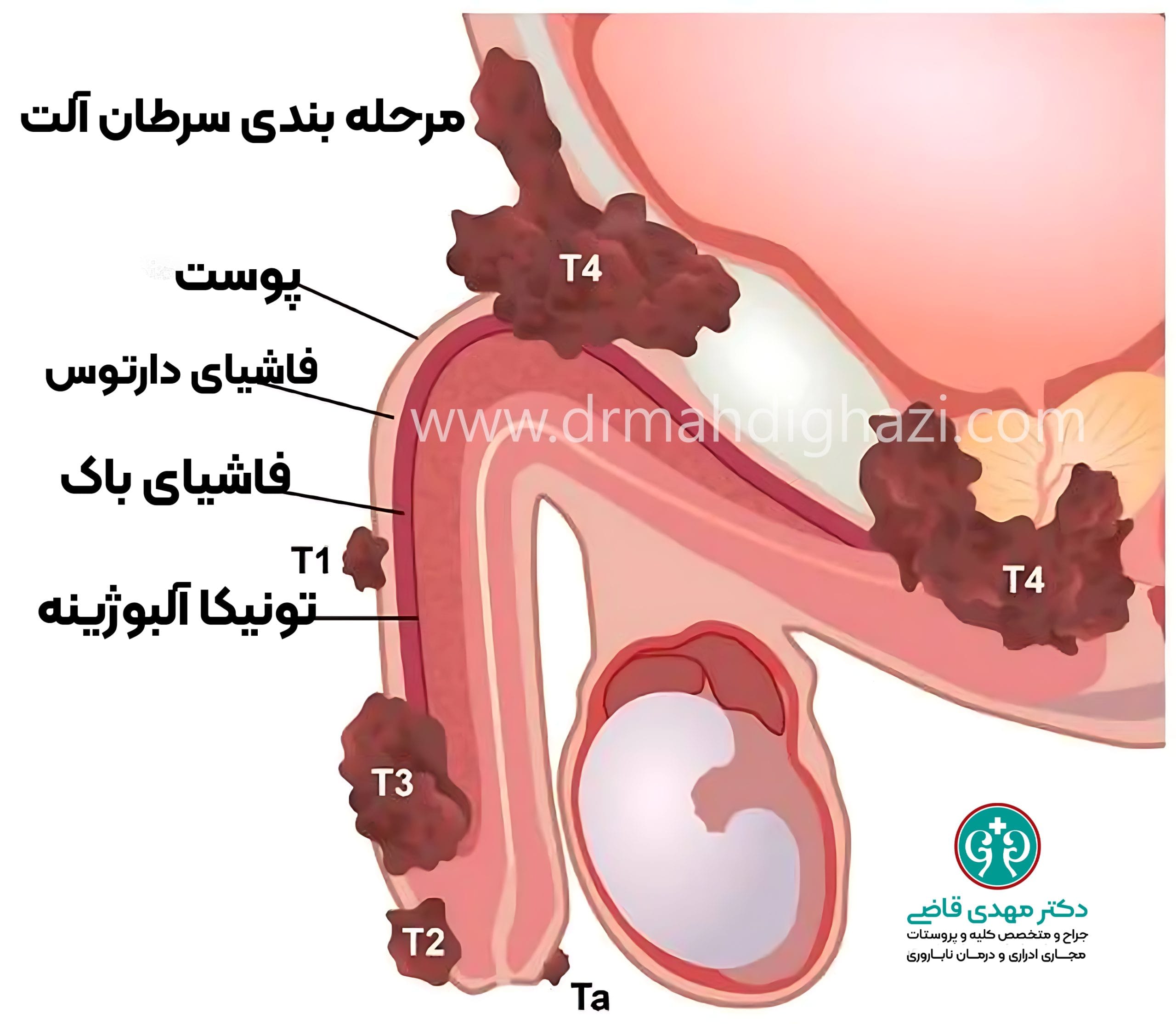
The urethra is a hollow tube that carries urine and semen out of the body. The two corpora cavernosa are soft, spongy structures that fill with blood during sexual stimulation and produce an erection.
These three tubes are surrounded by a very strong fibrous sheath called the tunica albuginea, which helps maintain the structure and firmness of the penis.
These structures allow the penis to perform its functions effectively.
Symptoms of Penile Cancer in Men
The earlier penile cancer is diagnosed, the greater the chance of successful treatment and recovery. Men who are uncircumcised are at higher risk of developing penile cancer.
Even so, every man should pay attention to symptoms and lesions on the penis.
Warning signs:
An area of skin that has become thicker or has suspicious discoloration.
A lump on the penis.
Sores that may bleed.
A red, velvety rash.
Small, scaly, persistent bumps.
Flat blue-brown growths.
Most of these symptoms can be caused by bacterial or fungal infections, or even allergic reactions, and usually respond to antibacterial or antifungal ointments and creams.
However, lumps that do not respond to treatment or sores that do not heal should be considered possible cancer until cancer has been ruled out.
Unfortunately, penile cancer is often overlooked and progresses over time.
Patients may avoid consulting a doctor because of embarrassment or fear of treatment and surgery on the penis.
Causes of Penile Cancer
Penile tumors may be related to secretions around the glans that become trapped under the foreskin. If these secretions are not washed away properly, they may have carcinogenic effects.
Older men and smokers are at greater risk of penile cancer. AIDS can also lead to penile cancer.
Another possible cause is human papillomavirus (HPV). HPV is a sexually transmitted virus that can cause genital warts.
Men who maintain good genital hygiene and have been circumcised are significantly less likely to develop penile cancer. Good hygiene and circumcision can prevent the buildup of secretions and the risks associated with them.
Diagnostic Methods
Penile cancer is diagnosed with a biopsy (tissue sampling). In this method, a small sample of penile tissue is removed and examined under a microscope. If the cells look like cancer cells, staging is performed. The common staging system is the TNM system:
T stands for the main (primary) tumor and shows how far the tumor has grown within the penis or nearby organs.
N stands for spread to nearby lymph nodes.
M stands for metastasis (spread) to other organs.
The cells are also evaluated by grading.
Grading is a measure of how abnormal the cells are, and they are often assigned a number from 1 to 4.
The higher the number, the more abnormal the cells appear; higher-grade cancers tend to grow and spread more quickly.
If there is concern that the cancer has spread to lymph nodes, further evaluations are performed.
A lymph node biopsy helps determine the stage and grade of the cancer.
If cancer is thought to have spread to other parts of the body, imaging tests such as CT scan or MRI are used for further evaluation.
Treatment Options
If penile cancer is diagnosed in its early stages, treatment is more likely to be successful.
If the tumor is on the skin surface, it may be treated with a topical cream that has few side effects.
Radiation therapy is also used for small lesions. If the lesion is larger but still smaller than a pea, a small local surgery or Mohs surgery may be performed.
In this type of surgery, layers of abnormal tissue are removed until normal tissue is reached. With either method, the penis will look natural and function as before.
In small lesions, the chance of cancer spreading to lymph nodes is low, and lymph node removal is not necessary.
For larger cancerous lesions, however, more penile tissue must be removed, along with lymph nodes in the groin.
A combination of surgery, radiation therapy, and chemotherapy may also be necessary.
In more advanced cancer, the entire penis may need to be removed, and the surgeon may also remove the groin lymph nodes.
In this situation, an opening is created under the testicles to drain urine (perineal urethrostomy). The person will no longer be able to urinate while standing.
After Treatment
After treatment, the patient must have regular follow-up. Almost every cancer treatment has side effects, some short-term and some long-term.
When lesions are diagnosed in the early stages, cancer treatment is almost curative. As the tumor becomes more advanced, treatment becomes more difficult.
If cancer is diagnosed at an advanced stage, treatment may have unavoidable side effects.
Summary
Penile cancer is a rare disease that can begin with early signs such as skin changes and non-healing sores.
Early diagnosis and appropriate treatment increase the chance of recovery. Personal hygiene, circumcision, and prevention of HPV infections are important prevention methods.
Because HPV is linked to this type of cancer, vaccination and regular screening are highly important.
Frequently Asked Questions
Actions & related links
Doctors for this topic in Mashhad
See all doctors: Best Men's Genital Health Specialists in Mashhad




About the author

Urologic Surgeon
دکتر مهدی قاضی, Urologic Surgeon in Mashhad. Articles on this site are written and reviewed under the supervision of the Urology Building's physicians.
View profile & bookRelated articles
All articlesWhat Is Polycystic Kidney Disease? (Fetal and Adult PKD)
دکتر مهدی قاضی · June 26, 2026
What Is a Renal Cortical Cyst? Symptoms, Diagnosis, and Treatment
دکتر مهدی قاضی · June 26, 2026
Kidney Transplant: Cost, Blood Type Compatibility, and Surgical Method
دکتر مهدی قاضی · June 26, 2026
What Is Pyelonephritis? Kidney Infection Symptoms, Diagnosis, and Treatment
دکتر مهدی قاضی · June 26, 2026
Comments
0 comments
No comments yet. Be the first to share your thoughts.