 Tap to zoom
What Are the Symptoms of Passing a Kidney Stone, and When Should You See a Doctor?
Passing a kidney stone can cause sudden flank pain, blood in the urine, urinary urgency, burning, nausea, fever, or blockage. Learn the stages and red flags that need urgent urology care.
- نویسنده
- دکتر مهدی قاضی
- Published on
- June 26, 2026
- Reading time
- 5 min read
- Last updated
- Updated: September 4, 2026
Symptoms of passing a kidney stone begin after the stone moves and enters the ureter. They include pain and discomfort in the kidney area and urinary tract. During this period, if symptoms such as fever and chills, inability to urinate, or heavy blood in the urine occur, you should see a urologist.
Below, we explain the symptoms of passing a kidney stone and the warning signs in more detail. We will also introduce the ways to confirm that a stone has passed. Read to the end to understand the symptoms at each stage of stone passage.
The Most Common Symptoms of Passing a Kidney Stone
When a stone leaves the kidney and enters the ureter, a set of symptoms indicates that the passage process has begun. Below, we review the most important symptoms of passing a kidney stone briefly and clearly.


1. Sudden, Severe Flank or Back Pain (Colicky Pain)

Colicky pain is the most common symptom of passing a kidney stone and usually starts suddenly in the flank or back. This pain comes in waves and attacks, meaning there are periods when the pain peaks and periods when it eases.
As the stone moves, the pain may radiate to the abdomen, groin, or genital area. The important point is that pain severity is not related to changing position or bending; it occurs independently of body position.
2. Blood in the Urine, or Hematuria, and Changes in Urine Color
A moving stone can scratch the wall of the ureter and cause blood in the urine. This bleeding may be visible, or it may be detected only on a urine test.
Urine may become pink, red, or brown, and it may sometimes be cloudy or foul-smelling, which can be a sign of a secondary infection. If you notice blood, seeing a urologist is necessary.
3. Frequent Urination, Urgency, and Burning During Urination
When the stone reaches the end of the ureter near the bladder, urinary symptoms appear. A person may feel an urgent need to urinate even when the bladder is not full. Burning with urination can be caused by the stone passing, or it may be a sign of a urinary tract infection starting because of obstruction. These symptoms usually occur when the stone is about to enter the bladder or leave it.
How Symptoms of Passing a Kidney Stone Differ in Women, Men, and Children
Symptoms of passing a kidney stone can vary slightly depending on a person's sex and age. Below, we discuss the differences in kidney stone passage symptoms across different groups:
Women may confuse pain from passing a kidney stone with gynecologic problems such as an ovarian cyst or menstrual cramps.
Men often report that pain from passing a kidney stone radiates to the testicles or penis.
In children, passing a kidney stone is more often marked by restlessness, nausea and vomiting, and sometimes fever, and diagnosis is more difficult in this age group.
Comparison Table: Differences in Symptoms of Passing a Kidney Stone in Women, Men, and Children | |||
|---|---|---|---|
Age Group / Population | Pain Location and Specific Symptoms | Important Diagnostic Point | |
Men | Flank and back pain that can radiate to the testicle and groin, with severe nausea or vomiting | Pain moves to the testicle or the tip of the penis | |
Women | Flank and back pain, sometimes similar to labor pain or severe menstrual cramps | A specialist should evaluate and rule out miscarriage-related concerns or pelvic causes of pain | |
Children | Abdominal pain, often as severe and poorly localized belly pain, with restlessness, crying, nausea, or vomiting | Pain may be described as severe belly pain, and its location may be unclear | |
Symptoms of Passing a Kidney Stone During Pregnancy

During pregnancy, diagnosing kidney stone passage becomes more complicated because some symptoms overlap with normal pregnancy discomforts. For example, mild pain or frequent urination may easily be attributed to uterine growth. During pregnancy, any severe, sudden pain that does not improve and is accompanied by fever and chills requires urgent evaluation by a specialist.
Kidney stones and passing a kidney stone during pregnancy are important because they can cause serious problems for the mother and fetus. Mothers who plan to become pregnant should make sure they seek treatment for kidney stones.
Stages and Changes During Kidney Stone Passage
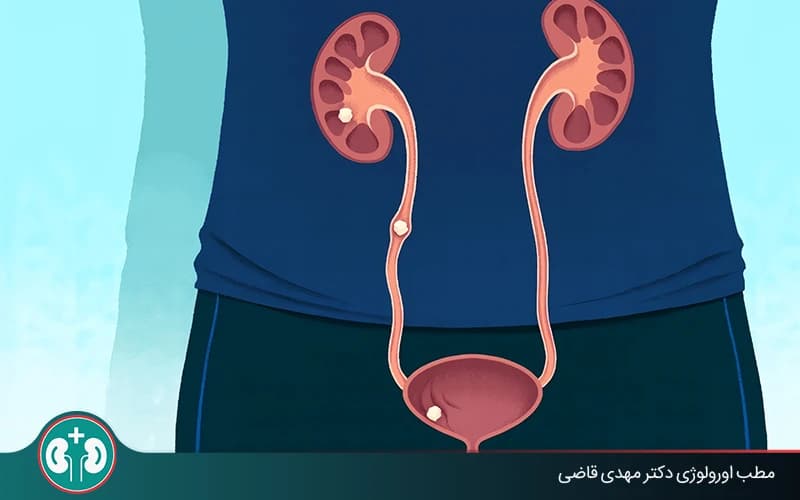
Symptoms of passing a kidney stone change as the stone moves along its path. Understanding the four stages of passage helps patients know roughly which stage they may be in.
1. Movement of the Stone From the Kidney Toward the Ureter, or Entry Into the Ureter
At this stage, the stone leaves the kidney and enters the ureter, the narrow tube that carries urine. The main pain at this stage is severe colicky pain in the flank and back, which usually radiates to the abdomen.
The duration of this stage varies depending on the size of the stone and how narrow the ureter is, and it can last from a few hours to several days. If the stone is large, there is a risk of obstruction and hydronephrosis, or swelling of the kidney.
2. Passage Through the Ureter and Approach to the Bladder
When a kidney stone reaches the lower end of the ureter near the bladder, the character of the pain changes. As the stone gets closer to the bladder, flank pain becomes relatively less intense and is replaced by urinary frequency and urgency. Sometimes the patient also has pain at the tip of the penis in men or in the pelvic area in women.
3. Entry of the Kidney Stone Into the Bladder
After the stone has completely passed through the ureter and entered the bladder, the pain suddenly becomes much less intense because the bladder has more space and no obstruction is created. The stone may remain in the bladder for a few hours or a few days until it passes with urine. The patient usually feels only mild discomfort or urinary frequency.
4. The Stage When the Kidney Stone Leaves the Body (Complete Passage)
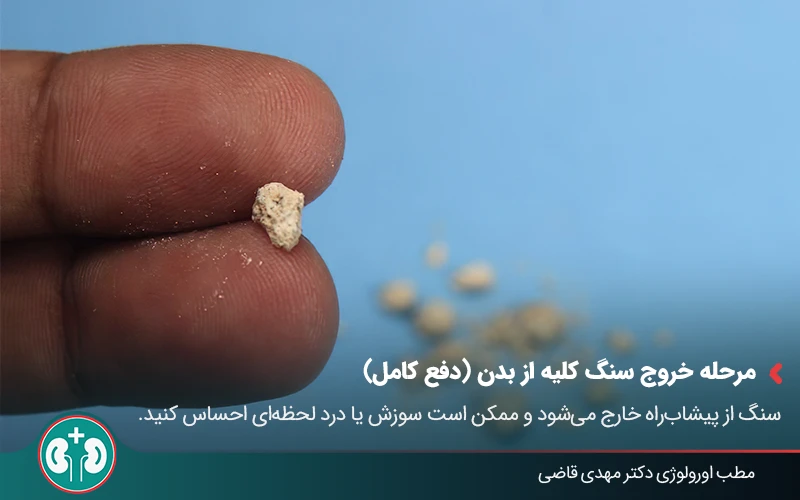
At this stage, the stone exits through the urethra. As it passes, brief burning or momentary pain may occur. After the stone comes out, the pain usually stops completely and the patient feels relief. In men, the stone is more likely to get stuck in the outlet channel; in women, this is rare because the urethra is shorter.
How Can You Tell Whether a Kidney Stone Has Passed or Has Fallen Into the Bladder?
If flank pain has decreased but urinary frequency or burning continues, the stone has probably entered the bladder. If the stone is seen during urination, or sand-like particles are seen, it can be said that the stone has come out.
A definite diagnosis is possible only with ultrasound or a urine test, because less pain does not always mean the stone has passed; it may be due to the stone becoming stuck and no longer moving. For that reason, imaging is necessary.
The Difference Between Passing Kidney Sand and Larger Stones
Kidney sand, meaning stones under 2 mm, usually passes without pain or with mild symptoms, and the patient may notice only tiny grains in the urine. Movement of larger stones, over 6 mm, is more painful and these stones take longer to pass. In many cases, passing larger stones requires medication or a medical procedure. The table below compares passage time and symptom differences for kidney stones.
Comparison Table: Passage Time and Symptom Differences for Kidney Stones | |||
|---|---|---|---|
Particle Type | Approximate Size | Usual Passage Time | Passage Symptoms |
Kidney Sand | Less than 2 mm | A few hours to 2 days | Passes very quickly, with milder pain or a brief burning sensation during exit, and sometimes without pain |
Small Stone | 2 to 4 mm | 2 to 7 days | Accompanied by severe kidney pain, but it passes relatively quickly |
Medium Stone | 4 to 7 mm | 1 to 3 weeks | Stones that are 6 mm or smaller usually pass easily. The chance of larger stones getting stuck is high, and they may need medical intervention. The pain of passing them is severe and lasts longer. |
Large Stone | More than 8 mm | Unlikely to pass naturally | Usually causes complete obstruction and the most severe pain, and it requires lithotripsy or surgery |
When Do You Need Urgent Medical Care?

In many cases, kidney stones pass naturally with pain and discomfort. Sometimes, however, this process lasts longer than expected or signs appear that indicate an emergency.
When these signs are present, you should not wait for the stone to pass naturally, because ignoring these conditions and symptoms can cause serious kidney damage or urinary tract infection. Below, we review the most important signs that mean you should see a urologist urgently for kidney stone treatment.
1. The Stone Passage Process Takes Too Long
A stone that has not passed after more than 10 days to two weeks is unlikely to pass on its own and needs lithotripsy and intervention.
2. Fever and Chills With Kidney Pain
Fever and chills with severe kidney pain indicate a kidney infection or urinary tract infection caused by obstruction from the stone. When the stone blocks the flow of urine, urine collects behind it and creates an excellent environment for bacteria to grow. If this infection is not treated quickly, it may enter the bloodstream, which is a dangerous emergency.
3. Complete Inability to Urinate
If a patient has severe kidney pain and, despite drinking plenty of water, cannot urinate or the amount of urine has decreased sharply, this is a sign of complete obstruction. In this situation, urine builds up in the kidneys and causes swelling and acute kidney injury, so urgent steps must be taken to relieve the obstruction.
4. Bleeding or Clearly Visible Blood in the Urine
Seeing red or dark urine is a sign of scratching or serious injury to the internal tissues of the urinary tract or kidney from the stone passing. If bleeding is heavy or blood clots are seen in the urine, the patient should see a urologist immediately so the exact cause can be evaluated.
5. Pain That Cannot Be Controlled With Pain Medicines
If kidney pain is severe and does not improve with standard doses of pain medicine, the patient's condition is an emergency. In this situation, the kidney stone has probably become stuck, and urinary tract obstruction has created severe pressure on the kidney.
How Is the Start of Kidney Stone Passage Diagnosed?

An accurate diagnosis of kidney stone passage symptoms is usually made through a doctor's examination, several tests, and imaging. The goal of these evaluations is to determine the location, size, and number of stones and to identify possible complications. These specialized methods include:
1. Urine and Blood Tests
A urine test is done to check for blood, infection, or salt crystals. Red blood cells in the urine are one of the important signs of a stone passing. The urologist asks the patient to have a blood test so creatinine, urea, and kidney function can be assessed.
2. Ultrasound
Ultrasound is one of the simple and painless ways to view the kidneys and bladder. It can detect large stones, kidney swelling, or urinary obstruction. The advantage of ultrasound is that it uses no radiation and is completely safe even for pregnant women.
However, it is important to know that ultrasound may be less accurate for detecting small stones or stones located at the lower end of the ureter, but it remains one of the best and most accessible first-line evaluation methods.
3. CT Scan
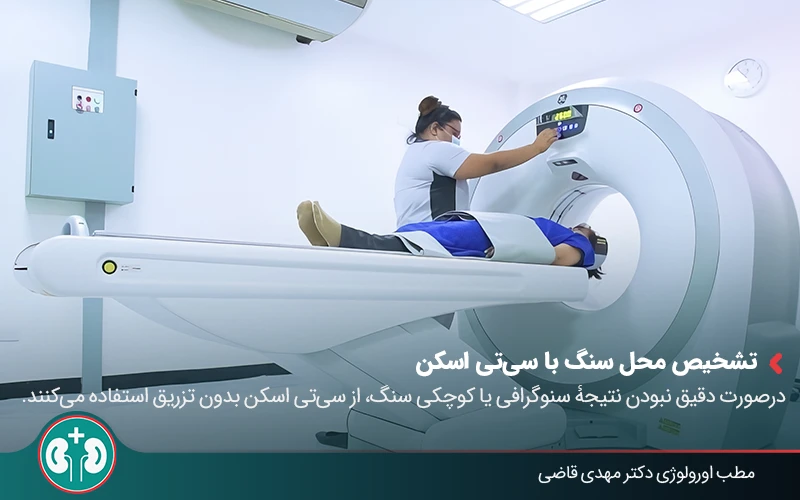
If the ultrasound result is not precise or the stone is very small, the doctor uses a non-contrast CT scan. This method uses X-rays to image the kidneys, ureters, and bladder and shows the exact location and size of the stone with high accuracy. CT scan is considered the most accurate method for diagnosing kidney stones.
Also, some stones cannot be seen on ultrasound because of their composition, intestinal gas, or other reasons such as obesity, anatomic differences, or limited radiologist experience. In these cases, a CT scan should also be performed so kidney stones can be diagnosed with high accuracy.
Summary
Symptoms of passing a kidney stone usually include severe flank or back pain, change in urine color, frequent urination, and a burning sensation when urinating. As the problem becomes more severe, kidney stone passage may also appear with nausea, fever, or urinary tract obstruction. Recognizing these signs helps people see a urologist at the right time and prevent complications such as infection or kidney damage.
Not every pain or change in urine necessarily means a stone is passing, and a definite diagnosis is possible only with medical examination and imaging. Therefore, if you have any signs of passing a kidney stone, see a urologist for reassurance and the necessary evaluation.
Frequently Asked Questions
Actions & related links
Doctors for this topic in Mashhad
See all doctors: Best Kidney Stone Doctors in Mashhad




About the author

Urologic Surgeon
دکتر مهدی قاضی, Urologic Surgeon in Mashhad. Articles on this site are written and reviewed under the supervision of the Urology Building's physicians.
View profile & bookRelated articles
All articlesWhat Is Polycystic Kidney Disease? (Fetal and Adult PKD)
دکتر مهدی قاضی · June 26, 2026
What Is a Renal Cortical Cyst? Symptoms, Diagnosis, and Treatment
دکتر مهدی قاضی · June 26, 2026
Kidney Transplant: Cost, Blood Type Compatibility, and Surgical Method
دکتر مهدی قاضی · June 26, 2026
What Is Pyelonephritis? Kidney Infection Symptoms, Diagnosis, and Treatment
دکتر مهدی قاضی · June 26, 2026
Comments
0 comments
No comments yet. Be the first to share your thoughts.