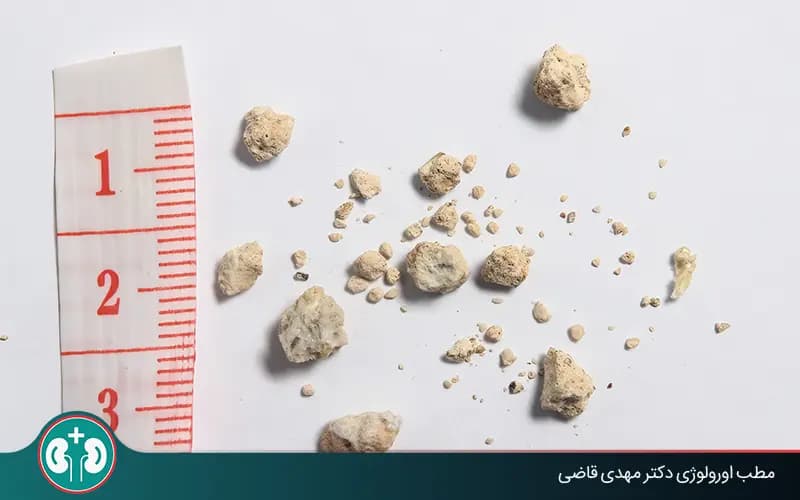
 Tap to zoom
Passing 4 to 10 mm Kidney Stones: Symptoms, Passage, and Treatment
Kidney stones 4 to 5 mm may pass naturally with medical supervision, while 6 to 10 mm stones are more likely to need medication, lithotripsy, or a procedure. Learn the symptoms, warning signs, and treatment thresholds.
- نویسنده
- دکتر مهدی قاضی
- Published on
- June 26, 2026
- Reading time
- 5 min read
- Last updated
- Updated: September 4, 2026
Passing 4 to 5 mm kidney stones is often possible naturally under a doctor's supervision. Drinking fluids, walking, and medicines that help stone passage can make this process faster. Passing 6 to 10 mm stones is harder, and especially at larger sizes, medical procedures and lithotripsy may be needed.
In this article, we discuss passing 4 to 10 mm kidney stones and explain which symptoms suggest that a stone is passing, which factors affect the chance of successful passage, what treatment methods are available, and when it is necessary to see a doctor. If you or someone close to you is dealing with a kidney stone of this size, stay with us to the end of this article.
Kidney and ureteral stone treatment: ESWL, laser and PCNL Kidney stone lithotripsy in Mashhad
Note: To improve care quality and patient satisfaction, appointments are triaged by reason for visit. Each physician sees patients within the relevant urology subspecialty.
Book appointment
Symptoms of Passing 4 to 10 mm Kidney Stones
Symptoms of passing a kidney stone can vary depending on stone size. Some symptoms are common to all types of stones, and only their severity changes. In this section, we first explain the shared symptoms and then review how symptoms differ in smaller and larger stones:
1. Symptoms Common to All Stones (With Different Severity)
These symptoms are seen in almost all patients, but their severity depends on stone size and the degree of obstruction:
Severe, sudden pain (renal colic): It usually starts in the flank and travels to the groin or abdomen. The intensity of this pain comes in waves; the patient has periods of severe pain followed by relative relief.
Blood in the urine (hematuria): As a stone passes through the urinary tract, it can scratch the lining and cause blood in the urine. The urine may look pink, red, or brown, or blood may be detected only on testing.
Burning or pain during urination: When the stone reaches the lower parts of the ureter or the bladder, burning or pain may occur during urination.
2. Differences in Symptoms by Stone Size
In addition to shared symptoms, stone size can change the type or severity of some symptoms.
Appointments related to Kidney and ureteral stone treatment: ESWL, laser and PCNL Kidney stone lithotripsy in Mashhad
Open the public booking path to review times and related information.
Book appointment
Comparison Table of Kidney Stone Symptoms by Size | |||
|---|---|---|---|
Stone size | Chance of spontaneous passage | Common symptoms | Passage status |
3 to 5 mm | High | Flank pain, burning with urination, and blood in the urine | Usually no medical procedure is needed because spontaneous passage is common |
6 to 7 mm | Moderate | More severe pain, possible lodging in the ureter | Possible obstruction and need for medical treatment |
8 to 10 mm and larger | Low | Obstruction, fever and chills, nausea and vomiting | High likelihood of obstruction and need for medical intervention |
Pain and Burning With Urination in 3 to 5 mm Stones
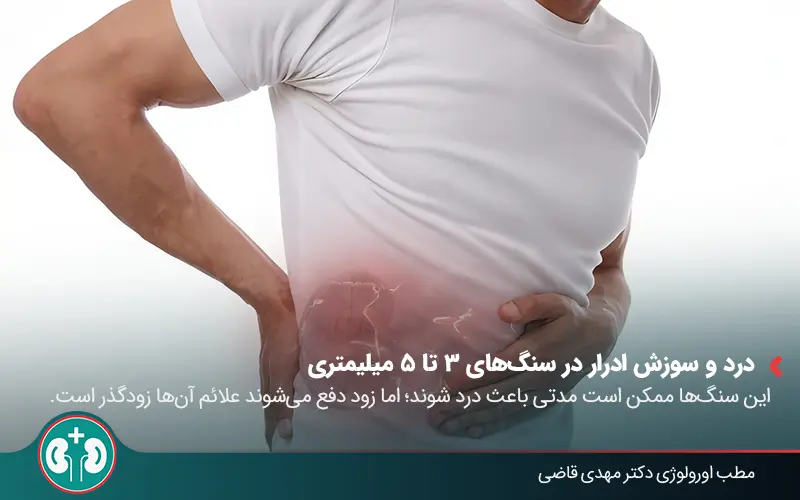
Smaller stones, such as 3 mm or 4 mm kidney stones, usually pass more easily through the urinary tract. These stones may cause severe pain for a short time, but because of their small size, they pass quickly through the ureter and their symptoms are short-lived.
Burning with urination in these cases is mostly due to the stone reaching the final parts of the passage route. In some patients, blood may also be seen in the urine as a pink or light-red color, but the problem usually resolves without hospitalization or surgery.
Fever, Chills, and Obstruction in 6 to 10 mm Stones
Larger stones, such as 6 mm to 10 mm stones, can easily become stuck in the ureter (the tube that carries urine from the kidney to the bladder) because of their size. This obstruction causes urine to back up into the kidney and the kidney to swell, and it can lead to more severe symptoms and more serious complications. Some of these symptoms include:
Q&A — Kidney and ureteral stone treatment: ESWL, laser and PCNL Kidney stone lithotripsy in Mashhad
General questions are shown on the destination page after review.
Book appointment
Prolonged pain: Severe pain caused by obstruction may continue for hours or days.
Fever and chills: Complete ureteral obstruction can lead to a kidney infection, accompanied by fever and chills, nausea, and vomiting. This is considered a medical emergency and must be treated quickly to prevent more serious kidney damage.
Reduced urine volume or complete stoppage: If a stone blocks the ureters of both kidneys or the ureter of a solitary functioning kidney, urine output drops sharply or stops completely. This can quickly lead to acute kidney failure and toxin buildup in the body.
Any severe decrease or complete stoppage of urine production is an emergency and requires immediate medical care. In this situation, the doctor must open the urine drainage pathway with treatments such as TUL and a double-J stent or nephrostomy to prevent permanent kidney damage.
What Factors Affect Whether a Kidney Stone Passes or Gets Stuck?
Three main factors affect spontaneous kidney stone passage: "stone size, stone location, and stone shape". These factors determine whether the stone can pass through the urinary tract easily. Below, we briefly and clearly review these three important factors in passing 4 to 10 mm kidney stones:
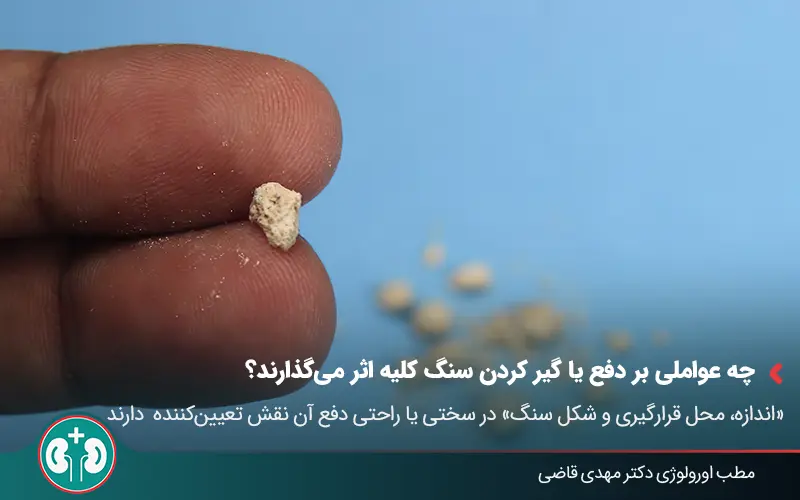
1. Kidney Stone Size: The Most Important Factor Determining Stone Passage
The most important factor in passing a kidney stone is its size. The smaller the stone, the higher the chance that it will pass on its own. This chance is higher for stones smaller than 4 mm than for larger stones. In general, the larger the stone, the lower the chance of passing it without surgery or lithotripsy.
2. Kidney Stone Location
The stone's location in the urinary tract has a major effect on whether it will pass. If the stone has recently left the kidney and is in the upper ureter (near the kidney), the chance of spontaneous passage is lower. If the stone reaches the lower ureter (near the bladder), the chance of passage is much higher because the channel is wider.
3. Stone Shape
The stone's composition and shape can also affect passage. Stones with a smooth surface pass through the ureter more easily than stones with sharp edges or points.
Considering these points, we can conclude that the chance of passing a kidney stone without surgery depends on several factors and cannot be judged based only on stone size. Location and shape also play a key role in how a kidney stone passes.
Treatment Methods for Small and Medium Kidney Stones

The best treatment method for a kidney stone depends on its size, location, and symptom severity. The appropriate method is chosen by a urologist after the necessary evaluation. Smaller stones (up to 4 to 5 mm) usually pass with simple, non-surgical methods, while larger stones may need more specialized treatments.
Non-Surgical Methods for Small Stones
For kidney stones smaller than 5 mm that are not stuck in the ureter, non-surgical supportive methods are usually used. These methods help the body pass the stone naturally. Below, we explain these methods:
Increasing fluid intake: Drinking plenty of water (about 2 to 3 liters per day) can increase urine volume and help the stone move through the urinary tract.
Medication: The doctor may prescribe pain relievers to control pain and medicines such as tamsulosin. Tamsulosin relaxes the smooth muscle of the urinary tract (ureter), helping the kidney stone pass more easily.
Physical activity: Movement and physical activity can help the stone move within the ureter and speed up the passage process.
Surgical or Lithotripsy Methods for Larger Stones
Stones between 6 and 10 mm are harder to pass. In this situation, the urologist may recommend minimally invasive or surgical methods. Below, we discuss these methods:
Extracorporeal shock wave lithotripsy (ESWL): This is the most common method for breaking medium stones (6 to 10 mm) without open surgery. This method is effective for stones at the beginning of the ureter, and if the stone has moved lower, it is not effective.
Endoscopic ureteral lithotripsy, or TUL: If the kidney stone is stuck in the ureter, the urologist enters the urinary tract with a thin instrument and removes or breaks the stone.
Surgery: In rare cases, when the stone is very hard or large, more advanced surgical methods may be needed.
What Should Be Done for a Kidney Stone Larger Than 10 mm?
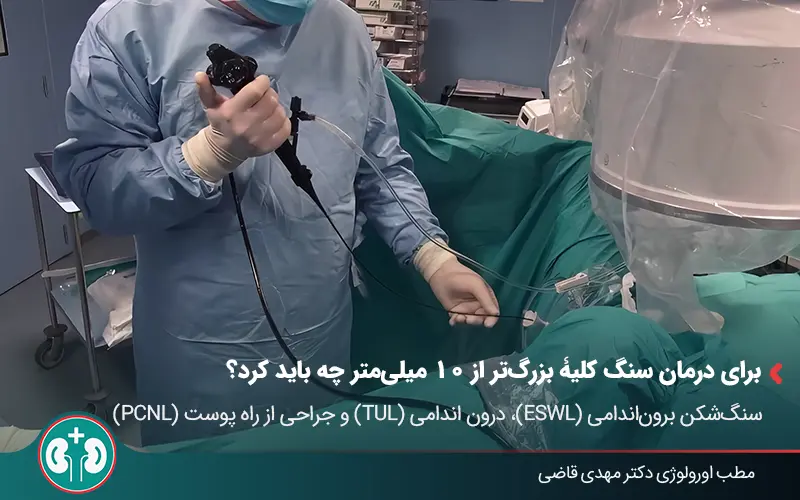
Stones that are 10 mm or larger rarely pass on their own. These stones usually get stuck in the urinary tract (ureter) and cause severe pain, urinary tract obstruction, and kidney damage.
In these cases, you must see a urologist. The doctor uses different methods to remove or pass these stones, which we discuss below:
ESWL: This method is used for stones in the proximal ureter, the beginning of the ureter, or inside the kidney.
Endoscopic ureteral lithotripsy, or TUL: In this method, the doctor uses a thin, flexible instrument with a camera to reach the ureter or kidney through the urinary tract and break or remove the stone.
Percutaneous surgery (PCNL): For stones larger than 2 cm, percutaneous nephrolithotomy is common. In this method, a small incision is made in the skin and special instruments are inserted into the kidney so the stone can be broken directly and removed. This method is used only for large stones inside the kidney and is not used for stones inside the ureter.
When Should You See a Specialist to Pass a Kidney Stone?
Passing a kidney stone is not always simple or risk-free, and it can sometimes cause severe urinary tract obstruction or a urinary tract infection. In these situations, the kidney is at risk of serious damage; for this reason, knowing the warning signs and acting quickly is very important. Below are the most important warning signs. If you notice any of them, you should see a urologist immediately.
Severe, persistent pain that is not relieved by usual painkillers;
Fever and chills (a sign of infection along with a stone);
Inability to urinate or a severe decrease in urine volume;
Blood in the urine;
Severe nausea and vomiting that prevent eating or drinking.
Ways to Prevent Kidney Stones From Forming Again

After a kidney stone has passed successfully, the most important step is preventing new stones from forming. This requires changes in lifestyle and diet. These include:
Drinking plenty of water;
Reducing salt intake;
Reducing carbonated drink intake;
Staying physically active to help small stones pass faster.
Summary
In this article, we discussed passing 4 to 10 mm kidney stones and explained the different passage and treatment methods for various stones that form in the kidney. Small kidney stones (3 to 5 mm) usually pass on their own with fluids and simple recommendations, but larger stones (7 to 10 mm) often need medication or medical interventions and should not be ignored.
Remember that if you notice dangerous symptoms such as fever and chills, severe pain, or inability to urinate, you should see a urologist immediately. Kidney health is vital, and delaying kidney stone treatment can lead to irreversible complications.
Frequently Asked Questions
Actions & related links
Doctors for this topic in Mashhad
See all doctors: Best Kidney Stone Doctors in Mashhad




About the author

Urologic Surgeon
دکتر مهدی قاضی, Urologic Surgeon in Mashhad. Articles on this site are written and reviewed under the supervision of the Urology Building's physicians.
View profile & bookRelated articles
All articlesWhat Is Polycystic Kidney Disease? (Fetal and Adult PKD)
دکتر مهدی قاضی · June 26, 2026
What Is a Renal Cortical Cyst? Symptoms, Diagnosis, and Treatment
دکتر مهدی قاضی · June 26, 2026
Kidney Transplant: Cost, Blood Type Compatibility, and Surgical Method
دکتر مهدی قاضی · June 26, 2026
What Is Pyelonephritis? Kidney Infection Symptoms, Diagnosis, and Treatment
دکتر مهدی قاضی · June 26, 2026
Comments
1 comments