 Tap to zoom
Open Kidney Stone Surgery: Definitive Treatment for Large Stones
Learn when open kidney stone surgery is used for large or resistant stones, how the procedure is performed, recovery, possible complications, success rates, cost factors, and follow-up care.
- نویسنده
- دکتر مهدی قاضی
- Published on
- June 26, 2026
- Reading time
- 5 min read
- Last updated
- Updated: September 4, 2026
Open kidney stone surgery is one of the oldest and still one of the most effective treatments for kidney stones. In this operation, the surgeon reaches the kidney through an incision and removes the stones completely.
Today, this method is used to treat large kidney stones. It may also be used for patients who have not responded to less invasive treatments such as extracorporeal shock wave lithotripsy (ESWL).
Contrary to what many patients believe, stones inside the kidney usually do not cause pain. They usually become painful only when they leave the kidney and get stuck in the ureter. In addition, open kidney stone surgery is performed only in selected situations, such as when the stones are very large. After the stone is removed, pain caused by obstruction improves, but new stones can still form.


In this article, in addition to answering these questions, we will discuss open kidney stone surgery in detail and explain what you should know before and after the operation. So if you or one of your loved ones has a kidney stone that is large, this guide can help you approach treatment with less worry.
Why is open kidney stone surgery chosen for treatment?
Open kidney surgery is now performed only in special situations, because most patients are treated with less invasive methods such as extracorporeal shock wave lithotripsy (ESWL), ureteroscopy, or PCNL. In general, open kidney stone surgery may be used in the following situations:
Very large stones, especially stones larger than 2 cm, particularly when ESWL or PCNL has not been effective.
Very hard stones or stones that cannot be broken, even with advanced devices.
Anatomical abnormalities or skeletal problems, such as a horseshoe kidney, severe ureteral narrowing, or abnormal kidney rotation, that prevent the passage of less invasive instruments.
Infected stones or stones that may threaten kidney function, especially when the stone has caused a severe infection or complete urinary obstruction and there is a risk of kidney damage.
Patients who have developed bleeding because of a kidney stone.
When the stone continues to grow despite medical care.
Patients who have excess body weight or certain medical conditions.

Overall, open kidney stone surgery can be described as the final and most reliable treatment option for patients with large kidney stones.
Who is not a candidate for open kidney surgery?
In contrast, some patients may not have suitable conditions for this operation:
Patients who take anticoagulant medicines, such as warfarin, clopidogrel, apixaban, and others, when temporary discontinuation is not possible.
Pregnant women, especially in the first and third trimesters.
Patients with an active urinary tract infection or sepsis.
Patients with uncontrolled diabetes or very high blood sugar.
Patients with advanced kidney failure, because kidney function may not be suitable for open surgery.
People with severe heart or lung failure for whom general anesthesia is dangerous.
People with inherited or acquired bleeding disorders, such as thrombocytopenia.
Steps of open kidney stone surgery and key details
Open kidney surgery is an invasive treatment. Although recovery takes longer than with other methods, in the situations mentioned earlier it may be the best and most definitive treatment option. In this section, we review what you should know before and after kidney stone surgery so you can move through this stage of treatment more smoothly.
Preparation before surgery
Before you enter the operating room, you need to prepare yourself for surgery ahead of time. Taking preoperative instructions seriously can reduce postoperative complications and help you recover faster. The most important steps before kidney surgery include:
Before surgery, you should have blood and urine tests so the doctor can check your general condition, especially kidney function.
After that, you may need a CT scan or ultrasound to determine the exact location and size of the stone.
Before surgery, be sure to tell your doctor about any medicine, vitamin, or herbal supplement you use. You may need to stop some medicines, such as blood thinners, a few days before the operation.
Reduce your salt intake and avoid high-calcium dairy products.
Preferably avoid animal protein and high-fat foods.
Do not smoke; stopping smoking can help speed your recovery after surgery.
You are usually advised to fast the night before surgery and to take essential medicines only with a small amount of water.
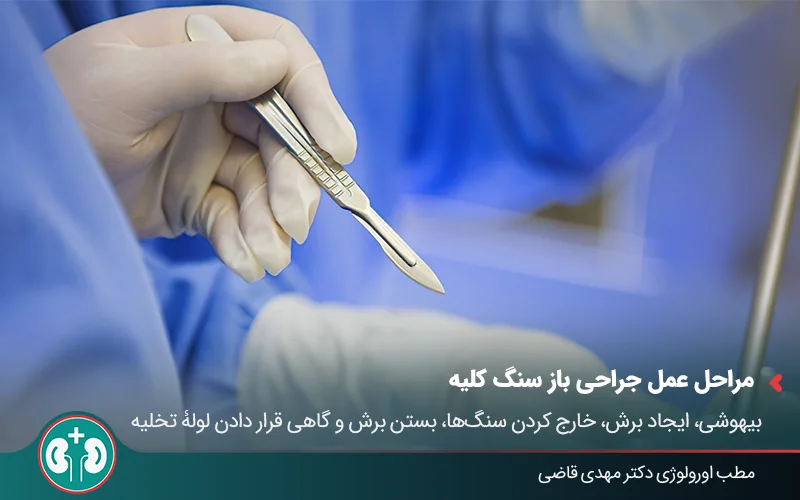
Stages of open kidney stone surgery
The process of open kidney surgery generally includes several main steps:
General anesthesia: The operation begins with anesthesia so the patient does not feel pain during surgery.
Making the surgical incision: The surgeon makes a large incision in the flank or back to reach the kidney.
Removing the stones: The stones are then removed completely from the kidney.
Closing the incision: At the end, the internal incisions are closed and the external incision is sutured. If needed, a drain tube is placed in the appropriate location.
Hospital stay and recovery after open kidney stone surgery
Recovery after open kidney surgery is longer than recovery after less invasive methods, so you should be patient and follow your doctor's instructions.
Length of hospital stay after open kidney surgery
After open kidney surgery, you will usually stay in the hospital for 3 to 5 days, although this depends on your general condition and how complex the surgery was.

Home care after discharge
After surgery, the body needs enough time and proper care to repair itself. Following these points can help you move through recovery more quickly:
Rest well during the first few weeks.
After surgery, start walking gradually and gently.
Use compression stockings to help prevent blood clots.
Take prescribed medicines, including pain relievers and antibiotics, exactly as directed.
Avoid lifting heavy objects for at least four weeks.
Do not drive for two weeks.
Drink plenty of fluids.
Checklist for the stages of open kidney surgery | |
|---|---|
Blood tests and imaging, stopping blood thinners, fasting, smoking cessation | Before surgery |
Checking fever and signs of infection, caring for the drain and sutures | During hospitalization |
Rest, a low-salt diet, fluid intake, taking medicines as prescribed, wound care | After discharge (at home) |
Complications of open kidney stone surgery and ways to prevent them
Open kidney surgery also like any other surgery, may be associated with complications such as postoperative pain. Fortunately, many complications can be controlled to a large extent by following the points mentioned earlier.
Symptoms you may experience after open kidney stone surgery include the following:
Blood in the urine (hematuria): A small amount of blood for a few days after surgery is normal. In this situation, it is better to drink more water.
Flank or abdominal pain and discomfort: Most patients have some pain after surgery, which can be controlled with pain medicine.
Mild urinary tract infections: You may have burning or frequent urination. In this situation, the doctor will usually prescribe an antibiotic.
Nausea and weakness: This usually occurs because of anesthesia medicines or pain relievers and is usually temporary.
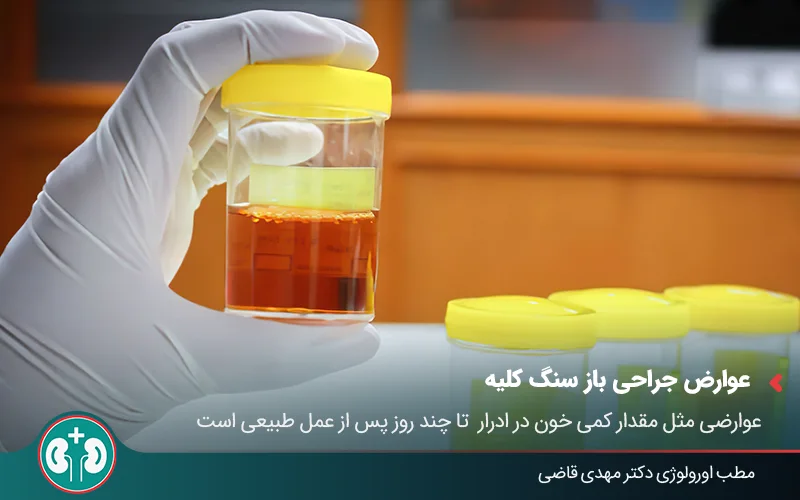
Warning signs after surgery
If you have any of the following symptoms after kidney surgery, see your doctor as soon as possible:
High fever and chills;
Heavy bleeding or clots in the urine;
Severe, intolerable pain;
Inability to urinate or complete blockage of urine flow.
Comparison of open and laparoscopic kidney stone surgery: advantages and disadvantages
Two methods are commonly used to treat large kidney stones: open kidney surgery and laparoscopic kidney surgery. The difference between open and laparoscopic kidney stone surgery is mainly the size of the incisions and the postoperative complications. In open surgery, one large incision is made on the flank or abdomen, whereas laparoscopy is performed through smaller incisions. The table below compares the advantages and disadvantages of kidney stone surgery methods:
Open kidney stone surgery | Laparoscopic kidney surgery | Comparison criterion |
|---|---|---|
Large (10-20 cm) | Small (several 0.5-1 cm incisions) | Incision size |
More pain and a greater need for stronger pain medicine | Less pain and easier control | Postoperative pain |
3 to 5 days, sometimes longer | 1 to 2 days | Length of hospital stay |
Longer, usually several weeks | Shorter, from a few days to 2 weeks | Recovery period |
Higher because of the larger incision | Low | Risk of infection |
Large | Very small | Scar |
High, especially for very large stones | Relatively high | Success rate |
Cost of open kidney surgery and factors that affect it
The truth is that a single fixed price cannot be given for the cost of open kidney stone surgery, because surgical cost depends on several factors, including the following:
Type of hospital (public or private);
The surgeon's experience and expertise;
Length of hospital stay;
Tests and imaging before and after surgery;
Medicines and disposable equipment (such as a stent or drain).
Insurance coverage for open kidney surgery
Almost all insurance plans cover part of the cost of kidney surgery, but the amount of coverage differs from one plan to another. For example, some supplemental insurance plans cover a large portion of the surgical cost.
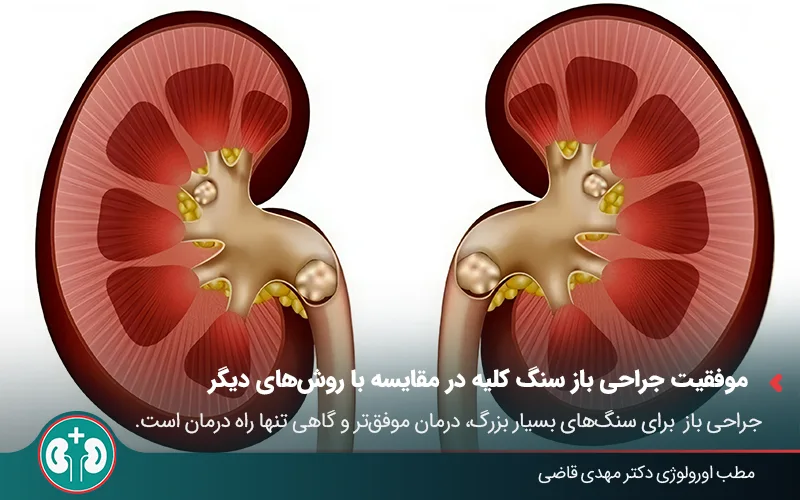
Success of open kidney stone surgery compared with other methods
Although less invasive methods such as PCNL have become the main treatment for kidney stones in recent years, scientific evidence shows that open kidney stone surgery can still be more successful for very large stones.
A comparison of open surgery and PCNL in patients with staghorn stones shows that the success rate of open surgery is about 91.6%, while the rate for PCNL is about 81.9%. These numbers show that open surgery still has advantages in complex cases. Source
Another study found that the success rate of open surgery in removing stones reaches about 97.5%. This figure shows that, in selected cases, open surgery can be the only definitive treatment for kidney stones. Source
Summary
Open kidney stone surgery is usually chosen when stones are very large or resistant to treatment and less invasive methods such as ESWL, ureteroscopy, or PCNL cannot remove them completely.
Although open surgery is more invasive than other methods and has a longer recovery period, it is still considered the most definitive and successful treatment for large stones, staghorn stones, infected stones, or stones that cannot be fragmented by other methods.
Finally, following your doctor's recommendations and preoperative and postoperative care instructions not only helps you recover faster but also minimizes the risk of complications.
Frequently Asked Questions
Actions & related links
Doctors for this topic in Mashhad
See all doctors: Best Kidney Stone Doctors in Mashhad




About the author

Urologic Surgeon
دکتر مهدی قاضی, Urologic Surgeon in Mashhad. Articles on this site are written and reviewed under the supervision of the Urology Building's physicians.
View profile & bookRelated articles
All articlesWhat Is Polycystic Kidney Disease? (Fetal and Adult PKD)
دکتر مهدی قاضی · June 26, 2026
What Is a Renal Cortical Cyst? Symptoms, Diagnosis, and Treatment
دکتر مهدی قاضی · June 26, 2026
Kidney Transplant: Cost, Blood Type Compatibility, and Surgical Method
دکتر مهدی قاضی · June 26, 2026
What Is Pyelonephritis? Kidney Infection Symptoms, Diagnosis, and Treatment
دکتر مهدی قاضی · June 26, 2026
Comments
0 comments
No comments yet. Be the first to share your thoughts.