
 Tap to zoom
Laparoscopic Surgery for Kidney Cysts
Laparoscopic kidney cyst surgery is a minimally invasive option for selected symptomatic kidney cysts, with less pain and faster recovery than open surgery.
- نویسنده
- دکتر مهدی قاضی
- Published on
- June 26, 2026
- Reading time
- 5 min read
- Last updated
- Updated: June 27, 2026
Laparoscopic kidney cyst surgery is one of the advanced, minimally invasive methods used to treat kidney cysts.
Kidney cysts are fluid-filled sacs that form on the kidney. In most cases they cause no symptoms, but if they enlarge or cause symptoms such as pain, pressure on nearby organs, or infection, surgical intervention may be needed.
Kidney and ureteral stone treatment: ESWL, laser and PCNL Kidney stone lithotripsy in Mashhad
Note: To improve care quality and patient satisfaction, appointments are triaged by reason for visit. Each physician sees patients within the relevant urology subspecialty.

Book appointment
Compared with open surgery, laparoscopic surgery has several advantages, including less postoperative pain, a shorter recovery period, and a lower risk of infection.
In this method, the surgeon uses several small incisions and inserts specialized instruments to drain or remove the kidney cyst, and the patient can return to daily activities after a short time.
Who is suitable for kidney cyst surgery?
This method is suitable for the following patients:
Appointments related to Kidney and ureteral stone treatment: ESWL, laser and PCNL Kidney stone lithotripsy in Mashhad
Open the public booking path to review times and related information.
Book appointment
People with large cysts who have flank and abdominal pain
People who have obstruction of kidney outflow and, ultimately, dilation of the kidney (hydronephrosis caused by the cyst),
Symptomatic kidney cysts
Because parapelvic cysts are close to the renal pelvis and kidney outlet, they become symptomatic earlier and, by pressing on the beginning of the ureter, can cause kidney dilation, hydronephrosis, pain, and even kidney failure.
If kidney cysts are not parapelvic, simple internal cysts (parenchymal) or cysts outside the kidney (exophytic) that are smaller than 10 cm generally do not need to be removed.
Benefits of laparoscopic surgery for kidney cysts
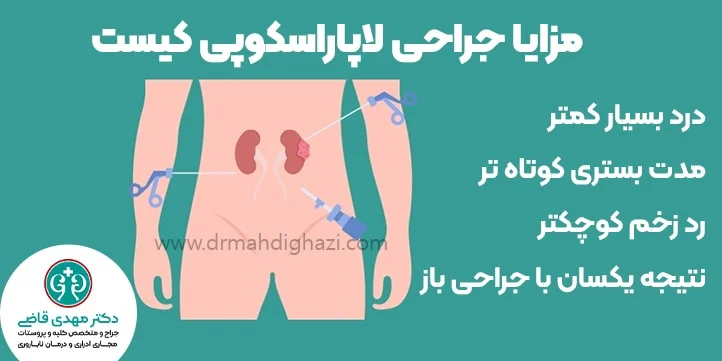
Compared with the open surgical technique (traditional surgery), laparoscopic cyst removal has the following advantages:
Q&A — Kidney and ureteral stone treatment: ESWL, laser and PCNL Kidney stone lithotripsy in Mashhad
General questions are shown on the destination page after review.
Book appointment
Much less pain after surgery
Shorter hospital stay
Earlier return to work
Better cosmetic result
Its success rate also appears to be the same as open surgery.
For selected patients with symptomatic kidney cysts, laparoscopic surgery has become a standard method.
How the surgery is performed
Laparoscopic kidney cyst removal is performed under general anesthesia.
The usual duration of surgery is 3 to 4 hours.
Surgery is performed through 3 or 4 small incisions, each about 1 cm, in the abdomen.
A telescope and small instruments are inserted into the abdomen through these small incisions. This allows the surgeon to completely separate and open the cyst and remove it, or remove its wall, without needing to place a hand inside the abdomen.
Cyst recurrence is the same after open and laparoscopic surgery and is very uncommon.
Surgical complications
Every type of treatment can have its own complications, and it is always important for patients to be aware of the possible complications of treatment.
Possible complications of laparoscopic kidney cyst surgery include:
Bleeding
The amount of bleeding during this procedure is usually low, and fewer than five percent of patients need a blood transfusion.
Infection
To reduce the chance of infection, all patients receive an intravenous antibiotic before surgery begins.
It is important that if the patient experiences any symptom or sign of infection after surgery, such as fever, drainage from the incision site, urinary frequency or discomfort, pain, or anything concerning, they should contact their doctor immediately.
Injury to nearby tissues and organs
Although rare, possible injury to nearby tissues and organs, including the intestine, blood vessels, spleen, liver, pancreas, and gallbladder, can occur and generally requires conversion to open surgery with a longer hospital stay.
Formation of scar tissue
Scar tissue and adhesions may form in the kidney and may require repeat surgery.
Injury to nerves or muscles of the body during anesthesia may also occur because the operation is relatively long and the patient remains still on the operating table.
Conversion to open surgery
If a problem occurs during laparoscopic surgery, it may be necessary to convert the operation to the traditional open method.
This can result in a larger incision for open surgery and possibly a longer recovery period.
Urine leakage
If the kidney collecting system is injured, or if it must be cut to remove the kidney cyst, it is usually sutured closed.
If urine leaks from this opening after surgery, the patient may need to be taken back to the operating room and may need an internal kidney catheter or double-J ureteral stent to drain urine better from the kidney and help stop the leak.
In rare cases, additional surgery may also be needed.
It is very important to gather all X-ray images and reports and bring them to the initial consultation with the surgeon.
Summary
Laparoscopic kidney cyst surgery, as an advanced and minimally invasive method, is a suitable option for patients who need removal of a kidney cyst.
By reducing pain, shortening the hospital stay, and allowing a faster return to daily life, this method is considered a safe and effective alternative to open surgery. Because the likelihood of complications is low, this surgery is becoming a standard method for treating symptomatic kidney cysts.
Frequently asked questions
Actions & related links
Doctors for this topic in Mashhad
See all doctors: Best Urologic Surgeons in Mashhad




About the author

Urologic Surgeon
دکتر مهدی قاضی, Urologic Surgeon in Mashhad. Articles on this site are written and reviewed under the supervision of the Urology Building's physicians.
View profile & bookRelated articles
All articlesWhat Is Polycystic Kidney Disease? (Fetal and Adult PKD)
دکتر مهدی قاضی · June 26, 2026
What Is a Renal Cortical Cyst? Symptoms, Diagnosis, and Treatment
دکتر مهدی قاضی · June 26, 2026
Kidney Transplant: Cost, Blood Type Compatibility, and Surgical Method
دکتر مهدی قاضی · June 26, 2026
What Is Pyelonephritis? Kidney Infection Symptoms, Diagnosis, and Treatment
دکتر مهدی قاضی · June 26, 2026
Comments
6 comments