 Tap to zoom
Guide to pre-kidney transplant tests: What is the transplant panel test?
Testing before a kidney transplant goes well beyond a simple blood draw, covering blood typing, HLA tissue typing, the PRA panel, and crossmatch for both recipient and donor. This guide walks through every step so you know what to expect on the path to transplant.
- نویسنده
- دکتر مهدی قاضی
- Published on
- June 26, 2026
- Reading time
- 5 min read
- Last updated
- Updated: June 28, 2026
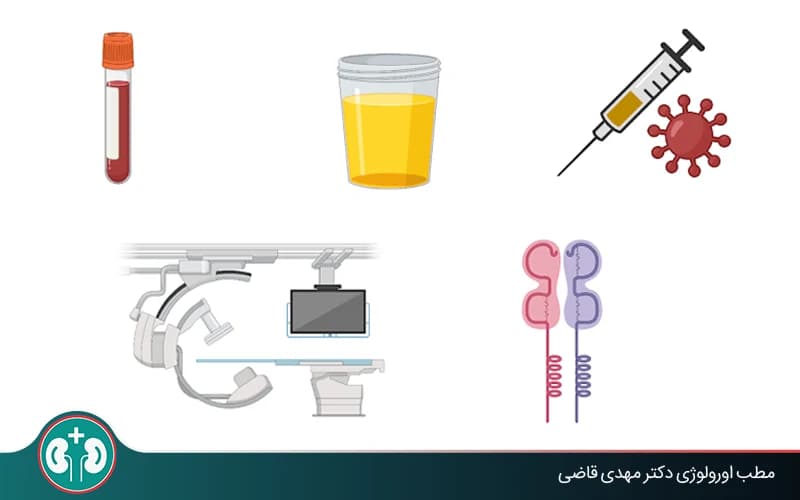
Pre-kidney-transplant testing is not limited to one or two simple tests; in fact, it involves multiple specialized evaluations. These include blood tests, imaging, and assessment of cardiac and pulmonary status.
Some of these tests must be performed before being placed on the waiting list, and others before surgery. Another point is that these tests are not only for the recipient; if a suitable candidate is found, the donor must also undergo several tests.
Kidney and ureteral stone treatment: ESWL, laser and PCNL Kidney stone lithotripsy in Mashhad
Note: To improve care quality and patient satisfaction, appointments are triaged by reason for visit. Each physician sees patients within the relevant urology subspecialty.
Book appointment
In this process, the physician evaluates whether the donated kidney is compatible with the body's immune system, and whether the patient is able to tolerate surgery and the subsequent treatments. Answering these questions plays an important role in reducing the risk of kidney transplant rejection and increasing the chances of a successful operation.
In what follows, we review all the essential pre-kidney-transplant tests step by step and in plain language. If you or one of your loved ones is facing a kidney transplant, be sure to read this article to the end so that you have a clear picture of the path ahead.
Why is pre-transplant evaluation essential?
As we noted at the outset, the purpose of performing kidney transplant tests is to reduce the likelihood of rejection and the risk of surgery. This evaluation is not limited to a single issue and simultaneously pursues several important goals:
Appointments related to Kidney and ureteral stone treatment: ESWL, laser and PCNL Kidney stone lithotripsy in Mashhad
Open the public booking path to review times and related information.
Book appointment
1. Selecting a kidney compatible with the patient's body
The most important goal is to find a kidney that has the greatest compatibility with the recipient's body. The greater this compatibility, the less likely the immune system is to identify the new kidney as "foreign." As a result, the likelihood of transplant rejection decreases significantly.
2. Assessing the body's ability to tolerate surgery
Kidney transplantation is a major surgery, and not all patients are in the same condition. At this stage, it is assessed whether the heart, lungs, and the body's general condition can tolerate the operation, because severe underlying diseases increase the surgical risk.
3. Assessing readiness for post-transplant treatments and identifying and controlling the risk of infections
Kidney transplantation is not the end of treatment; in fact, it is the beginning of a new path. The patient must take immunosuppressive medications for the rest of their life. Although these drugs prevent transplant rejection, they make the body susceptible to various infections.
Q&A — Kidney and ureteral stone treatment: ESWL, laser and PCNL Kidney stone lithotripsy in Mashhad
General questions are shown on the destination page after review.
Book appointment
Before transplantation, any active infection (such as a dental, pulmonary, or urinary infection) must be identified and treated. It is also necessary to assess the body's overall condition for hidden infections and other diseases.
The purpose of these evaluations is to reduce postoperative complications and increase the success of the transplant.

Timing and stages: how long do pre-kidney-transplant tests take?
The time required to complete these tests varies depending on each individual's condition and may take from a few days to several months.
If the patient's general condition is stable, the tests can usually be completed in a short time; however, in many cases, because of the need for more detailed evaluations (such as cardiac assessment, infections, or immune tests), completing this stage takes longer.
In general, the time required to perform these tests depends on several different factors, which are:
The patient's general health status;
The presence or absence of underlying diseases (such as cardiac problems or infections);
The speed of performing the tests and completing the file at the transplant center;
The need to repeat certain tests (such as the crossmatch).
بهترین زمان برای شروع آزمایشهای پیش از پیوند کلیه، وقتی است که نرخ فیلتراسیون گلومرولی (GFR) به حدود ۲۰ میرسد؛ یعنی حتی قبل از اینکه بیمار وارد مرحله دیالیز شود. توجه کنید تا زمانی که آزمایشها کامل نشوند، امکان ورود به لیست انتظار پیوند وجود ندارد. بنابراین، هر چه زودتر اقدام کنید، زودتر در لیست پیوند قرار میگیرید.
Essential tests for the kidney recipient: from the panel to histology
The physician performs a complete, multi-stage evaluation to determine:
Whether the body will accept the new kidney or not?
And whether you are able to tolerate the surgery and the treatments that follow it?
In the rest of this section, we will tell you which tests you will face at this stage so that you can step onto the treatment path with greater preparedness.
1. Determining the blood group and the best blood group for kidney transplantation
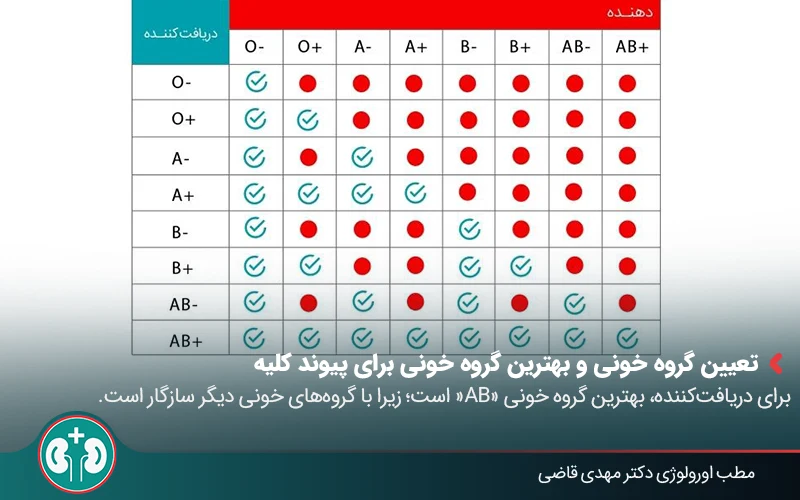
One of the first tests performed along the transplant path is blood group (ABO) determination. This is usually done in the early stages of the patient's evaluation, even before being placed on the waiting list. The goal is to select a donor with a compatible blood group for the patient. In general, the compatibility of the various blood groups can be summarized as follows:
Blood group O: people whose blood group is O can donate an organ to all blood groups, but can receive an organ only from people with blood group O;
Blood group AB: people whose blood group is AB can receive an organ from all blood groups;
Blood groups A and B: these two blood groups are compatible with their own group and with O.
Therefore, the best blood group for kidney transplantation can be considered blood group AB.
2. HLA testing for kidney transplantation (tissue typing)
HLA testing for kidney transplantation actually examines the "genetic code" of your body's cells. This test determines how likely your immune system is to recognize the new kidney as a foreign organ.
In this test, three main groups of antigens are examined:
HLA-A;
HLA-B;
HLA-C;
HLA-DQY;
HLA-DR.
The greater the similarity of these antigens between the donor and the recipient, the higher the likelihood of a successful transplant, and the less the immune system attacks the kidney.

3. Antibody screening (PRA) and crossmatch tests
Among kidney transplant tests, the panel test (PRA) and the crossmatch test play an important role in assessing the "sensitivity of the immune system." In fact, these two tests determine the extent to which your body might react to the transplanted kidney.
a) Antibody screening test (PRA)
The panel test for kidney transplant (PRA) measures how sensitized your immune system is. The result of this test is expressed as a percentage. The lower this percentage, the easier it is to find a compatible kidney.
Conversely, the higher this percentage, the more it means your immune system has already produced antibodies against many human tissues; for this reason, the likelihood of rejection is greater and finding a compatible kidney will be more difficult.
There are several causes for an elevated PRA, namely:
Multiple pregnancies;
Previous blood transfusions;
A previous organ transplant.
B) Crossmatch
The crossmatch is the final test before the transplant, and it is also of great importance. In this test, a sample of your blood is mixed with the donor's blood in the laboratory to assess how they react with each other:
Compatible (negative crossmatch): if no reaction occurs, the crossmatch is negative, your body accepts the kidney, and the transplant can be performed;
Incompatible (positive crossmatch): if the two blood samples react with each other, the crossmatch is positive, your immune system will attack the kidney, and the transplant operation is therefore cancelled.

4. Other essential tests (heart, lungs, and cancer)
In addition to the tests we have discussed so far, there are other tests with which the physician evaluates the body's overall condition.
Among these supplementary tests are the following:
Cardiac evaluation: to examine this organ, an echocardiogram is usually performed in addition to an electrocardiogram (ECG);
Lung assessment: the health of the lungs and the detection of infection or underlying problems are evaluated by means of a radiographic (X-ray) image;
Cancer screening: to prevent the activation of hidden diseases after the transplant (especially because of the use of immunosuppressive medications), the following examinations also need to be carried out:
Colonoscopy (usually for people over 50 years of age);
Pap smear in women;
PSA test in men;
Dental check-up: since the immunosuppressive medications (taken after the transplant) weaken the immune system, any dental infection may turn into a major problem.

Who cannot undergo a kidney transplant?
An important point to know about kidney transplantation is that not everyone with kidney disease, and not even everyone who has reached the stage of kidney failure, is a candidate for a transplant.
Among the most important of these conditions are the following:
Active, untreated infections: infections such as a dental or bone infection, or systemic infections, may spread rapidly after the transplant and lead to more serious problems;
Severe cardiac or pulmonary disease: if these diseases are advanced and uncontrollable, the surgical risk becomes so high that the operation is practically not justifiable;
Active or recently treated cancer: because of the weakening of the immune system after the transplant, these patients are at risk of cancer recurrence or progression;
Morbid obesity (high BMI): a body mass index above 35 to 40 usually increases the risk of surgical complications;
Uncontrolled psychological disorders: if a person has severe mental disorders, there is a risk of irregular medication use;
Use of narcotics or alcohol: this disrupts the recovery process and increases the risk of complications.
بسیاری از این موارد «مطلق و دائمی» نیستند. بهعنوان مثال، اگر عفونت درمان شود یا وضعیت قلبی بهبود یابد، امکان بررسی مجدد برای پیوند وجود دارد.
Donor guide: the tests required for kidney donation and the documents
If you intend to donate a kidney, you should know that you, like the recipient, must undergo a thorough medical, legal, and psychological evaluation. The aim of these assessments is to protect your health and to increase the chances of a successful transplant.
In the rest of this article, we will discuss the tests required for kidney donation as well as the documents needed for kidney donation.
Documents required for kidney donation and initial preparations
The first thing you must do is to open a medical and administrative file. At this stage the applicant's identity is verified, and then the person's informed consent to undergo the procedure is reviewed.
The required documents are as follows:
Identification and insurance documents: national ID card, birth certificate, and health insurance documents;
Complete medical history: including previous illnesses, surgeries, and medications being taken;
Informed consent forms: confirming that the decision to donate the kidney was made without coercion and with full awareness;
Psychosocial evaluation: assessment of the person's mental state, family support, and ability to make a rational decision.
The donor's medical tests
After the documents are completed, the main stage—namely the donor's medical examinations—begins. The aim is to ensure that the donor is completely healthy and that donating a kidney will not cause any problem for them in the future. It must also be ensured that there is no risk of transmitting high-risk diseases such as hepatitis and AIDS to the recipient.
For this purpose, the donor needs to undergo the following tests:
Blood and urine tests: to assess kidney function and the body's general condition and to detect diabetes;
Infectious disease tests: to check for diseases such as hepatitis B and C, HIV, and other transmissible infections;
Cancer screening (based on age and sex): such as Pap smear and mammography in women, or colonoscopy at older ages;
Cardiac and pulmonary evaluation: including an electrocardiogram (ECG) and a chest X-ray to assess the body's readiness for surgery;
Imaging of the kidneys: such as ultrasonography to assess the structure, size, and health of the kidneys.

Risks for the kidney donor
Overall, kidney donation is considered a low-risk procedure, but like any other surgery it is not without risk. For this reason, being aware of these risks helps the donor make a more informed decision.
These risks can be divided into two categories: short-term and long-term risks:
Table of kidney donor risks | |
Short-term risks (related to surgery) | Bleeding, infection, blood clot formation, urine leakage at the junction of the ureter and bladder, narrowing or obstruction of the urinary tract |
Long-term risks | A slight increase in blood pressure, an increased risk of cardiovascular disease in some patients, the risk of living with a single kidney (having no spare kidney in the event of damage) |
Placing the kidney recipient candidate on the transplant waiting list
After completing the pre-kidney-transplant tests, your file enters a specialized review stage. If you are found to be medically eligible, you are placed on the kidney transplant waiting list.
Note that because demand for kidneys is very high, you may remain on the waiting list for a long time. Of course, this duration also depends on various factors such as tissue compatibility, blood type, the body's general condition, and the urgency of the patient's situation.
During this period, your file is reviewed periodically, and if a compatible kidney is found, the transplant center will contact you. Therefore, you need to register a phone number in your file that is always reachable.
در طول زمان انتظار، لازم است تغییر شماره تماس یا هرگونه تغییر در وضعیت جسمانی خود مثل عفونت، بستری شدن یا تغییر داروها را باید حتماً به مرکز پیوند اطلاع دهید.
What is meant by a "deceased" donor?
The term "deceased donor" may be a little misleading, but in practice it has a specific definition. In medicine, deceased donors are divided into two groups:
Brain death: a person whose entire brain activity has completely ceased, but whose circulation is maintained by a machine;
Cardiac death: a person who has suffered cardiac arrest and whose circulation has stopped.
Most donated kidneys come from brain-dead individuals, and kidneys from people who have died of cardiac death are rarely used.

The cost of pre-kidney-transplant tests and insurance coverage
According to a directive from the Ministry of Health, a significant portion of kidney transplant costs (especially at public centers) is covered by basic and supplementary insurance. The cost of kidney transplant tests and pre- and post-operative evaluations is also among these items. However, some specialized pre-transplant tests (especially at private centers) and the frequent follow-up visits and check-ups after the operation will be the patient's responsibility.
What factors affect the final cost?
In fact, it can be said that the final amount is not the same for every patient and depends on various factors:
The type of medical center (public or private);
The type of insurance (basic or supplementary);
The patient's general condition and the need for additional services;
The need to repeat tests.
Important note: In Iran, kidney transplantation is among the services that receive significant insurance support.
Things you should know: the difficulties of the treatment process and surgical complications
As we have repeatedly noted, the kidney transplant process is not a simple or short journey; from performing the pre-transplant tests to the long-term care after the operation, all of these stages require awareness and preparation.
1. The probability of death
Death during kidney transplant surgery is very rare, and this operation is today considered a relatively safe procedure; but, like any other surgery, it is not without risk.
2. The possibility of transplant rejection
Sometimes, despite compatible test results, the immune system identifies the new kidney as a "foreign" organ and attacks it. Fortunately, today, with the use of immunosuppressant medications, this issue has been largely controlled.
3. Care and medication use (lifelong)
Life after a transplant requires ongoing follow-up. That is, you must periodically perform the tests needed to monitor kidney function and take anti-rejection medications for life.

Is a kidney transplant worth it?
Despite all the difficulties and risks we have mentioned, a kidney transplant represents a fresh start for many patients with kidney failure. Compared with dialysis, transplantation has more advantages, which are:
Increased life expectancy compared with patients who only undergo dialysis;
Fewer dietary restrictions;
Increased energy levels and quality of life;
Greater freedom in work, travel, and daily activities;
A return to a relatively normal life.
For this reason, in many cases this approach is considered the best treatment option.
Closing remarks
In this article, we have tried to explain the path of pre-kidney-transplant testing clearly and simply, so that you can embark on the road to treatment with greater peace of mind and preparation. The key point is that these tests play an important role in reducing the likelihood of transplant rejection, increasing the success of the surgery, and safeguarding your health.
Therefore, if you have kidney failure, it is best not to postpone the evaluation and testing process. Starting this path earlier (even before dialysis) allows you to enter the waiting list sooner and gives you a greater chance of receiving a suitable kidney.
Finally, keep in mind that throughout this journey you must inform the transplant center of any change in your physical condition (such as an infection) or even a change in your contact number.
Do not forget that kidney transplantation is not the end of the road, and you can only enjoy a higher-quality life if you take your post-transplant medical follow-up seriously.
Frequently asked questions
Actions & related links
Doctors for this topic in Mashhad
See all doctors: Best Urologists in Mashhad




About the author

Urologic Surgeon
دکتر مهدی قاضی, Urologic Surgeon in Mashhad. Articles on this site are written and reviewed under the supervision of the Urology Building's physicians.
View profile & bookRelated articles
All articlesWhat Is Polycystic Kidney Disease? (Fetal and Adult PKD)
دکتر مهدی قاضی · June 26, 2026
What Is a Renal Cortical Cyst? Symptoms, Diagnosis, and Treatment
دکتر مهدی قاضی · June 26, 2026
Kidney Transplant: Cost, Blood Type Compatibility, and Surgical Method
دکتر مهدی قاضی · June 26, 2026
What Is Pyelonephritis? Kidney Infection Symptoms, Diagnosis, and Treatment
دکتر مهدی قاضی · June 26, 2026
Comments
0 comments
No comments yet. Be the first to share your thoughts.