 Tap to zoom
What Happens If a Kidney Stone Enters the Urinary Tract?
A kidney stone can lodge in the ureter, causing severe flank pain, urinary obstruction, infection risk, hydronephrosis, or kidney injury.
- نویسنده
- دکتر مهدی قاضی
- Published on
- June 26, 2026
- Reading time
- 2 min read
- Last updated
- Updated: June 26, 2026
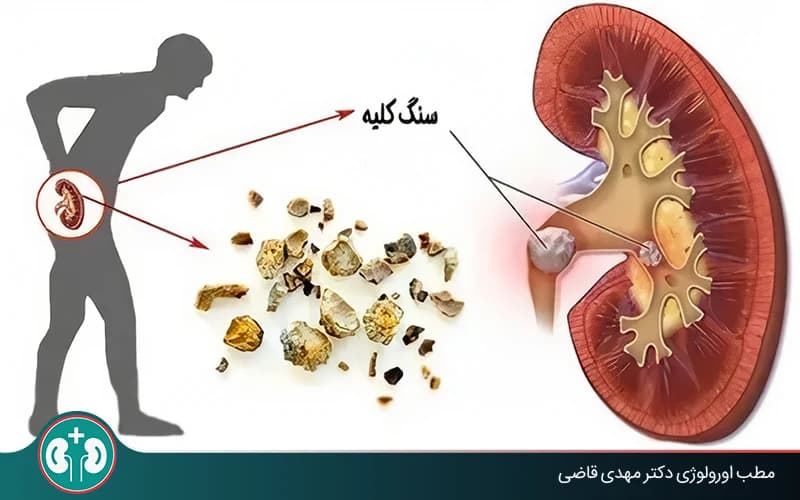
When a kidney stone separates from kidney tissue and enters the urine drainage pathway, meaning the urinary tract, it may become stuck in a part of this pathway called the ureter This requires prompt follow-up because it may block the flow of urine, which can become an emergency.
The ureter is a narrow muscular tube that carries urine from the kidney to the bladder. Small stones can often pass through this pathway, but larger stones may stop at one of the three common narrowing points where stones lodge:
Kidney and ureteral stone treatment: ESWL, laser and PCNL Kidney stone lithotripsy in Mashhad
Note: To improve care quality and patient satisfaction, appointments are triaged by reason for visit. Each physician sees patients within the relevant urology subspecialty.
Book appointment
where the renal pelvis joins the ureter;
the middle part of the ureter, where it crosses over the main pelvic arteries, the iliac vessels;
where the ureter enters the bladder.
When a stone becomes stuck at these points, the ureter contracts to move it forward. These strong muscular contractions occur while the stone is a hard, sharp object. This can irritate pain receptors in the ureter wall and cause sharp, severe flank pain. The pain is usually wave-like and may radiate to the lower abdomen, groin, or genital area.
Other symptoms include burning or frequent urination, blood in the urine (hematuria), nausea and vomiting, and, if infection is present, fever and chills. If urine flow through the ureter is completely blocked, pressure inside the kidney rises and there is a risk of kidney damage or kidney swelling (hydronephrosis).
If you develop sudden severe pain, fever, or a noticeable decrease in urine flow, you should see a doctor or go to the emergency department immediately. Delayed treatment can lead to severe kidney infection (pyelonephritis) or permanent damage to kidney tissue. Treatment depends on the size and location of the stone and may include medication, lithotripsy, or endoscopic surgery.
Appointments related to Kidney and ureteral stone treatment: ESWL, laser and PCNL Kidney stone lithotripsy in Mashhad
Open the public booking path to review times and related information.
Book appointment
Q&A — Kidney and ureteral stone treatment: ESWL, laser and PCNL Kidney stone lithotripsy in Mashhad
General questions are shown on the destination page after review.
Book appointment
Actions & related links
Doctors for this topic in Mashhad
See all doctors: Best Kidney Stone Doctors in Mashhad




About the author

Urologic Surgeon
دکتر مهدی قاضی, Urologic Surgeon in Mashhad. Articles on this site are written and reviewed under the supervision of the Urology Building's physicians.
View profile & bookRelated articles
All articlesWhat Is Polycystic Kidney Disease? (Fetal and Adult PKD)
دکتر مهدی قاضی · June 26, 2026
What Is a Renal Cortical Cyst? Symptoms, Diagnosis, and Treatment
دکتر مهدی قاضی · June 26, 2026
Kidney Transplant: Cost, Blood Type Compatibility, and Surgical Method
دکتر مهدی قاضی · June 26, 2026
What Is Pyelonephritis? Kidney Infection Symptoms, Diagnosis, and Treatment
دکتر مهدی قاضی · June 26, 2026
Comments
0 comments
No comments yet. Be the first to share your thoughts.