
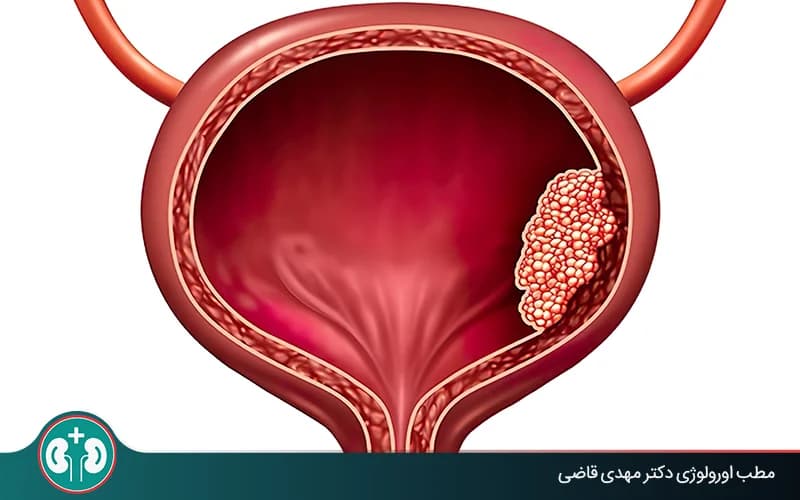
 Tap to zoom
Can Bladder Cancer Be Cured? Recovery Chances Explained
Bladder cancer can sometimes be cured, especially when diagnosed early. Recovery depends on stage, tumor type, treatment, and follow-up.
- نویسنده
- دکتر مهدی قاضی
- Published on
- June 26, 2026
- Reading time
- 5 min read
- Last updated
- Updated: July 20, 2026
Can bladder cancer be cured? The main concern of people who ask this question is whether bladder cancer treatments are effective and useful. A definite answer depends on several factors, including the stage at which the cancer is diagnosed, the type of treatment, the skill and expertise of the medical team, and how the patient’s body responds to treatment.
Bladder cancer treatments are varied and include surgery, chemotherapy, immunotherapy, and radiotherapy. Depending on the patient’s condition, each of these methods can help control or eradicate the disease. Timely diagnosis and choosing the best treatment combination with a specialist’s guidance are also very important in cancer treatment.
In this article, we discuss definitive treatment methods for bladder cancer and explain under what conditions a cure for bladder cancer may be possible. If you would like scientific and accurate information about bladder cancer treatment, stay with us until the end of this article.
Bladder infection, overactive bladder, incontinence and bladder tumours Bladder disease treatment in Mashhad
Note: To improve care quality and patient satisfaction, appointments are triaged by reason for visit. Each physician sees patients within the relevant urology subspecialty.

Book appointment
Can bladder cancer be cured?
In the early stages of the disease, when the tumor has not yet spread to the deeper layers of the bladder or to other organs, a definitive cure for bladder cancer may be possible with methods such as surgery or a combination of surgery and additional treatments such as chemotherapy or immunotherapy. In this situation, the chance of recovery and even eradication of the disease is very high, and many patients return to normal life after treatment.
When cancer reaches more advanced stages, it may invade the bladder wall or metastasize to other organs, making treatment more complicated. In these cases, the goal of treatment is usually to control the disease, reduce symptoms, and increase the patient’s lifespan, and a definitive cure may not be possible.
In advanced bladder cancer, treatments such as bladder cancer chemotherapy, radiotherapy, or immunotherapy can help improve quality of life and slow disease progression, but the chance of completely eradicating the cancer is lower at these stages.
With this in mind, it can be said that in some patients, especially in early stages, a definitive cure for bladder cancer is possible. In more advanced stages, however, it depends on several factors, including cancer type, the body’s response to treatment, and the expertise of the medical team. Early diagnosis remains the most important key to increasing the chance of curing bladder cancer.
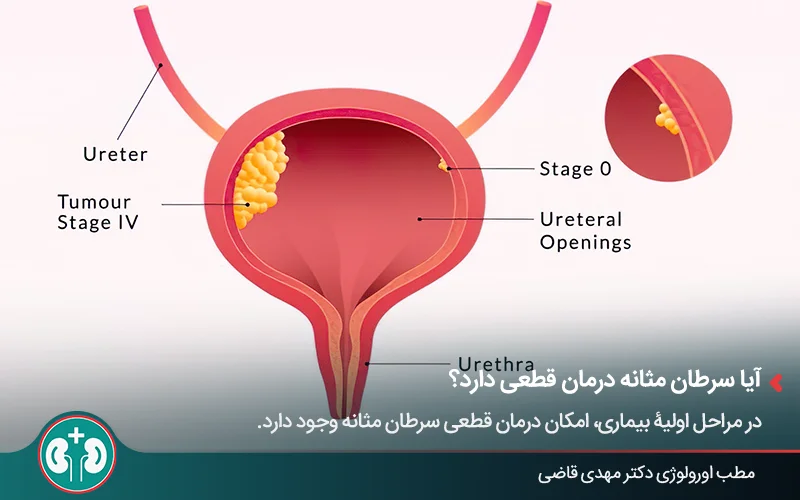
Everything about bladder cancer treatment; examining whether bladder cancer can be cured
Bladder cancer treatment is chosen based on the stage of the disease, the patient’s overall health, and tumor type. Fortunately, today there are various methods that help doctors manage the disease in both early stages and more advanced conditions. In this section, we first discuss the main and common treatments for bladder cancer and then talk about newer bladder cancer treatments.
Main treatments for bladder cancer
Bladder cancer treatment is usually chosen as a combination of methods according to each patient’s specific condition. The main bladder cancer treatments include the following:
Bladder cancer surgery
Bladder removal in bladder cancer is the main treatment for this disease. To remove superficial tumors, TURBT, or transurethral resection of bladder tumor, is used. Note that this method is minimally invasive and does not require opening the abdomen.
For more invasive cancers that have entered the muscular wall of the bladder, cystectomy surgery, meaning complete or partial removal of the bladder, or treatment of invasive bladder cancer, is performed.
Chemotherapy
In this method, strong medicines are used to destroy cancer cells. Chemotherapy may be used before surgery to shrink the tumor, after surgery to destroy remaining cells, or independently in advanced cancers.
Bladder cancer immunotherapy
This treatment helps the body’s immune system identify and destroy cancer cells. The BCG vaccine is one of the most common types of immunotherapy; it is injected directly into the bladder and is used to treat superficial bladder cancers.
Radiotherapy
In this method, high-energy radiation is used to destroy cancer cells. Radiotherapy is usually used together with chemotherapy and for patients who cannot undergo surgery.
Newest bladder cancer treatment methods
Scientific advances have introduced new options for bladder cancer treatment. Bladder cancer gene therapy, aimed at correcting or changing genes in cancer cells to stop their growth, is under investigation. In addition, some bladder cancer vaccines have been designed to activate the immune system specifically against bladder cancer cells.
Participation in clinical trials is also an opportunity to access the newest medicines and bladder cancer treatment methods that are not yet widely available. International organizations such as WHO, the World Health Organization, and NCI, the U.S. National Cancer Institute, play important roles in monitoring and developing these new methods.
These advances have created new hope for patients with bladder cancer and for people concerned about developing this disease. However, more research is still needed to prove the definitive effectiveness of these new methods.
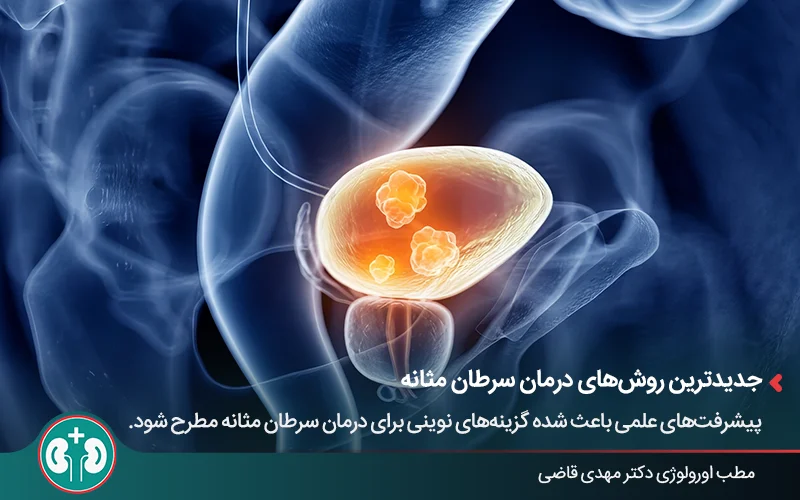
Can bladder cancer be treated forever?
In this section, we want to answer an important question: can bladder cancer be treated in a way that reduces the risk of recurrence to the lowest possible level? In general, definitive treatment of bladder cancer, complete elimination of cancer cells, and prevention of their return are more possible in early and superficial stages. In more advanced stages, however, different treatment methods can still be used to control the disease and improve patients’ quality of life.
Some people want to know whether the chance of bladder cancer recurrence can be reduced to zero. The answer is not simple, because this disease has a particular behavior and may recur even after successful treatment. The prognosis of bladder cancer depends on several factors, and patients’ life expectancy depends on the stage of the disease, type of treatment, and individual circumstances.
Bladder cancer prognosis means that the doctor predicts the chance of treatment success, the patient’s lifespan, and the possibility of recurrence based on disease stage, tumor type, general health, and treatment method. In simpler terms, prognosis means estimating whether the disease can be completely treated, how much chance there is to control or suppress it, and how long and how well the patient may live with treatment.
Factors that affect treatment success
Success in bladder cancer treatment is affected by several key factors. In this section, we review them:
Disease stage
The stage, or degree of cancer advancement, is the most important prognostic factor. Cancers diagnosed in early stages that have not invaded the muscular wall of the bladder, known as superficial bladder cancer, have a higher chance of cure. In contrast, cancers that have spread to deeper bladder layers or other organs are harder to treat and have a higher chance of recurrence.
Type of cancer
The type of cancer cells also affects prognosis. The most common type is transitional cell carcinoma, or TCC.
Transitional cells are the cells that line the inner surface of the bladder and naturally stretch when the bladder fills and empties. For this reason, this type of cancer accounts for the largest share of bladder cancers. Fortunately, many TCC cases are diagnosed in early stages, and in this situation the prognosis is relatively good.
Patient’s general health
Overall health, age, and underlying diseases determine the patient’s ability to tolerate aggressive treatments such as surgery or chemotherapy.
Choosing the right treatment method
Choosing the right treatment method, such as surgery, chemotherapy, immunotherapy, or radiotherapy, based on accurate diagnosis and patient characteristics, plays a vital role in treatment success.
What factors cause bladder cancer to return? Risk of bladder cancer recurrence
The risk of bladder cancer recurrence exists even after successful treatment. This recurrence may occur in the original site, the bladder, or in other parts of the body.
Factors such as advanced disease, bladder tumor type, whether superficial or invasive, presence of multiple tumors, incomplete or inadequate treatment, lack of regular follow-up after treatment, and an unhealthy lifestyle such as smoking increase the risk of bladder cancer recurrence. Therefore, after treatment, patients should remain under medical supervision and take periodic tests and ultrasounds seriously and do them regularly.
Keep in mind that, in general, early diagnosis and appropriate treatment of bladder cancer greatly increase the chance of complete treatment and longer survival.
Which doctor should you see for bladder cancer treatment?
The first specialist you should see for bladder cancer treatment is a urologist. Urologists specialize in diagnosing and treating diseases of the bladder, kidneys, and urinary tract and are usually primarily responsible for surgeries and bladder tumor removal. Of course, bladder cancer treatment is usually done with cooperation among several specialists:
Urologist for diagnosis, surgery, and overall disease management
Oncologist (cancer specialist) for chemotherapy or immunotherapy
Radiation oncologist for radiotherapy when needed
Pathologist and radiologist for detailed tissue evaluation and imaging
In simple terms, the starting point for bladder cancer treatment is the urologist, but depending on the stage of disease, the urologist may also refer the patient to other specialists so the best treatment method can be chosen.

Survival statistics and life expectancy in patients with bladder cancer
Based on NCI/SEER data and the American Cancer Society (American Cancer Society), the “5-year relative survival rate” in bladder cancer depends on disease stage. For people whose cancer is only in situ, survival is reported at about 97-98 percent.
If the cancer is localized and limited to the bladder, survival is about 72-73 percent; at the regional stage it is about 40-41 percent; and at the distant or metastatic stage it is about 9 percent. All stages combined are estimated at about 78 percent. These figures were reported from U.S. population registries for 2014 to 2020.
Bladder cancer status | Chance of being alive 5 years after diagnosis |
|---|---|
Cancer only in the superficial layer (In Situ) | About 97 percent |
Cancer limited to the bladder (Localized) | About 72 percent |
Cancer spread to nearby areas (Regional) | About 40 percent |
Spread to distant sites (Distant/metastasis) | About 9 percent |
Average of all stages (all patients) | About 78 percent |
Summary
In this article, we tried to answer the question: can bladder cancer be cured? We also discussed the main treatments for bladder cancer and new treatment methods for this disease, and reviewed survival statistics and life expectancy in patients with bladder cancer.
We learned that bladder cancer can be completely treated in early stages, but in more advanced stages the chance of recurrence is high and treatment becomes more complicated. Choosing a specialist, determining the best treatment method based on the patient’s condition, and regular follow-up after treatment play essential roles in success and preventing recurrence.
To learn the best treatment method for their own condition, patients should consult an experienced urologist. In addition, for accurate and comprehensive information about bladder cancer, how it is diagnosed, and how it is treated, we recommend reading the comprehensive article on bladder cancer.
Frequently asked questions
Actions & related links
Doctors for this topic in Mashhad
See all doctors: Best Doctors for UTI & Urinary Incontinence in Mashhad




About the author

Urologic Surgeon
دکتر مهدی قاضی, Urologic Surgeon in Mashhad. Articles on this site are written and reviewed under the supervision of the Urology Building's physicians.
View profile & bookRelated articles
All articlesWhat Is Polycystic Kidney Disease? (Fetal and Adult PKD)
دکتر مهدی قاضی · June 26, 2026
What Is a Renal Cortical Cyst? Symptoms, Diagnosis, and Treatment
دکتر مهدی قاضی · June 26, 2026
Kidney Transplant: Cost, Blood Type Compatibility, and Surgical Method
دکتر مهدی قاضی · June 26, 2026
What Is Pyelonephritis? Kidney Infection Symptoms, Diagnosis, and Treatment
دکتر مهدی قاضی · June 26, 2026
Comments
0 comments
No comments yet. Be the first to share your thoughts.