
 Tap to zoom
Herbal Remedies for Kidney Pain: A Scientific Look at Benefits and Risks
Herbal remedies may offer only limited supportive relief for kidney or flank pain and cannot replace medical care for stones, infection, or urinary obstruction. Learn the evidence, risks, and when to see a urologist.
- نویسنده
- دکتر مهدی قاضی
- Published on
- June 26, 2026
- Reading time
- 5 min read
- Last updated
- Updated: September 4, 2026
When people develop kidney pain, it is natural to worry about the side effects of conventional medicines and to look for an herbal remedy for relief.
We understand that concern, but it is important to know from the start that medicinal herbs can only play a supportive role. In conditions such as kidney infection or urinary obstruction, they are not a substitute for medical treatment.
Kidney and ureteral stone treatment: ESWL, laser and PCNL Kidney stone lithotripsy in Mashhad
Note: To improve care quality and patient satisfaction, appointments are triaged by reason for visit. Each physician sees patients within the relevant urology subspecialty.
Book appointment
Our goal in this article is not simply to list herbal teas for kidney pain. We want to review the benefits and risks of these approaches scientifically. Before using any herbal remedy for kidney pain, read these points so you do not harm your kidneys.
What Causes Kidney Pain?
If you have flank pain, the first step is to identify the exact cause with help from a urologist.
Urinary stones, especially ureteral stones, and kidney infection are among the most common and important causes of this pain, but they are not the only causes. Even so, knowing the difference between these two matters because their treatments are completely different.
Appointments related to Kidney and ureteral stone treatment: ESWL, laser and PCNL Kidney stone lithotripsy in Mashhad
Open the public booking path to review times and related information.
Book appointment
Pain caused by a stone is usually severe and fluctuating, coming and going in waves. With a kidney infection, the pain is often steady and persistent and is usually accompanied by fever.
For this reason, treating kidney pain with painkillers alone is not enough. Choosing the right treatment depends on accurately diagnosing the cause of the pain. With that in mind, let us review the causes of kidney pain:

Kidney and Ureteral Stones (Renal Colic)
Renal colic occurs when a stone blocks the urinary tract, especially the ureter, increasing pressure inside the kidney and stretching the renal capsule. In this situation, the pain is usually severe, fluctuating, and wave-like, and it may radiate to nearby areas.
Q&A — Kidney and ureteral stone treatment: ESWL, laser and PCNL Kidney stone lithotripsy in Mashhad
General questions are shown on the destination page after review.
Book appointment
The important point is that many stones located inside the kidney usually do not cause symptoms. Severe kidney-stone pain often begins when a stone starts leaving the kidney and enters the ureter.
Kidney Infection (Pyelonephritis)
In a kidney infection, the source of pain is inflammation and bacterial infection of kidney tissue, not blockage of the urinary tract. For this reason, the pain is usually steady and continuous and is often accompanied by fever, chills, fatigue, and other urinary tract infection symptoms such as burning or frequent urination.
Urinary Tract Obstruction
Anything that prevents normal urine drainage, such as a stone, ureteral stricture, or enlarged prostate, can increase pressure inside the kidney and cause flank pain. This obstruction may develop gradually or suddenly and, if it persists, can damage the kidney.
Herbal and Home Treatment for Kidney Pain: Complementary or Alternative?
At best, herbal treatment is a complementary approach for kidney pain, not an alternative treatment. Complementary care may help reduce symptoms alongside medical treatment, but it is not meant to replace antibiotics, specialist medications, or medical procedures.
Scientific evidence on kidney pain shows that herbal and home methods have, at best, a supportive role, especially when the cause is a kidney stone or kidney infection.
Many herbs mentioned in traditional medicine for kidney pain either lack enough scientific support or contain active ingredients that cannot be measured and adjusted reliably. This means you cannot count on their therapeutic effect or be sure they are safe. For this reason, relying completely on these methods can delay effective treatment.
With these explanations and facts in mind, we can now look at home remedies for kidney pain:
Hydration
Among all home methods, the option with the strongest scientific support is drinking enough water.
When you drink enough water, the urine becomes more diluted and its volume increases. Scientifically, when daily urine output reaches about 2.5 liters or more, the body uses a natural flushing mechanism. This process may help small stones pass and may allow stone-related colicky pain to settle sooner.

Foods and Medicinal Herbs
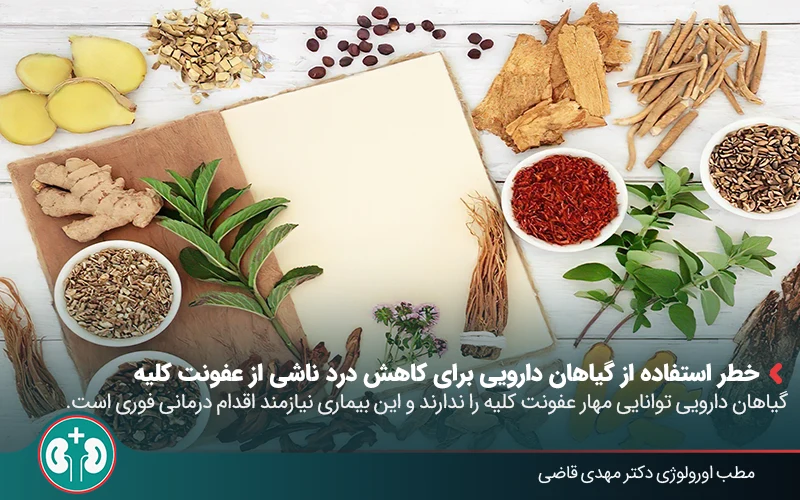
Traditional medicine claims that some herbs may help kidney pain because they increase urination, reduce inflammation, or relax the urinary tract. However, these effects are often only claims, and even if they exist, they are usually limited and mild and do not play a decisive role in acute situations.
Below, we look more closely at some of these foods and medicinal herbs:
Camelthorn (Alhagi)
In traditional medicine, this plant is said to have diuretic properties and to relax the ureteral muscles, which may help shorten the time needed for a stone to pass.
Limited scientific studies suggest that camelthorn may have mild diuretic and antispasmodic effects, but there is no reliable evidence showing that taking it can dependably reduce kidney-stone pain or effectively speed stone passage.
Puncture Vine (Tribulus terrestris)
In traditional sources, puncture vine is described as a plant that increases urine volume and reduces inflammation. Scientifically, there are reports of increased urine flow after consuming its distillate, but this effect is usually limited and has no proven therapeutic impact.
High-dose or long-term use of puncture vine has been associated with reports of kidney injury.
Maidenhair Fern
Traditional medicine says that maidenhair fern may help relax the muscles of the urinary tract, making stone passage easier and reducing the severity of renal colic. However, there is no reliable scientific evidence for this.
In practice, it is not clear whether the amount of active ingredient entering the body with usual use is enough to produce such an effect; for this reason, it may be ineffective in many cases.
Rosemary
Rosemary is best known for its anti-inflammatory and antioxidant compounds. Scientifically, these compounds may help reduce swelling, or edema, caused by a stone or by stone-fragmentation treatment, but rosemary has a limited role in directly reducing kidney pain, and you should not expect a major effect.
Nettle and Corn Silk Combination
According to traditional medicine practitioners, nettle and corn silk may slightly increase urine output and reduce mild inflammation around the kidney. For this reason, some people use this combination for kidney pain.
The reality, however, is that even if such an effect exists, it is usually weak and limited, and this combination by itself cannot resolve kidney pain or kidney stones.
Black Seed
Black seed contains a substance called thymoquinone. In some laboratory, non-human studies, this substance has shown pain-relieving and antispasmodic effects and could theoretically help reduce the severity of renal colic pain.
The important point is that the amount of this substance in the plant is not precise or adjustable, so it is not possible to say with confidence that using it is both effective and safe.
Espand (Syrian Rue)
Espand contains alkaloids with central and peripheral pain-relieving effects and, in theory, could reduce the severity of intense kidney pain. However, the gap between a medicinal dose and a toxic dose of espand is very small. For this reason, using it for kidney pain can be dangerous.
The Danger of Using Medicinal Herbs to Reduce Pain from Kidney Infection
If flank pain is caused by a kidney infection, the situation is completely different. In this setting, using herbs is very risky and can take away the opportunity for timely treatment. Medicinal herbs cannot control a kidney infection, while this condition requires urgent medical care and antibiotics.
If medicinal herbs are used while scientific treatment is ignored, the infection may spread to the bloodstream. Delayed treatment can also lead to permanent kidney damage.
How Effective Is Cranberry for Preventing Kidney Infection?
Cranberry contains substances called proanthocyanidins. These compounds are said to make it harder for E. coli bacteria to stick to the bladder wall and, in this way, may reduce the chance of a urinary tract infection. However, scientific reviews show that cranberry prevention is not certain or firmly proven, and it should not be relied on with confidence.
At best, cranberry may have a limited preventive role in simple urinary tract infections, but it has no role in treating kidney infection or the pain caused by it. A kidney infection is an active infection of kidney tissue that requires medical care and antibiotics, and treatment should not be delayed.
Note: Cranberry, especially in concentrated forms or high-strength supplements, contains a high amount of oxalate. Excessive intake may increase the risk of calcium oxalate stones, especially in people with a history of kidney stones.
Why Are Herbal and Traditional Methods Not Recommended?

Kidney pain can have several causes, such as kidney stones, kidney infection, or urinary obstruction, and missing the diagnosis or delaying proper treatment can have serious, irreversible consequences. Each condition needs its own specific medical approach.
On the other hand, there is no strong, reliable scientific evidence that traditional methods are effective. Research findings on medicinal herbs are often contradictory and do not show consistent results. Even in studies that report effects, these methods have usually been weaker than standard medical treatments.
In addition, most studies have been done in animals or on a small scale, not in real-world human patient settings. The dose of active ingredient in herbs is also unknown and cannot be adjusted reliably, which can make them ineffective or even toxic.
Summary
Throughout the article, you saw that herbs such as camelthorn, puncture vine, maidenhair fern, rosemary, nettle and corn silk, black seed, espand, and cranberry are mostly discussed based on traditional experience or limited evidence.
Even if these herbal remedies have any effect on relieving kidney pain, that effect is usually mild, uncertain, and unpredictable. Their dose is not clear, and you cannot be sure they will be effective or safe for you.
The main problem is that kidney pain is often a sign of a more serious issue, such as a stone, infection, or urinary obstruction. If you rely only on herbal remedies in this situation, the pain may ease a little, but the underlying problem can remain and even get worse.
If you are dealing with kidney pain, herbal methods may be slightly helpful at best, but they cannot replace an accurate diagnosis, evidence-based treatment, and medical follow-up. The best step is to see a urologist.
Frequently Asked Questions
Actions & related links
Doctors for this topic in Mashhad
See all doctors: Best Kidney Stone Doctors in Mashhad




About the author

Urologic Surgeon
دکتر مهدی قاضی, Urologic Surgeon in Mashhad. Articles on this site are written and reviewed under the supervision of the Urology Building's physicians.
View profile & bookRelated articles
All articlesWhat Is Polycystic Kidney Disease? (Fetal and Adult PKD)
دکتر مهدی قاضی · June 26, 2026
What Is a Renal Cortical Cyst? Symptoms, Diagnosis, and Treatment
دکتر مهدی قاضی · June 26, 2026
Kidney Transplant: Cost, Blood Type Compatibility, and Surgical Method
دکتر مهدی قاضی · June 26, 2026
What Is Pyelonephritis? Kidney Infection Symptoms, Diagnosis, and Treatment
دکتر مهدی قاضی · June 26, 2026
Comments
0 comments
No comments yet. Be the first to share your thoughts.