 Tap to zoom
Skin growths on the circumcision site: causes, diagnosis, and safe treatment
Skin growths on the circumcision site are relatively common and usually harmless. Learn what causes them — from scarring and skin irritation to benign cysts and genital warts (HPV) — and how a urologist diagnoses and safely treats them.
- نویسنده
- دکتر مهدی قاضی
- Published on
- June 26, 2026
- Reading time
- 5 min read
- Last updated
- Updated: July 20, 2026
Bumps in the genital area, or lesions on the circumcision site, are a relatively common phenomenon. These lesions may develop for a variety of reasons, such as a normal skin reaction, inflammation, viral infection, physical irritation, or complications of circumcision. In some cases these skin changes are harmless and transient, but at times they can be a sign of a disease or infection that requires evaluation.
Fortunately, in most cases these lesions are harmless and can be removed with the specialized methods available. After an examination and the necessary evaluations, a urologist can diagnose the underlying cause of the lesion and prescribe a beneficial, effective treatment.
In this article, we intend to discuss the types of lesions on the circumcision site, examine their causes, and see how they differ from one another. Stay with us to learn more about these lesions and how excess penile skin is removed.


An overview of lesions on the circumcision site and their causes
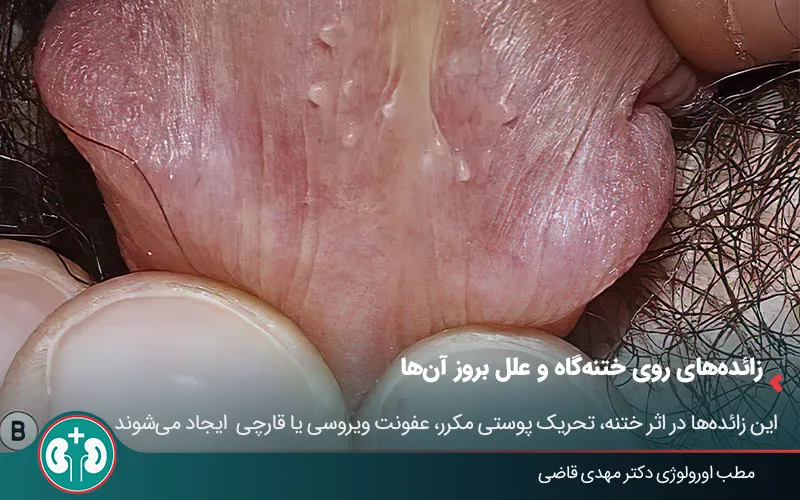
Lesions on the circumcision site are small, soft skin growths that develop on the penis after circumcision or as a result of repeated irritation or viral (HPV) and fungal infections. The skin of the circumcision site is very thin and sensitive, and any inflammation, friction, or incomplete healing can cause excessive growth of skin tissue at the incision site. Below, we will review the common causes of these lesions.
1. Wound healing and scarring
After circumcision, the body produces fibrous tissue to heal the incision site. In some people, this tissue can grow raised and denser than usual, taking on an appearance resembling a lesion or excess flesh.
Raised lesions resulting from circumcision usually appear due to excessive wound healing or repeated friction with clothing. These lesions pose no health risk, are not contagious, and are mostly bothersome only in terms of appearance.
2. Repeated irritation and inflammation
Intense rubbing or chronic inflammation can irritate the sensitive skin of the circumcision site and lead to the growth of superficial lesions. This irritation usually appears as small or dark-colored bumps.
Brown or dark lesions may arise from these same skin irritations or from pigment changes. If these lesions are accompanied by itching or a gradual increase in size, they require specialist evaluation.
3. Viral infections (such as HPV) and fungal infections
Infection with HPV or fungal infections is another common cause of lesions on the circumcision site. These lesions may appear as small, dark-colored bumps or with a rough, irregular surface.
In viral cases such as genital warts, the lesions can gradually spread. Accurate diagnosis of this type of lesion requires examination by a urologist and sometimes laboratory testing.
4. Residual foreskin (incomplete circumcision)
If circumcision is performed incompletely and part of the foreskin remains, this area may become raised or wrinkled over time, which is why this skin looks like a lesion.
Lesions caused by incomplete circumcision are usually painless and benign, but they may be cosmetically unpleasant. If the lesions enlarge or change in appearance, you should see a urologist for an examination and specialist evaluation.
5. Benign skin conditions
In some cases, lesions such as pearly penile papules or skin tags may appear on the circumcision site. These lesions are often benign and have no connection to sexually transmitted infections, but they may be mistaken for genital warts or excess flesh.
6. Dead skin cells or harmless subcutaneous lumps
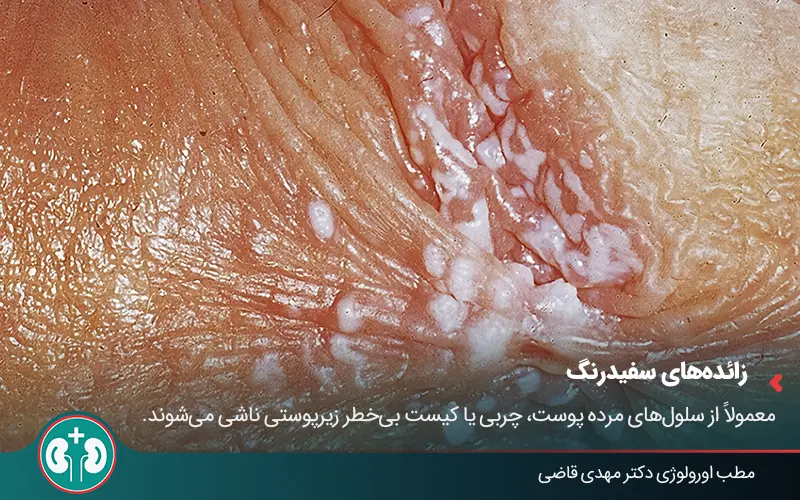
White-colored lesions on the circumcision site usually result from a buildup of dead skin cells, subcutaneous fat, or small harmless cysts. These lesions are soft and painless unless they become inflamed or infected. If inflammation or white discharge occurs, a fungal or bacterial infection may be present, which requires medical treatment.
Examining the difference between genital warts and excess flesh on the circumcision site
Distinguishing genital warts from other lesions of the circumcision site is very important. Conditions such as residual foreskin, scarring, and skin tags are non-contagious and harmless lesions; however, genital warts are caused by infection with the human papillomavirus (HPV) and are highly contagious. In the table below, we compare the symptoms, cause, and complications of genital warts with those of other lesions on the circumcision site.
Comparison table of genital warts versus skin lesions on the circumcision site | ||
Characteristic | Skin lesions on the circumcision site | Genital warts caused by HPV |
Cause | Excessive skin growth, wound healing, or incomplete circumcision (non-viral) | Infection with the HPV virus |
General appearance | Round and soft, attached to the skin by a narrow base | Can be smooth and flat, raised and firm, or cauliflower-shaped and uneven |
Color | Same color as the skin or slightly darker (light to dark brown) | Usually skin-colored, pink, or brown |
Surface | Soft, flexible skin that bends easily when pressed | Rough, coarse, and firm (although it may be smooth at first) |
Pain and itching | Usually without pain or itching, except as a result of repeated friction | May be accompanied by itching and burning |
Contagiousness | Non-contagious | Contagious and transmitted mainly through sexual contact |
An important point when distinguishing genital warts from other lesions on the circumcision area is that individuals may not be able to correctly identify the type of lesion themselves. The best course of action is to see a urologist so that, after the necessary evaluations, the specialist can determine the nature of the lesion.
Methods for diagnosing lesions on the circumcision area
After noticing skin lesions in the circumcision area, you should see a urologist to carry out the necessary evaluations to determine the cause of the lesions. These lesions may be a simple scar, excess tissue resulting from incomplete circumcision, or genital warts. Specialists follow a specific process to determine their nature. Below, we review the process of diagnosing lesions on the circumcision area:

1. Physical examination
As a first step, through a visual examination the physician pays attention to the shape, color, location, and texture of the lesion in order to identify common possibilities such as excess tissue after circumcision, genital warts, or skin inflammation. Physical examination is the most important step in the process of diagnosing the cause of lesions in the circumcision area, and experienced urologists can identify the type of lesion through physical examination.
2. Specialized tests such as the HPV test
If the physician suspects that the lesion is a genital wart, complementary tests are used for a definitive diagnosis. The HPV test (detection of human papillomavirus) via molecular sampling is the most important test that the urologist orders to confirm whether the patient is infected with this virus.
3. Tissue sampling or biopsy
If the lesion has an unusual appearance, grows rapidly, or does not respond to conventional treatments, the physician may perform a biopsy for a definitive diagnosis. In this method, a small portion of tissue is removed and sent to the laboratory for microscopic examination. This determines whether the lesion is merely excess tissue or a genital wart.
Treatment options for lesions on the circumcision area and circumcision revision in adulthood
The choice of treatment method for lesions on the circumcision area depends on whether the lesion is benign (such as excess tissue resulting from incomplete circumcision) or a viral lesion (such as a genital wart). Treatments are usually carried out with the aim of removing the lesion for cosmetic and hygienic purposes or to prevent the spread of infection. Below, we mention some of the most common methods for removing lesions or for circumcision revision in adulthood:
1. Cryotherapy
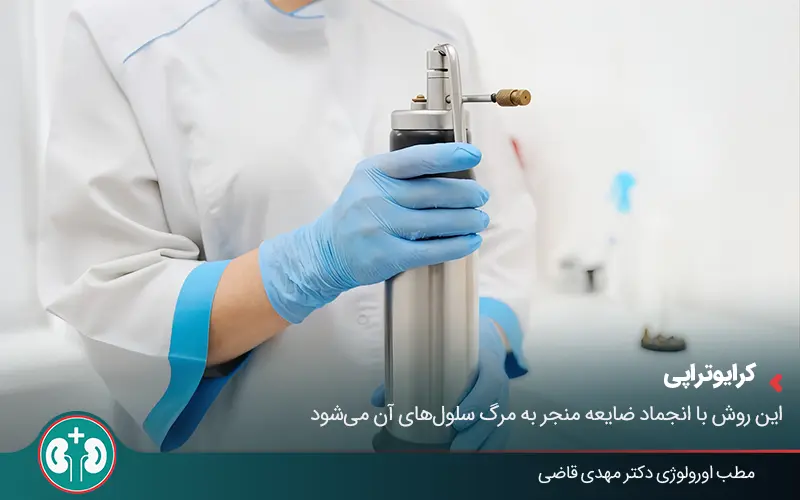
In this method, the lesion is frozen using liquid nitrogen. Freezing causes the death of the lesion's cells and the drying out of its tissue. As a result, after some time the skin lesion falls off. Cryotherapy is particularly practical and effective for treating genital warts.
2. Laser therapy
In this method, a focused beam of light is used to destroy or precisely cut the excess tissue. Laser therapy is minimally invasive and is used to remove various benign skin lesions as well as some genital warts.
3. Minor surgery for circumcision revision in adulthood
If the skin lesion results from incomplete circumcision or residual excess skin, circumcision revision in adulthood may be needed. In this method, the surgeon carefully removes the uneven skin or excess tissue and reconstructs the circumcision site so that the appearance and symmetry of the penis become more natural. This procedure is usually performed under local anesthesia and has a short recovery period.
Minor surgery is a reconstructive surgical procedure performed with the aim of improving the circumcision line, completely removing excess skin, or correcting adhesions that have formed. The end result of this surgery is a more attractive appearance and improved hygiene of the penis.
Necessary care after removing lesions on the circumcision area
The recovery period after removing lesions on the circumcision area is usually short, but observing a few simple points can prevent infection, inflammation, or the formation of excess tissue and can speed up the healing process. Below, we mention a few of the important care measures during the period after circumcision revision in adulthood:
Washing the surgical site regularly: You should clean the surgical site daily with lukewarm water and a mild soap or the prescribed cleansing solution. You should also avoid rubbing it with a towel or applying any pressure on the wound, and after washing, gently dry the area with a clean tissue.
Regular use of the prescribed antibiotic or healing ointment: The physician usually prescribes a specific antibiotic or healing ointment for the patient. Using it regularly reduces inflammation and prevents infection. Using medication on your own or applying home-made ointments can cause various problems.
Avoiding sexual contact or stimulation of the genital area until the wounds have healed: As long as the stitches have not been fully absorbed and pain and swelling persist, you should avoid sexual contact or stimulation of the genital area. It is best to consult a urologist about the appropriate time to resume sexual activity.
Wearing suitable underwear: Wearing cotton, loose, and clean underwear helps reduce friction. In case of excessive sweating, changing the underwear regularly is essential.
Informing the urologist if suspicious symptoms appear: If you notice severe redness, purulent discharge, an unpleasant odor, or unusual pain, inform the urologist immediately. A follow-up examination is usually performed one to two weeks after the procedure so that the urologist can assess your healing process.
When should you see a urologist to remove lesions on the circumcision area?

If the skin of the circumcision area is irregular and causes discomfort, bleeding, discharge, repeated irritation, or the skin getting caught during sexual intercourse, you should see a urologist. Likewise, in the case of HPV infection, genital warts need to be removed to reduce the likelihood of transmitting the virus to others. The presence of a lesion or excess tissue, retained stitches, or a change in color also requires evaluation.
In addition, if you suffer from premature ejaculation or have no control over the timing of ejaculation, circumcision revision may help improve the condition. Circumcision revision in adulthood can improve the quality of and satisfaction with sexual intercourse. In any case, determining the exact cause of the lesion is done only through a specialist examination, and its removal can improve the hygiene and appearance of the penis as well as sexual function.
Conclusion
Most lesions in the circumcision area are benign and harmless and usually arise due to skin healing, repeated irritation, or incomplete circumcision. However, some lesions can be a sign of HPV infection and genital warts and require careful evaluation. To accurately determine the type of lesion and its cause, you should see a urologist.
After determining the type of lesion and its cause, the urologist uses specialized minimally invasive methods to remove the lesion and improve the appearance of the penis. Also, if the lesion is a genital wart, the urologist removes it and points out care instructions to the patient in order to reduce the risk of transmitting the HPV virus to others.
In general, removing lesions on the circumcision area is not done solely to improve the appearance of the penis. It also helps enhance hygiene, reduce skin inflammation, increase comfort during sexual intercourse, and control ejaculation.
Frequently asked questions
Actions & related links
Doctors for this topic in Mashhad
See all doctors: Best Male Genital Warts Doctors in Mashhad



About the author

Urologic Surgeon
دکتر مهدی قاضی, Urologic Surgeon in Mashhad. Articles on this site are written and reviewed under the supervision of the Urology Building's physicians.
View profile & bookRelated articles
All articlesWhat Is Polycystic Kidney Disease? (Fetal and Adult PKD)
دکتر مهدی قاضی · June 26, 2026
What Is a Renal Cortical Cyst? Symptoms, Diagnosis, and Treatment
دکتر مهدی قاضی · June 26, 2026
Kidney Transplant: Cost, Blood Type Compatibility, and Surgical Method
دکتر مهدی قاضی · June 26, 2026
What Is Pyelonephritis? Kidney Infection Symptoms, Diagnosis, and Treatment
دکتر مهدی قاضی · June 26, 2026
Comments
0 comments
No comments yet. Be the first to share your thoughts.