 Tap to zoom
Bladder Diverticulum
A bladder diverticulum is an outward pouch in the bladder wall. It may be congenital or acquired and sometimes needs evaluation or surgery.
- نویسنده
- دکتر مهدی قاضی
- Published on
- June 26, 2026
- Reading time
- 4 min read
- Last updated
- Updated: June 26, 2026
A bladder diverticulum is a pouch that bulges outward from the bladder wall. It can be congenital or develop later in life. A congenital diverticulum forms when the bladder wall is weak and part of the inner lining of the bladder passes through the wall and bulges outward from the bladder like a bubble. Congenital diverticulum is often found incidentally during imaging studies in childhood, and the bladder usually contains one diverticulum. This condition generally does not require treatment.
Multiple bladder diverticula (more than 1 diverticulum) usually develop because of obstruction at the bladder outlet, such as prostate enlargement or urethral stricture, poor bladder function due to nerve injury, or, rarely, previous bladder surgery. Acquired diverticula are seen in adults, and the bladder often contains multiple diverticula, especially in older people who more commonly have bladder outlet obstruction due to prostate enlargement.
Symptoms of bladder diverticulum
In most cases, bladder diverticulum has no symptoms. These diverticula are usually found when doctors are evaluating the bladder for other urinary problems.
Some problems that may be associated with bladder diverticulum and may raise the need for surgery include:
Urinary tract infections
Bladder stone
Backflow of urine toward the kidneys (reflux)
Bladder tumors
Difficulty emptying urine from the bladder
Obstruction of the ureteral openings or the bladder outlet
Diagnostic methods for bladder diverticulum
Bladder diverticula can be diagnosed with X-ray imaging. During this imaging, the bladder is filled with contrast material, a substance that is clearly visible on X-ray, and then images of the bladder are taken. The diverticulum appears as a bubble outside the bladder and attached to it.
With cystoscopy, or bladder endoscopy, the doctor uses a long, thin camera to look inside the bladder. If a tumor has developed in the bladder diverticulum, the tumor will be visible. Urodynamic testing can help diagnose any obstruction by evaluating pressure inside the bladder and bladder function.
Ultrasound can also show the inside of the bladder and can help diagnose a possible obstruction and its effect on the kidneys.
Treatment of bladder diverticulum
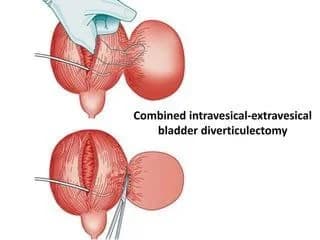
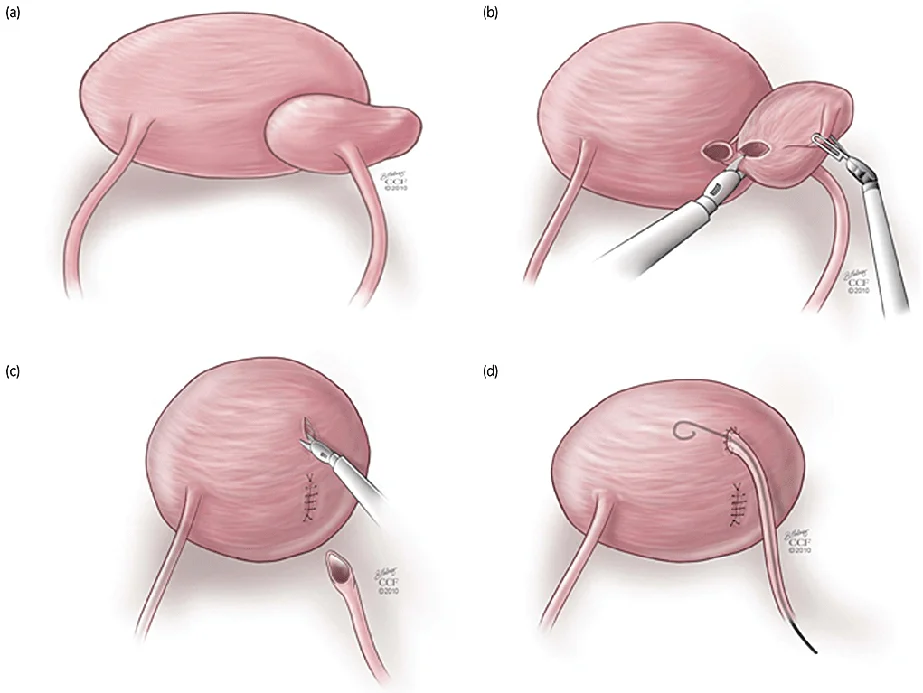
If the diverticulum causes obstruction in the bladder or ureters, surgery is needed, and treatment includes removal of the diverticulum or correction of the obstruction. Diverticulum surgery will be more difficult if severe infection and swelling are present.
In patients in whom removal of the diverticulum is not possible, the opening of the diverticulum into the bladder can be widened so that urine inside the diverticulum drains easily into the bladder. If a tumor is seen inside the diverticulum, a sample is taken to check for cancer.
If a bladder diverticulum does not cause any symptoms, it does not need treatment.
Follow-up after treatment
Treatment of bladder diverticulum is often effective and helps reduce symptoms. In some cases, after the cause of the diverticulum is corrected, such as bladder obstruction, you may not need further treatment. However, the urologist may occasionally use cystoscopy, meaning bladder endoscopy through the urethra, to check the diverticulum.
After surgery, you will need a catheter to drain the bladder for 1 or 2 weeks.
Some rare complications of diverticulum surgery include:
Injury to the bowel or ureter, the tubes that carry urine from the kidneys
Urine leakage from the bladder after surgery
Infection
In some cases, the diverticulum may need to be removed later with open surgery. In some people, the bladder does not empty well, and daily intermittent catheterization may be needed for proper bladder drainage.
Actions & related links
Doctors for this topic in Mashhad
See all doctors: Best Doctors for UTI & Urinary Incontinence in Mashhad




About the author

Urologic Surgeon
دکتر مهدی قاضی, Urologic Surgeon in Mashhad. Articles on this site are written and reviewed under the supervision of the Urology Building's physicians.
View profile & bookRelated articles
All articlesWhat Is Polycystic Kidney Disease? (Fetal and Adult PKD)
دکتر مهدی قاضی · June 26, 2026
What Is a Renal Cortical Cyst? Symptoms, Diagnosis, and Treatment
دکتر مهدی قاضی · June 26, 2026
Kidney Transplant: Cost, Blood Type Compatibility, and Surgical Method
دکتر مهدی قاضی · June 26, 2026
What Is Pyelonephritis? Kidney Infection Symptoms, Diagnosis, and Treatment
دکتر مهدی قاضی · June 26, 2026
Comments
0 comments
No comments yet. Be the first to share your thoughts.