
 Tap to zoom
How Long Do Patients With Bladder Cancer Live? Personal and Medical Factors
- نویسنده
- دکتر مهدی قاضی
- Published on
- June 26, 2026
- Reading time
- 5 min read
- Last updated
- Updated: July 20, 2026
Life expectancy in bladder cancer is not a fixed or definite number, because it depends on many factors. In many cases, the lifespan of patients with bladder cancer and their life expectancy can be much higher than global overall statistics. Factors that affect survival rate include:
Stage and extent of disease progression at the time of diagnosis;
Type of cancer, such as invasive or noninvasive bladder cancer;
The patient's lifestyle and general health;
Choice of treatment, such as surgery, chemotherapy, or immunotherapy
The patient's age and how their body responds to treatment.
In this article, we discuss the lifespan of patients with bladder cancer and review survival statistics in bladder cancer. Stay with us for more information about bladder cancer and life expectancy after this disease.
Definition of life expectancy in patients with bladder cancer
Life expectancy in patients with bladder cancer means the length of time patients are likely to live after diagnosis. Life expectancy in bladder cancer is reported based on statistics and medical experience.
Bladder infection, overactive bladder, incontinence and bladder tumours Bladder disease treatment in Mashhad
Note: To improve care quality and patient satisfaction, appointments are triaged by reason for visit. Each physician sees patients within the relevant urology subspecialty.

Book appointment
This concept is expressed with terms such as “5-year survival” or “relative survival.” Relative survival or 5-year survival shows what percentage of people with bladder cancer are still alive after a specified period from diagnosis, usually five years.
What is the survival rate in patients with bladder cancer?
Survival statistics are usually extracted from information on thousands of patients and from large datasets such as the US SEER database. This estimate may differ between countries. In addition, each person has unique circumstances that can affect the chance of bladder cancer recovery and lifespan.
The American Cancer Societyhas reported the 5-year survival rate for bladder cancer as 78%; in other words, on average, 78 out of every 100 patients with bladder cancer are alive five years after diagnosis.
This index is calculated based on population data and medical databases. Reputable institutions such as the American Cancer Society (ACS) and the US National Cancer Institute (NCI) publish these statistics regularly.
5-year bladder cancer survival rate by disease stage
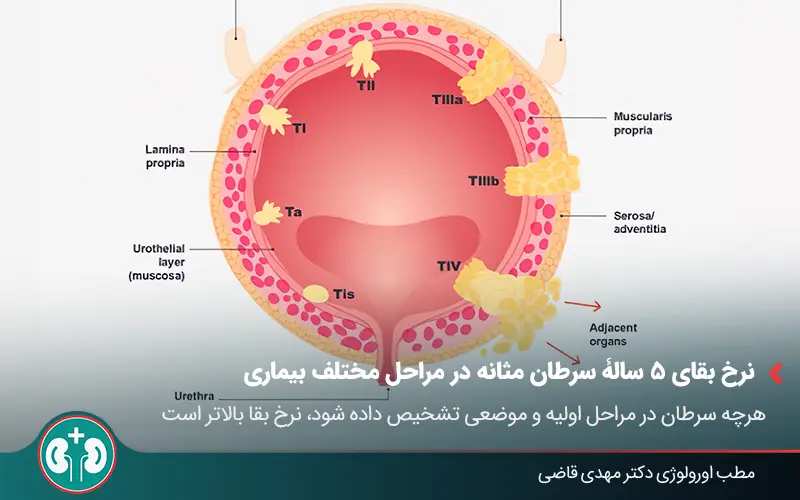
Survival statistics for patients with bladder cancer depend greatly on the disease stage at diagnosis. In general, the earlier and more localized the cancer is at diagnosis, the higher the survival rate. According to statistics from the American Cancer Society (ACS), 5-year survival rates for bladder cancer at different stages are as follows.
Bladder cancer stage | Description | 5-year survival rate |
|---|---|---|
Very early localized stage or carcinoma in situ | Limited to the superficial layer of the bladder, without invasion of deeper tissues | 97 percent |
Cancer limited to the bladder | Cancer has passed beyond the mucosal surface, invaded the submucosal layer or even the bladder muscle, and remains limited to the bladder | 72 percent |
Spread to nearby areas | Extension beyond the bladder, spread to surrounding tissues or nearby lymph nodes | 40 percent |
Metastasis to distant organs | Metastasis to distant organs such as liver, lung, and bone; metastasis to distant lymph nodes | 9 percent |
1. Very early localized stage or carcinoma in situ
At this stage, cancer cells exist only in the inner layer of the bladder, the bladder lining, and have not invaded deeper tissues. This is considered a noninvasive stage, and the chance of complete treatment at this stage is very high. The 5-year survival rate at this stage is 97 percent.
2. Cancer limited to the bladder
In this phase, the cancer crosses the mucosal surface and may have reached the submucosal layer or even the bladder muscle, but it has not yet gone beyond the bladder. The 5-year survival rate at this stage is 72 percent.
3. Spread to nearby areas
At this stage, cancer has passed through the bladder wall and spread to surrounding tissues such as fat around the bladder or nearby organs, the uterus in women and prostate in men, or to nearby lymph nodes. The 5-year survival rate at this stage is about 40 percent.
4. Metastasis to distant organs
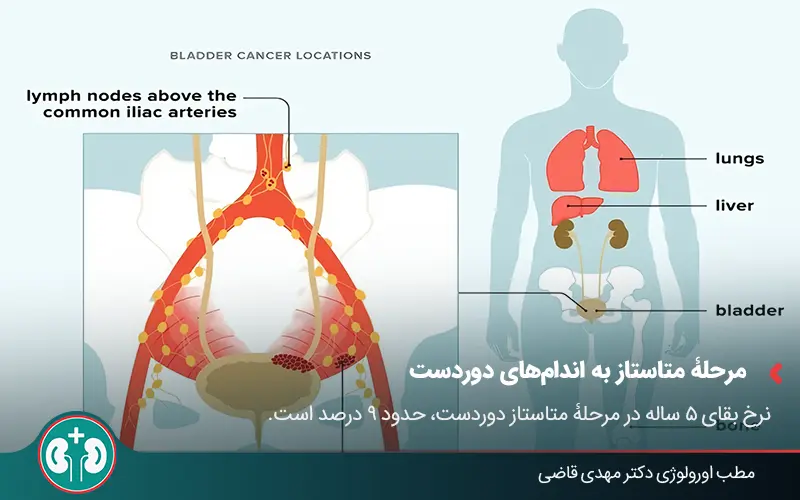
This is the most advanced stage of bladder cancer. At this stage, the tumor has metastasized to distant lymph nodes or distant organs such as lung, liver, or bone. The 5-year survival rate in distant metastatic disease is about 9 percent.
Bladder cancer prognosis and factors that affect it
Bladder cancer prognosis means evaluation of the patient's likelihood of recovery, lifespan, and quality of life after diagnosis. In fact, prognosis refers to prediction of the likely course and outcome of the disease. This prognosis is determined based on a set of medical and personal factors and helps physicians choose the best treatment pathway. Below we review the medical and personal factors affecting bladder cancer prognosis.
Extent of disease progression at diagnosis
The stage of bladder cancer is the most important factor determining bladder cancer prognosis. In early stages, when the cancer is limited to the superficial layers of the bladder, the chance of complete treatment and longer lifespan is high; but in more advanced stages, when the tumor has spread to nearby tissues or distant organs, the prognosis becomes poorer.
Tumor grade
This factor indicates how abnormal the cancer cells are and how quickly they grow.
Low-grade tumors grow more slowly and are less likely to spread to the bladder muscle or other parts of the body. These tumors usually have a better prognosis.
High-grade tumors are more aggressive and more likely to spread to other tissues.
Presence of metastasis
The greater the spread of the disease, the lower the chance of long-term control. When cancer spreads to organs such as the liver, lungs, or bones, controlling it becomes much more difficult and life expectancy decreases.
Personal factors affecting prognosis
In addition to medical factors, the patient's personal characteristics and lifestyle also affect bladder cancer prognosis. Below we review several influential personal factors:
1. Age:Younger patients respond better to treatment and have a higher chance of longer survival. In contrast, older adults usually have a poorer prognosis because of reduced physical reserve, underlying diseases, and lower tolerance for invasive treatments.
2. Sex:Some studies have shown that women often have more advanced bladder cancer at the time of diagnosis than men, and therefore may have a poorer prognosis than men.
3. General physical condition:The patient's overall health and underlying diseases such as diabetes or heart disease play an important role in prognosis. Patients with better physical capacity may also be able to receive combined or stronger treatments.
4. Lifestyle:Smoking cessation, healthy nutrition, regular exercise, and following medical recommendations can help improve quality of life and increase the chance of disease control. A balanced diet that includes fruits, vegetables, whole grains, and reduced processed meats can also help strengthen the immune system and improve treatment tolerance.
5. Psychological and social support: the level of stress, depression, or family support can affect quality of life and even adherence to treatment.
6. Economic status and access to medical care: better access to equipped centers and modern treatments improves prognosis.

Role of treatment methods in the lifespan of patients with bladder cancer
Choosing the appropriate treatment method plays an important role in increasing the lifespan of patients with bladder cancer. This choice is made based on the stage and type of cancer and the patient's overall health.
Surgery
The main treatment method, especially in early stages, is surgery. For noninvasive tumors, surgery is limited to removal of the tumor (TURBT), which is associated with a very high survival rate.
In more advanced stages, complete removal of the bladder, or radical cystectomy, is necessary. If all cancer cells are successfully removed, this method can substantially increase the lifespan of patients with bladder cancer.
Chemotherapy
Chemotherapy is often used in combination with surgery or radiation therapy. It can shrink the tumor before surgery or destroy remaining cancer cells. Its effect on survival depends on the type of cancer and the patient's body response.
Immunotherapy
This method helps the immune system fight cancer cells. In advanced bladder cancer, immunotherapy is considered an effective treatment option, especially after chemotherapy failure, and it may increase survival rates to a satisfactory degree.
Summary
In this article, we discussed the lifespan of patients with bladder cancer and reviewed the 5-year survival rate for these patients. As explained throughout the article, patients' prognosis and survival depend directly on the disease stage at diagnosis, tumor type, and selection of the appropriate treatment method.
We also noted that survival statistics, such as the 5-year survival rate, are only a general guide and should not be considered an absolute prediction for any individual. Personal conditions, such as age, general health, and the body's response to treatment, play an important role in determining the final outcome and lifespan of patients with bladder cancer.
Therefore, to receive accurate and personalized information, be sure to consult a urologist. By considering all your medical and personal factors, the urologist can provide the best prognosis and prescribe the most appropriate treatment plan for you.
Actions & related links
Doctors for this topic in Mashhad
See all doctors: Best Doctors for UTI & Urinary Incontinence in Mashhad




About the author

Urologic Surgeon
دکتر مهدی قاضی, Urologic Surgeon in Mashhad. Articles on this site are written and reviewed under the supervision of the Urology Building's physicians.
View profile & bookRelated articles
All articlesWhat Is Polycystic Kidney Disease? (Fetal and Adult PKD)
دکتر مهدی قاضی · June 26, 2026
What Is a Renal Cortical Cyst? Symptoms, Diagnosis, and Treatment
دکتر مهدی قاضی · June 26, 2026
Kidney Transplant: Cost, Blood Type Compatibility, and Surgical Method
دکتر مهدی قاضی · June 26, 2026
What Is Pyelonephritis? Kidney Infection Symptoms, Diagnosis, and Treatment
دکتر مهدی قاضی · June 26, 2026
Comments
0 comments
No comments yet. Be the first to share your thoughts.