
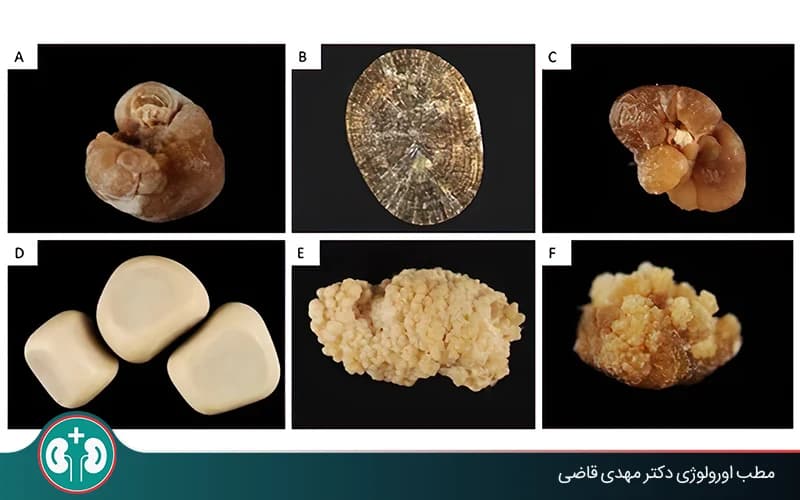
 Tap to zoom
Types of Kidney Stones by Color, Composition, Shape, and Size
Kidney stones differ by chemical composition, color, shape, and size. These features help guide prevention, recurrence risk, and when urgent treatment may be needed.
- نویسنده
- دکتر مهدی قاضی
- Published on
- June 26, 2026
- Reading time
- 5 min read
- Last updated
- Updated: July 20, 2026
Kidney stones have several types based on their composition, appearance, color, material, and size. Some of these differences mean that different types of kidney stones may have somewhat different complications and risks.
Clinically, symptom severity usually depends on the size and location of the stone and whether obstruction or infection is present. However, identifying the stone type is very important for preventing recurrence. Kidney stones can generally be divided into 4 groups: calcium stones, uric acid stones, struvite stones, and cystine stones.
Although stone type is an important factor, stone size and location are even more important in determining the treatment method. Small stones may pass naturally, but when large stones move from the kidney into the ureter, they can obstruct the urinary tract and, if neglected, may even lead to kidney damage.


Because this topic is important and kidney stones are diverse, this article reviews the different types of kidney stones so we can ultimately see which type is more dangerous and why. We will also introduce strategies to help prevent stones from forming again.
If you or a loved one may have kidney stones, or if you have a kidney that tends to form stones, follow this article to the end.
Why kidney stone characteristics matter in preventing recurrence
Although stone type, meaning its chemical composition, is not the main criterion for choosing treatment, it plays an important role in preventing recurrence. By analyzing the stone’s chemical components, the doctor can provide a precise plan for post-treatment care and recurrence prevention.
1. Managing the underlying cause of stone formation
Each type of kidney stone usually has one or more underlying causes. For example, some stones form because of dehydration and concentrated urine, while others result from an unbalanced or inappropriate diet. Some may also form because of underlying diseases such as gout or genetic disorders.
Therefore, the stone composition must first be identified so the doctor can determine the main cause of stone formation and then recommend ways to control it and reduce the chance of another stone forming.

2. Preventing stone precipitation
Alongside managing the underlying cause, there is also a complementary method to help prevent stones from forming again. The doctor may prescribe medicines that prevent or slow the precipitation of the substances that make up the stone.
These medicines are specific and are prescribed according to stone type. A medicine that helps prevent one type of stone may have no effect on another type or may even be harmful. For this reason, never take these medicines on your own.
Types of kidney stones by composition, or chemical makeup
One of the most important ways to classify kidney stones is by their composition or chemical makeup. As mentioned earlier, each stone type has a specific underlying factor, so recurrence-prevention strategies differ from one stone type to another.
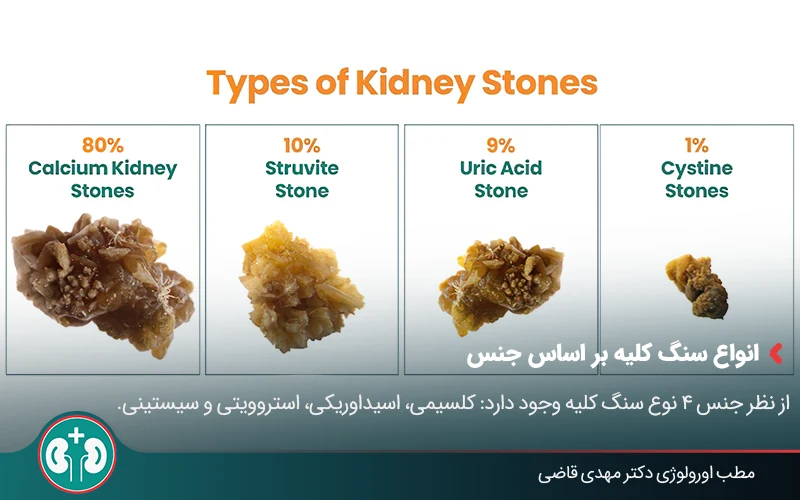
In general, there are four types of kidney stones by composition:
Calcium stones;
Uric acid stones;
Struvite, or infection-related, stones;
Cystine, or inherited, stones.
Below, each of these stones is reviewed separately in detail.
1. Calcium stones
Calcium kidney stones are the most common type of kidney stone. Contrary to common belief, calcium alone is not the cause of this type of stone. In fact, the way calcium interacts with other substances in urine is what leads to formation of these stones.
Calcium stones are divided into two main types, discussed separately below.
1. Calcium oxalate stones
Calcium oxalate stones form when oxalate or calcium levels in the urine are high and, at the same time, levels of substances such as citrate, which prevents crystals from sticking together, are reduced. Dehydration, concentrated urine, and genetic factors are among the most important reasons these stones form.
Oxalate is produced naturally in the body and also enters the body through diet. Eating large amounts of foods such as spinach, beets, nuts, chocolate, and some drinks increases oxalate levels in urine and subsequently increases the likelihood of stone formation.
Severely reducing dietary calcium is not useful and may even increase the risk of calcium oxalate kidney stones. The reason is that when dietary calcium is low, more free oxalate is absorbed in the intestine and enters the blood. Oxalate in the blood eventually enters the kidney and urine, where it can precipitate.
2. Calcium phosphate stones
Calcium phosphate kidney stones are less common than oxalate stones and usually form when urine is more alkaline than normal. Some metabolic disorders and kidney or urinary tract problems can predispose to this type of stone.
In many patients with calcium phosphate stones, blood calcium levels are normal, but the chemical composition of the urine promotes formation of this stone type.
2. Uric acid stones
Uric acid stones are one type of kidney stone and are seen more often in men. They form when urine pH is low and the amount of uric acid in the urine is high. Dehydration and increased urine concentration are also risk factors. Under these conditions, uric acid deposits as crystals in the kidney instead of dissolving.
The color of uric acid kidney stones may be yellow, yellow-orange, or dark orange. Important underlying factors include dehydration, high intake of animal protein, especially red meat, gout, and some metabolic disorders.
In these patients, even if the stone is small, the risk of recurrence or new stone formation is high because the main problem is usually related to urine chemistry. However, in some cases, correcting urine pH and making the urine more alkaline can help prevent these stones from forming again.
3. Struvite stones
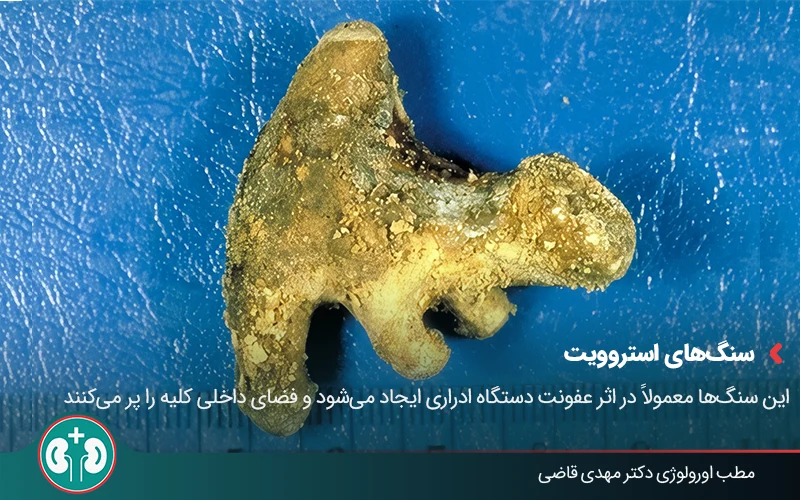
Struvite kidney stones usually form because of urinary tract infection. Some bacteria alkalinize the urine and kidney environment, causing magnesium, ammonium, and phosphate to precipitate quickly and form stones.
The important feature of magnesium ammonium phosphate stones is their rapid growth. These stones may become large and branching within a short time and fill the entire kidney collecting space. In that situation, the risk of kidney tissue damage and reduced kidney function also increases.
Because of their shape, these are also called staghorn stones. In terms of color, struvite stones are usually white or cream-colored. They are seen more often in women with a history of recurrent urinary tract infections. For this reason, treatment of struvite stones is not limited to removing the stone; controlling and treating the infection is even more important because it prevents stones from forming again.
4. Cystine stones, inherited stones
Cystine stones are the rarest type of kidney stone and usually result from an inherited genetic disorder called cystinuria. In this disease, the kidneys cannot properly reabsorb the amino acid cystine. As a result, large amounts of cystine enter the urine, and crystals and then stones gradually form.
These stones are often hard and resistant and are usually pale yellow, transparent, or translucent. They may appear in childhood or adolescence. Timely treatment of kidney stones, especially in children, is very important because they can significantly harm a growing kidney.
These stones have the highest recurrence rate among all kidney stone types. For this reason, patients with cystine stones should always remain under medical supervision and take drug treatments and medical advice seriously.
Types of kidney stones by color
Although the color of a passed stone alone is not a definitive diagnostic criterion, in many cases the doctor can estimate the stone type by considering color, shape, size, and test results together. A precise and definitive diagnosis should be made only through stone analysis.
Kidney stones can have a wide range of colors, from white and pale yellow to dark brown and even black. This color difference is usually related to the stone’s chemical composition.
The table below shows the colors of different kidney stone types:
Kidney stone composition | Kidney stone color |
|---|---|
Calcium oxalate monohydrate | Dark brown, burnt brown, dark gray to black |
Calcium oxalate dihydrate | Light brown, yellowish brown, sometimes yellow |
Uric acid | Yellow, yellow-orange, orange to brick red |
Cystine | Pale yellow, transparent or translucent, light amber |
Calcium phosphate | White, chalky white, light gray |
Struvite | White, cream, beige, sometimes light gray |
Two stones with a similar color may have different compositions. Therefore, if you pass a stone, the best step is to submit it to a laboratory so its chemical composition can be identified accurately.
Types of kidney stones by shape
Although stone size and location have the greatest effect on whether and how a kidney stone can pass, its shape can also indirectly affect the chance of becoming stuck, the degree of tract irritation, and the amount of pain.
In general, kidney stones can be divided by shape into three groups: smooth and round stones, rough stones with sharp edges, and staghorn stones.
Before reviewing the different shapes of kidney stones in more detail, it is important to know that usually kidney stones do not cause symptoms while they remain in the kidney and the pain known as kidney stone pain occurs when the stone enters the ureter.

Smooth, round stones
As the name suggests, these stones do not have sharp edges. If they are smaller than 5 millimeters, they are more likely to pass naturally. On the other hand, if these stones are small, they do not injure the urinary tract wall.
Rough, crystalline, sharp-edged stones
Some stones have an uneven, rough, or crystalline surface. When these stones enter the ureter, they irritate the wall of the channel more than smooth, round stones. In this situation, the person experiences more severe pain. In addition, the angular shape of these stones increases the likelihood that they will become stuck in the ureter.
Staghorn stones
Staghorn stones are usually struvite stones and grow in a shape that fills the internal space of the kidney, meaning the renal pelvis and calyces. Natural passage of these stones is impossible because of their shape, and they must be removed by open surgery or PCNL.
Types of kidney stones by size and their effect on treatment
As mentioned earlier, stone size is the most important factor in choosing treatment. In fact, size determines whether natural passage is possible or whether other methods such as surgery are needed to remove the stone. This section discusses kidney stones by size.

Small stones, less than 5 millimeters
Small stones usually pass naturally with increased fluid intake, adequate movement, and pain medicines. In some cases, the doctor may prescribe antispasmodic medicines such as tamsulosin to make passage of a small kidney stone easier.
Medium stones, 6 to 10 millimeters
These stones may cause severe pain when they move into the ureter, and they may also become stuck there. In this situation, the risk of ureteral obstruction and severe pain is very high. Methods such as extracorporeal shock wave lithotripsy (ESWL) or transurethral lithotripsy (TUL) are usually used to remove these stones.
Large stones, more than 10 millimeters
Spontaneous passage of these stones is almost impossible. Even if they enter the ureter, the chance that they will cause severe obstruction, infection, and kidney tissue damage is very high.
These stones must be removed with surgical methods such as percutaneous nephrolithotomy (PCNL), or in selected cases open surgery. Delaying treatment of this type of stone increases the risk of permanent injury and decline in kidney function.
Which type of kidney stone is the worst?
The truth is that there is no single, definite answer to this question, because kidney stone complications depend on several criteria, including growth speed, likelihood of infection, amount of kidney damage, stone size, and recurrence risk. Still, several groups of stones can be considered more dangerous than others.
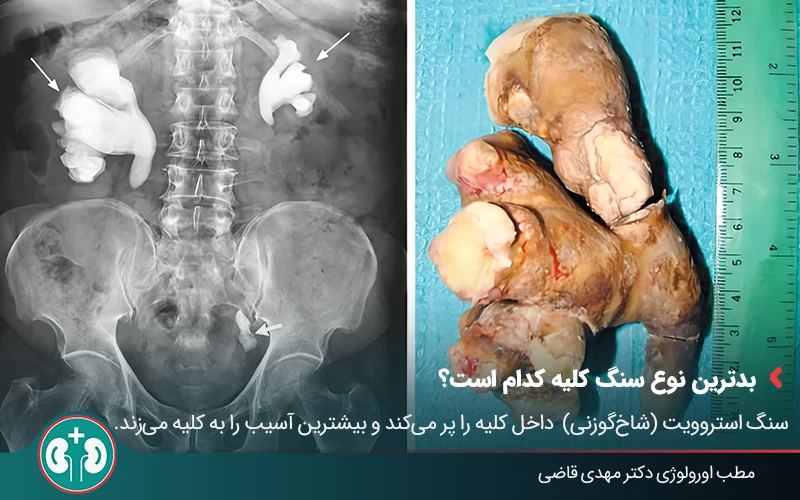
The most dangerous in terms of kidney damage
In terms of gradual kidney destruction, struvite, or staghorn, stones are the most dangerous type of kidney stone. Because of their rapid growth and special shape, these stones gradually fill the entire internal collecting space of the kidney.
While growing, these stones may not cause specific symptoms and may silently reduce kidney function and increase the risk of severe infections.
Stones that are hard to pass and have a high recurrence risk
Cystine stones have the highest recurrence risk because they arise from an inherited underlying disease. For this reason, patients should always remain under medical supervision. These stones are also often hard, making them more difficult to pass or break.
Irregular, sharp-edged, or medium to large stones

Stones with a rough, pointed surface, or stones that measure 6 to 10 millimeters, are usually more painful and are more likely to become stuck in the ureter. They may cause urinary obstruction, severe colicky pain, and, if treatment is delayed, injury to the ureter or kidney.
Of course, stone size and location are the most important factors in the chance of impaction and the severity of colicky pain; irregular shape plays a smaller role in these issues.
Methods for definitive diagnosis of stone type
Accurate diagnosis of kidney stone type is not necessary for every patient. In other words, if this is your first kidney stone and the stone passed easily, determining the type may not be required. In contrast, identifying stone type is necessary for people with the following conditions:
People whose kidneys are described as stone-forming;
Those who have previously had a large kidney stone;
Those with a family history of large kidney stones.
Diagnosing stone type before passage
When the stone is still inside the body, the doctor can estimate its type to some extent through several methods. These methods are reviewed below.
CT scan (CT Scan)
One of the most accurate methods is CT scan, which provides the doctor with important information about the stone’s location, size, and even hardness. For example, calcium stones are denser and harder, while uric acid stones are less dense.

Urine test
If the urine is acidic, the stone is likely uric acid or cystine; if the urine is alkaline, it is more likely an infection-related stone or calcium phosphate stone. On the other hand, if calcium and uric acid levels in the blood are high, the doctor may suspect a uric acid stone or a calcium stone.
Family history review
As mentioned, cystine stones are inherited. If this history exists, you should be sure to tell your doctor.
Diagnosing stone type after passage
The most accurate method for identifying kidney stone type is stone analysis after it has passed. If the patient uses a urine strainer during passage and keeps the stone, it can be submitted to a laboratory for analysis. In the laboratory, the exact stone type is determined by examining its chemical composition.
In some cases, the doctor can make an initial assessment by looking at the stone’s color and shape, but definitive diagnosis is possible only with laboratory analysis.
Prevention strategies by stone composition
The first recommendation for all types of kidney stones is to drink enough water so the urine stays dilute. In other words, fluid intake should be high enough for urine output to reach 2.5 liters per day. Depending on the stone type, however, there are other strategies as well, discussed below.

Prevention strategies for calcium stones
In patients with calcium stones, changing the urine composition through diet may help. For this purpose, it is better to:
Reduce salt and sugar intake.
Avoid excessive intake of calcium-containing foods, but never remove them from your diet completely, because that can have the opposite effect and increase kidney stone formation.
For calcium oxalate stones, it is also better to limit high-oxalate foods such as spinach, nuts, and chocolate.
Prevention strategies for uric acid stones
Reducing urine acidity is an effective way to prevent this type of stone. Therefore:
Reduce animal protein, especially red meat.
If needed, use urine-alkalinizing medicines under medical supervision.
Control underlying diseases such as gout with your doctor’s help.
Prevention strategies for struvite stones
Preventing these stones is not possible without controlling urinary tract infection. Therefore:
Urinary tract infections should first be treated completely and properly.
Remain under your doctor’s supervision to prevent infection recurrence.
Prevention strategies for cystine stones
The most important strategy for preventing cystine stone recurrence is regular medical follow-up to continuously monitor kidney status. Very high fluid intake, keeping the urine alkaline, and sometimes specific drug treatment under medical supervision play important roles in preventing these stones. Because cystine stones result from an underlying disease, they have the highest risk of recurrence.
Summary
As explained in this article, kidney stones have many different types, so one single treatment cannot be defined for all of them. Factors such as stone composition, color, shape, and especially size affect how the stone passes, how much pain the person feels, the treatment method, and even the risk of recurrence.
However, one important point applies to all kidney stones: after a stone has passed, prevention steps should be taken seriously and the doctor’s recommendations should be followed. This is even more important for people whose kidney stones are caused by infection or an underlying disease.
Therefore, if you have passed a stone or if ultrasound or CT scan has shown a kidney stone, you should see a urologist for accurate diagnosis of stone type, dietary guidance, and a plan to prevent stone recurrence. Correct diagnosis today can spare you repeated pain in the future.
Frequently asked questions
Actions & related links
Doctors for this topic in Mashhad
See all doctors: Best Kidney Stone Doctors in Mashhad


About the author

Urologic Surgeon
دکتر مهدی قاضی, Urologic Surgeon in Mashhad. Articles on this site are written and reviewed under the supervision of the Urology Building's physicians.
View profile & bookRelated articles
All articlesWhat Is Polycystic Kidney Disease? (Fetal and Adult PKD)
دکتر مهدی قاضی · June 26, 2026
What Is a Renal Cortical Cyst? Symptoms, Diagnosis, and Treatment
دکتر مهدی قاضی · June 26, 2026
Kidney Transplant: Cost, Blood Type Compatibility, and Surgical Method
دکتر مهدی قاضی · June 26, 2026
What Is Pyelonephritis? Kidney Infection Symptoms, Diagnosis, and Treatment
دکتر مهدی قاضی · June 26, 2026
Comments
0 comments
No comments yet. Be the first to share your thoughts.