 Tap to zoom
Testosterone Deficiency: Causes, Symptoms, and Effective Treatments
Testosterone deficiency can reduce sex drive, energy, and muscle mass. Learn about its causes, symptoms, diagnosis, treatment options, and follow-up care.
- نویسنده
- دکتر مهدی قاضی
- Published on
- June 26, 2026
- Reading time
- 5 min read
- Last updated
- Updated: September 4, 2026
Testosterone is a male sex hormone produced in the testicles, and it is important for normal male sexual development and function. This hormone also plays an important role in sperm production. Usually, blood testosterone levels decrease with age.
The American Urological Association (AUA) defines low testosterone as a level below 300 nanograms per deciliter (ng/dL).
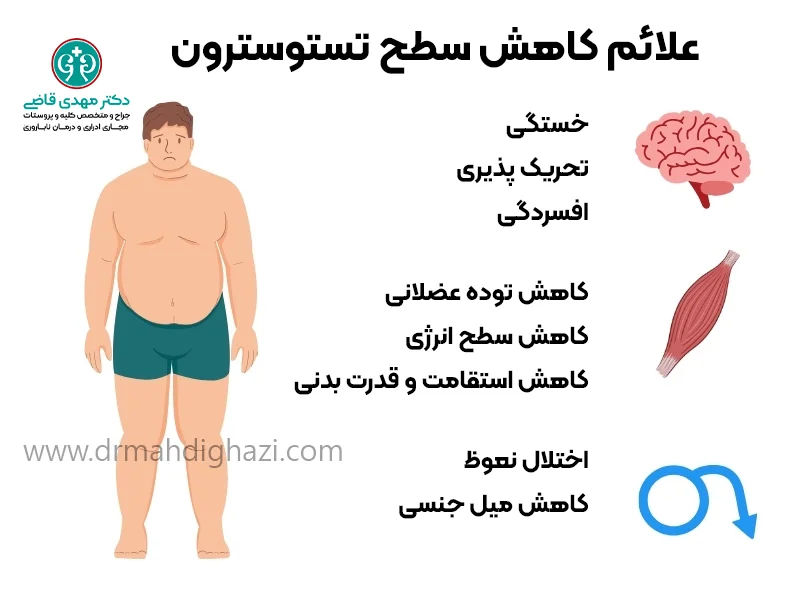
Symptoms of testosterone deficiency may include:
Decreased sex drive
Fatigue
Loss of muscle mass
Irritability
Erectile dysfunction
Depression
There are, of course, other possible causes for these symptoms, such as drug use, some congenital conditions, loss of or injury to the testicles, diabetes, and obesity.
Who needs testosterone treatment?
In general, men with low testosterone are treated when they have symptoms and blood tests show a low testosterone level. A low blood testosterone level alone, if it has not caused symptoms, does not require treatment.
Nonspecific signs and symptoms:
These symptoms may or may not be related to testosterone deficiency.
Reduced energy, stamina, and physical strength
Memory problems
Difficulty finding words
Poor concentration
Poor performance at work
Important note: Having any specific or nonspecific symptom does not mean a person has testosterone deficiency (TD).
Causes of testosterone deficiency
Testosterone deficiency can result from different factors that affect the production and function of this hormone in the body.
Some people are born with congenital conditions that cause low testosterone levels, while others may develop this problem during life for different reasons, including injuries, diseases, and environmental factors.
Below, we review the main causes of testosterone deficiency:
Some people are born with conditions that cause testosterone deficiency, such as:
Noonan syndrome
Ambiguous genitalia
Some men may develop testosterone deficiency due to conditions such as:
Testicular injury from an accident
Chemotherapy or radiation therapy
Pituitary gland disease that leads to low sex hormone levels
Some infections
Certain autoimmune diseases
Some men also develop testosterone deficiency for the following reasons:
Aging
Obesity
Metabolic syndrome
Use of some medications, such as antidepressants and sedatives
Diagnosis of testosterone deficiency
Diagnosing testosterone deficiency requires careful review of symptoms and the patient's history, along with relevant laboratory tests.
Although many symptoms may be associated with testosterone deficiency, the most important criterion for diagnosing this condition is the total blood testosterone level.
To get a complete picture of the patient's condition, the physician needs to take a detailed history and review past medical records. This process includes asking detailed questions, performing a physical examination, and ordering different tests to confirm or rule out testosterone deficiency.

Below, we discuss the details of this diagnostic process.
Blood testosterone level
Although many of a person's symptoms may be associated with testosterone deficiency, total blood testosterone level is the most important criterion for diagnosing testosterone deficiency.
Taking a history and reviewing previous medical conditions
The physician may ask the patient about the following:
Headache, changes in the visual field, double vision (possible signs of brain masses such as a pituitary tumor)
How the patient developed during puberty
History of head trauma
Skull surgery / brain tumor or cranial radiation therapy
Anosmia (loss of sense of smell)
History of testicular infection
Major injury to the testicles
Measles after puberty
Past or current use of anabolic steroids
Use of narcotics
Use of corticosteroids
History of chemotherapy or radiation therapy
Family history of conditions related to testosterone deficiency
History of stroke or heart attack
History of anemia without a clear cause
Physical examination
The urologist will assess the following:
Body mass index (BMI) or waist circumference to diagnose obesity
Metabolic syndrome: This is a cluster of findings that occur together and includes high blood pressure, high blood sugar, excess body fat around the waist, and abnormal cholesterol or triglyceride levels.
Hair pattern, amount, and location of hair growth
Gynecomastia (enlarged breasts)
Presence and size of the testicles
Prostate size
Tests
The following tests may be needed:
Total blood testosterone level
This test should be done at two different times on blood samples taken before noon. Testosterone levels are lower later in the day. If a person has a particular illness, the physician will not order the test until the patient has recovered, because some illnesses can cause false test results.
Luteinizing hormone (LH)
This test is done to help find the cause of low testosterone. This hormone controls how testosterone is made. Abnormal LH levels may indicate a pituitary gland disorder.
Blood prolactin hormone level
If the blood prolactin level is high, the physician may repeat the blood test to make sure there was no error. High prolactin levels can also be a sign of benign pituitary problems or masses.
The following evaluations may also be done to help with further diagnosis:
Follicle-stimulating hormone (FSH)
This test is done to evaluate sperm production function if the person wants to have children. A semen analysis may also be needed. These tests are performed before any hormone therapy.
Estradiol hormone test
This is done if there are signs of breast enlargement.
HbA1C blood test
It may be done for diabetes.
Magnetic resonance imaging (MRI) of the pituitary gland
Bone density test: to check for osteoporosis
Karyotype (chromosome test)
Treatment of testosterone deficiency
There are different ways to use testosterone, each with its own features and benefits. Choosing the right method of testosterone use depends on different factors, such as personal preference, health status, and the physician's recommendation.
None of these methods is superior to the others, but the goal of all of them is to raise the blood testosterone level to the normal range and improve symptoms of testosterone deficiency.
The physician may recheck the testosterone level with a blood test to make sure the treatment is working properly.

Overall, there are five different ways to use testosterone. These methods are:
Transdermal (through the skin)
Intramuscular injection
Oral / buccal (through the mouth)
Intranasal (through the nose)
Pellet placed under the skin
Here are more details about the five different methods of testosterone use:
1. Topical methods (Transdermal):
Topical testosterone gels, creams, lotions, and patches are available.
Topical medications often last about four days.
These medications are absorbed better when covered with a waterproof dressing.
Lotions, gels, creams, or patches should be applied to dry skin without cuts or scratches.
The application area should not be washed until the next dose is applied.
Hands should be washed after applying lotions, gels, or creams.
Make sure other people, especially women and children, do not come into contact with topical medications.
2. Injection:
Short-acting and long-acting forms of testosterone injection are available.
The short-acting medication may be injected under the skin or into a muscle. The long-acting medication is usually injected into a muscle.
Injections are usually given weekly, every two weeks, or monthly.
3. Oral / buccal (through the mouth):
The buccal dose is a small patch placed above the front tooth (canine).
The medication is similar to a tablet, but it should not be chewed or swallowed.
The medication is released over 12 hours.
This method has fewer liver side effects than swallowing medication, but it may cause headache or irritation at the application site.
4. Intranasal:
This form of testosterone is a spray. As directed, a specific amount of medication must be sprayed into each nostril.
This medication is usually used three times a day.
5. Pellet:
The physician implants testosterone pellets under the skin of the buttock or upper hip and injects local anesthetic to numb the skin. Then a small incision is made, and the pellets are placed into the fatty tissue under the skin.
This medication dissolves slowly and, depending on the number of pellets, is released over 3 to 6 months.
Side effects of testosterone use
Each method of testosterone use may have particular side effects that should be considered.
From topical gels and lotions to injections and pellets, each may produce different reactions in the body.
These side effects can range from minor skin irritation to serious allergic reactions.
In addition, testosterone use can disrupt some normal body functions, such as sperm production. Topical testosterone can also be transferred to others, especially women and children, which requires special precautions.
Below are more details about the side effects and precautions related to each method of testosterone use.
Gels and lotions
Mild redness may be seen at the application site on the skin. With patches, itching and skin rash may occur around the application area. A very small number of patients have also reported back pain.
Short-acting injections
A mild allergic reaction may occur at the injection site. Some people have had a serious allergic reaction to long-acting injections. For this reason, after a long-acting injection, the patient will be observed in the physician's office for a period of time.
Testosterone pellets
Possible side effects include swelling, pain, bruising, and rarely, hematoma (a blood clot under the skin).
During testosterone treatment, the risk of increased blood concentration (an abnormal rise in blood hemoglobin and hematocrit) increases.
Testosterone may interfere with natural sperm production. If a person is being treated for testosterone deficiency, the physician may suggest additional treatments to support sperm production.
Topical testosterone, especially gels, creams, and lotions, may be transferred to others. Women and children are more vulnerable to side effects from contact with these medications. Care should be taken to cover the application area and to wash the hands well after using the medication. It is important to make sure the area where topical testosterone was applied does not come into contact with others, because this can transfer the medication to them.
The U.S. Food and Drug Administration (FDA) recommends that if topical testosterone is used, attention should be paid to signs and symptoms of early puberty in children who live with or are in contact with the person. Children should not be allowed to touch an application area that has not been washed or covered.
Important points about testosterone treatment
The following should be known about testosterone treatment:
There is no evidence linking testosterone to prostate cancer.
There is no reliable evidence that testosterone increases blood clotting in the veins.
Currently, there is not enough evidence to show that testosterone increases or decreases the risk of cardiovascular events. However, while a person is receiving testosterone treatment, they should contact their physician immediately if they have signs or symptoms of a stroke or heart attack.
After treatment
Every person is unique, and each body responds differently to treatment. Testosterone replacement therapy may help with:
Erectile function
Low sex drive
Bone mineral density
Anemia
Lean body mass
Symptoms of depression
However, there is no evidence showing that testosterone helps with:
Memory
Diabetes control
Energy
Fatigue
Blood lipid profile
Quality of life
Periodic checkups are needed to make sure the testosterone level remains within the normal range.
In stable patients receiving testosterone treatment, total testosterone and some other tests should be repeated every 6 to 12 months.
If excess weight is present, the person should try to keep weight within the recommended range.
Increasing physical activity may help with weight loss and may also increase testosterone levels.
Frequently Asked Questions
Actions & related links
Doctors for this topic in Mashhad
See all doctors: Best Urologists in Mashhad




About the author

Urologic Surgeon
دکتر مهدی قاضی, Urologic Surgeon in Mashhad. Articles on this site are written and reviewed under the supervision of the Urology Building's physicians.
View profile & bookRelated articles
All articlesWhat Is Polycystic Kidney Disease? (Fetal and Adult PKD)
دکتر مهدی قاضی · June 26, 2026
What Is a Renal Cortical Cyst? Symptoms, Diagnosis, and Treatment
دکتر مهدی قاضی · June 26, 2026
Kidney Transplant: Cost, Blood Type Compatibility, and Surgical Method
دکتر مهدی قاضی · June 26, 2026
What Is Pyelonephritis? Kidney Infection Symptoms, Diagnosis, and Treatment
دکتر مهدی قاضی · June 26, 2026
Comments
0 comments
No comments yet. Be the first to share your thoughts.