 Tap to zoom
Treating Male Infertility With Sperm Retrieval Techniques
Sperm retrieval can help some men with azoospermia, ejaculatory disorders, or obstructed sperm transport provide sperm for IVF or ICSI. This article reviews TESE, TESA, PESA, Micro-TESE, recovery, and risks.
- نویسنده
- دکتر مهدی قاضی
- Published on
- June 26, 2026
- Reading time
- 5 min read
- Last updated
- Updated: June 26, 2026
Male infertility is one of the medical problems that can cause many challenges for couples.
One of the advanced techniques inthe field of male infertility treatmentis sperm recovery or extraction.
This method allows fertility to men who are unable to produce or transfer sperm in a natural way due to reasons such as azoospermia, lack of ejaculation, or obstruction of the exit ducts.
By using various methods such as testicular sperm extraction (TESE), testicular sperm aspiration (TESA), and microscopic sperm recovery, the sperm needed for fertilization can be obtained.
The normal routine of sperm production
Sperm and male hormone (testosterone) are produced in the testicles.
After the sperm is produced, it exits the testicles through a coiled tube behind the testicles called the epididymis.
From the epididymis of the testicle, a tube called vas enters the abdomen and back of the bladder and finally, after connecting to the seminal vesicles, it enters the penis and creates the ejaculatory ducts.
Each vas deferens is connected to a seminal vesicle and forms the ejaculatory duct.
At the time of ejaculation, the sperm passes through the ejaculatory ducts, mixes with the fluid of the seminal vesicles, prostate and other glands and forms semen, and after passing through the urethra, it exits the end of the penis.
Reasons for sperm recovery
By extracting sperm in men who have a severe lack of sperm or the absence of sperm, it is possible to obtain suitable sperm from the testicles.
Also, sperm harvesting is helpful in those who are unable to ejaculate
In these cases, sperm can be collected from other parts of the reproductive system.
After sperm extraction, sperm can be used in the following in vitro fertilization methods:
IVF is a process in which the egg and sperm are fertilized together in a laboratorycontainer and an embryo is formed and the embryo is transferred to the uterus for development.
Intracytoplasmic sperm injection (ICSI) is a form of IVF in which a sperm is injected directly into an egg.
Semen analysis is a method used to check the presence of sperm in semen.
When azoospermia is reported in the semen examination, it means that there is zero sperm in the semen, and sampling from the testicles and sperm extraction can be helpful.
Azoospermia (zero sperm)
Azoospermia is divided into two main types, obstructive azoospermia and non-obstructive azoospermia.
Obstructive azoospermia
In obstructive azoospermia, the testicles produce sperm, but the sperm does not leave the male reproductive system.
Causes of obstructive azoospermia:
History ofvasectomy orprevious sterilization
Absence of vas tubes in the form of placenta
Obstruction in the ejaculatory ducts due to damage to that area (for example, the ducts may have been damaged in previous surgeries)
In some cases, obstructive azoospermia may be treated by surgery.
Non-obstructive azoospermia
In this case, the body does not produce sperm at all or the sperms are so few that they do not appear enough in the ejaculate.
Hormonal blood tests and genetic tests can help find the cause.
In some men, in spite of sexual satisfaction, semen does not ejaculate from their penis and they suffer from no ejaculation or retrograde ejaculation.
In case of no ejaculation (dry ejaculation), no semen reaches the penis.
However, in retrograde ejaculation, semen enters the urethra, but flows in the wrong direction and goes backwards into the bladder.
This does not harm the body, but it can cause infertility.
Absence of ejaculation or retrograde ejaculationoccurs following injury, disease, or surgery.
Some of the reasons for this condition are:
spinal cord injury
Advanced diabetes
MS disease (multiple sclerosis)
Psychological issues
Pelvic surgery
If the sperm does not have the ability to leave naturally, extracting sperm from the testicles and testicular ducts and freezing in the sperm bank can be helpful for fertilization in the future.
treatment
Sperm recovery without surgery
In patients who suffer from no ejaculation or retrograde ejaculation, sperm can be harvested by artificial ejaculation induction.
penile vibratory stimulation (PVS)
In this method, a special vibrator is used, which is placed on the tip of the penis and causes ejaculation.
electric ejaculation (EEJ)
In this method, using a tool, electrical energy is sent to the prostate and seminal vesicles.
In people who have nerve damage and sensory paralysis, this procedure can be done on an outpatient basis and in the office.
But for men who have normal sensation, general anesthesia is necessary.
If the vibrator or electric ejaculation does not work, the next step is to retrieve the sperm from the epididymis or testicle.
Recovery of sperm from the testicles
There are several ways to collect sperm from the genital tract.
The main goal is to harvest the highest number of quality sperm.
Also, care should be taken to avoid damaging the reproductive system during sperm collection.
We describe several methods of removing sperm from the testicles
Methods of sperm extraction
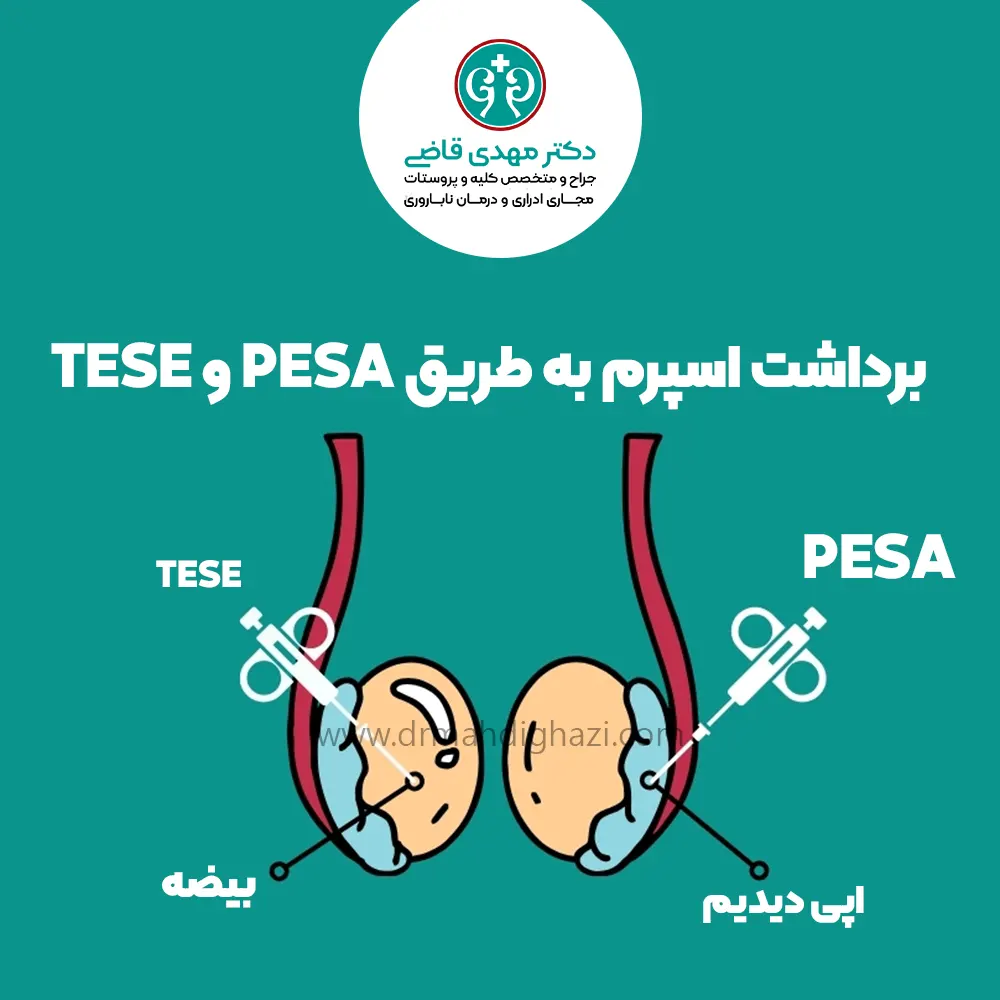
Extraction of sperm from the testicles (TESE)
TESE is often used to diagnose the cause of azoospermia, and during surgery, sufficient tissue can be removed from the testicle and, if possible, sperm can be extracted and frozen for fertilization.
Sperm can be used fresh or frozen. This procedure is often performed in the urologist's office with local anesthesia
Of course, TESE can also be performed under general anesthesia in a surgical center where one or more small incisions are made in the testicle.
Aspiration of sperm from the testicle or TESA (TESA)
TESA, sometimes called testicular fine needle aspiration (TFNA), is used to diagnose or treat azoospermia.
This method is also used to collect sperm from the testicles.
After local anesthesia or anesthesia, the urologist pierces the skin and testicles with a thin needle and collects the sperm.
TESA with mapping
In this method, TESA is performed with a large number of aspirations on the testicles.
Some doctors believe that this method is TESE.
TESA is sometimes a good option for patients with non-obstructive azoospermia.
In this method, a surgical microscope is used to help retrieve sperm from the epididymal tubes.
TESA can retrieve many healthy sperms and these sperms are stored and frozen for reuse.
Although this procedure is extremely safe, it still requires general anesthesia and a skilled surgeon with a microscope.
Percutaneous Epididymal Sperm Aspiration (PESA)
This method is similar to the TESA method, with the difference thatsperm are extracted through the skin from the ducts behind the testicles (epididymis)with a needle similar to insulin and stored in the culture medium.
Micro-TESE
It is only used in non-obstructive azoospermia; In this method, the outer covering of the testicle is opened and its interior is examined.
Then the urologist can see the areas where there is a possibility of sperm production
This technique is performed by a urologist who also works in the field of microsurgery and usually it should be in the operating room.
Although less tissue is removed, more of the testicle is examined.
In addition, the damage to the blood vessels is less
Some experts believe that Micro-TESE has a better chance of finding sperm in men with non-obstructive azoospermia than other methods.
Recovery process after surgery
Recovery after sperm retrieval from the epididymis or testicle depends on the type of surgery performed and varies from a few days to a week.
During this period, intense physical activity should be avoided.
Surgeons usually prescribe antibiotics before and after surgery, which are very effective in preventing infection.
Cold compress is also helpful immediately after surgery.
If the surgical site has stitches, it will take longer to heal.
Most men can return to work after 24 to 48 hours, and those who perform strenuous activity may need up to 10 days of rest.
Possible complications after surgery
include
Bleeding
infection
the pain
The possibility of not finding sperm
Need for re-surgery
Testicular damage or loss (rare).
Summary
Sperm recovery is one ofthe advanced and promising methods inthe treatment of male infertility.
These methods give men who have problems with sperm production or exit the opportunity to become fathers, and by using them, suitable sperm can be provided for in vitro fertilization and more advanced methods such as intracytoplasmic sperm injection (ICSI).
Various methods such as TESE, TESA, and Micro-TESE are specially designed for different types of azoospermia and no ejaculation, and according to the specific conditions of each patient, one or more appropriate methods are selected.
Although these methods have possible complications such as pain, infection and failure to find sperm, but with the cooperation of an experienced medical team and the use of advanced techniques, positive results can be achieved.
Sperm recovery is actually a new opportunity to realize the dreams of becoming parents in couples who are facing male infertility problems and are trying to have a better life.
Frequently asked questions
Actions & related links
Doctors for this topic in Mashhad
See all doctors: Best Male Infertility Doctors in Mashhad




About the author

Urologic Surgeon
دکتر مهدی قاضی, Urologic Surgeon in Mashhad. Articles on this site are written and reviewed under the supervision of the Urology Building's physicians.
View profile & bookRelated articles
All articlesWhat Is Polycystic Kidney Disease? (Fetal and Adult PKD)
دکتر مهدی قاضی · June 26, 2026
What Is a Renal Cortical Cyst? Symptoms, Diagnosis, and Treatment
دکتر مهدی قاضی · June 26, 2026
Kidney Transplant: Cost, Blood Type Compatibility, and Surgical Method
دکتر مهدی قاضی · June 26, 2026
What Is Pyelonephritis? Kidney Infection Symptoms, Diagnosis, and Treatment
دکتر مهدی قاضی · June 26, 2026
Comments
0 comments
No comments yet. Be the first to share your thoughts.