 Tap to zoom
Interpreting PSA After Prostate Surgery: Does a Rising Level Mean Cancer?
Learn how to interpret PSA after radical prostatectomy or TURP, when to test, which values are normal or concerning, why PSA may rise, and when to see a urologist.
- نویسنده
- دکتر مهدی قاضی
- Published on
- June 26, 2026
- Reading time
- 5 min read
- Last updated
- Updated: September 4, 2026
PSA after prostate surgery, and what counts as a normal value, depends on the type of operation. After radical prostatectomy, the PSA level should be close to zero; after TURP, however, it is usually enough for the level to remain stable.
Of course, interpreting a prostate blood test is not that simple, because the PSA level can change under the influence of many factors. Below, we explain what PSA means, the right time to have a PSA test, what values are normal or concerning, why the number may rise or fall, and what to do in each situation.
BPH, prostatitis and prostate cancer: medication, laser and surgery Prostate disease treatment in Mashhad
Note: To improve care quality and patient satisfaction, appointments are triaged by reason for visit. Each physician sees patients within the relevant urology subspecialty.
Book appointment
If you have recently had prostate surgery or are preparing for it, you can use the different sections of this article to follow your treatment plan with a clearer understanding.
What is PSA, and what role does it play in prostate cancer?
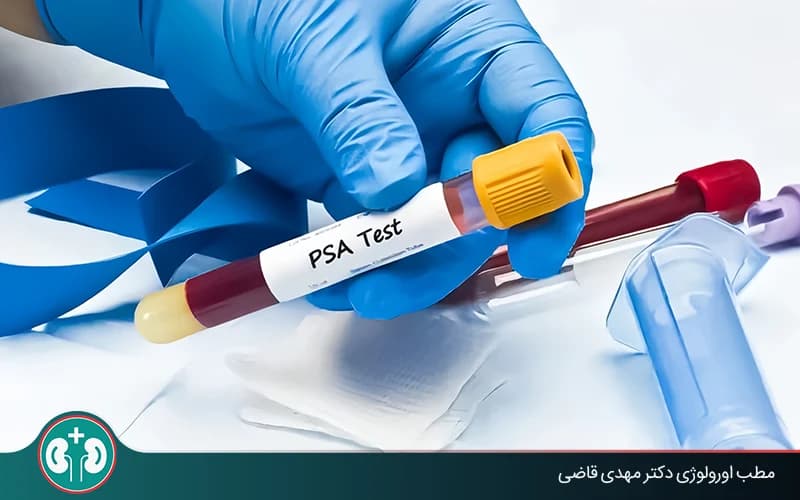
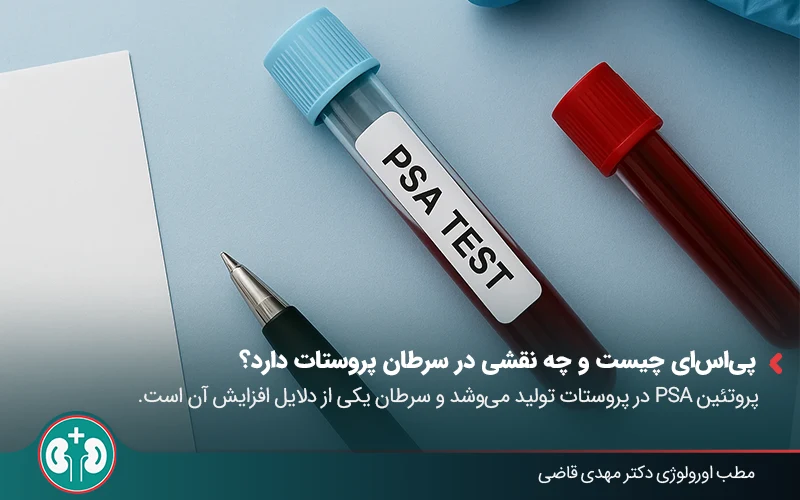
PSA, or prostate-specific antigen, is a protein secreted by normal prostate gland cells. Blood PSA levels are usually low in healthy men.
When the prostate is affected by inflammation, benign prostatic enlargement or cancer, this level can rise. Damage to prostate cells allows more PSA to enter the bloodstream. For this reason, a PSA test can be an early warning sign that more evaluation is needed, although prostate cancer is not always the cause of a higher PSA level.
Appointments related to BPH, prostatitis and prostate cancer: medication, laser and surgery Prostate disease treatment in Mashhad
Open the public booking path to review times and related information.
Book appointment
When someone has prostate cancer, urologists use the same PSA test to monitor the course of the disease. This test helps show whether treatment has been effective and whether the cancer may have returned.
Note: A high PSA result can be an early warning sign that further evaluation is needed. However, cancer is not always the reason PSA rises.
When should PSA be tested after prostate surgery?
For this reason, the first PSA test after this surgery should be done 6 to 8 weeks later so there is enough time for the blood PSA level to fall.
Q&A — BPH, prostatitis and prostate cancer: medication, laser and surgery Prostate disease treatment in Mashhad
General questions are shown on the destination page after review.
Book appointment
The right time for PSA testing after partial prostate surgery
Because PSA is produced only by prostate cells or prostate cancer cells, its level changes after surgery. This change does not happen immediately, because PSA is already present in the blood and some time is needed for the value to stabilize.
The first PSA test is usually performed about 6 to 8 weeks after surgery. The key point for these patients is that the PSA level after surgery should remain roughly stable over time.
What PSA level is concerning after surgery?
Whether PSA is normal or concerning after prostate removal depends on the type of surgery. After a summary table, we review this issue in more detail for both types of surgery.
PSA level after surgery | Possible interpretation | Suggested action |
|---|---|---|
Less than 0.1 ng/mL | Normal after radical surgery | Routine follow-up, such as periodic testing every 6 to 12 months |
Between 0.2 and 0.4 ng/mL | Suspicious for recurrence or remaining cells | Repeat the test and assess free PSA |
More than 0.4 ng/mL | Possible cancer recurrence | Imaging such as MRI or PET, plus specialist consultation |
PSA level after prostatectomy
In radical prostatectomy, the urologic surgeon removes the entire prostate gland. Because PSA is produced only in the prostate, after complete removal the level of this antigen should fall to almost zero after surgery. Since the prostate is the body's only source of PSA, any measurable PSA after this type of surgery may be concerning.
Urology specialists generally interpret a normal PSA level after prostatectomy as follows:
If PSA is less than 0.1 ng/mL, it is considered normal.
If PSA reaches 0.2 ng/mL or higher and remains elevated on two consecutive tests, cancer recurrence is possible.
If the test result shows that PSA has reached 0.2 or higher, or has increased on two consecutive measurements, it may mean that cancer cells are still present in the body or that the cancer has returned.
After TURP
Transurethral resection of the prostate (TURP) is used to manage complications of benign prostatic enlargement. In this operation, which is performed through the urethra, the urologist removes the central part of the prostate with a loop-shaped wire. As a result of this surgery and as prostate tissue decreases, the PSA level also falls; this is because the protein is produced in prostate tissue.
Keep in mind that in these cases PSA does not become zero because a source of PSA production remains, but the level should stay stable and should not rise over time. If the PSA level rises suddenly, or increases by more than 0.75 ng/mL over one year, it may signal a new problem such as inflammation or even possible cancer, and further evaluation is needed.
Note: After partial prostate surgery, the urologist usually pays more attention to the trend in PSA over time than to the PSA number by itself.

Why might PSA rise again after surgery?
One common concern after prostate surgery is why PSA has risen again, even though the level was expected to reach zero or stay low after the prostate was removed.
In practice, PSA changes after prostate cancer treatment do not always definitely mean that the disease has returned, but they can point to a condition that needs evaluation.
In this situation, urologists may review imaging results, the patient's symptoms, and the rate of PSA rise, or the "PSA doubling time". If PSA doubles in less than 3 months, this can be a sign of active cancer growth and may require prompt treatment.
In this situation, the urologist usually considers several factors together, including the PSA trend over time, how quickly it is rising, imaging results, and the patient's symptoms.
Below are the most important causes of a PSA rise after prostatectomy or other prostate treatments:
1. Biochemical recurrence
The most common cause of a PSA rise after prostatectomy is biochemical recurrence.
In this situation, cancer cells are still present in the body, but they are too small to be seen on imaging. These cells gradually begin producing PSA.
2. Remaining prostate tissue after surgery
Even in complete surgery, a small amount of prostate tissue may remain. If this tissue is active, it can secrete PSA and cause the level to rise.
3. Regrowth of prostate cells, benign or malignant
If PSA rises again after complete prostatectomy, it may be because cancer cells or healthy prostate tissue were not fully removed.
If the entire prostate was not removed, however, remaining tissue, even if benign, may also produce a small amount of PSA.
4. Metastasis, or spread of cancer to other parts of the body
If prostate cancer has spread to the bones, lymph nodes, or other organs, those cells can also produce PSA. Therefore, metastatic disease is usually associated with a rapid and continuous PSA rise.

What is a temporary PSA rise after treatment?
Sometimes after prostate cancer treatment, especially radiation therapy, the PSA level may rise slightly and then fall on its own after a period of time. This is called a temporary PSA fluctuation, or "PSA bounce after treatment".
This usually occurs 12 to 24 months after treatment and often is not a cause for concern.
The main reason is usually temporary inflammation in prostate tissue caused by radiation therapy, not cancer recurrence.
In fact, many men who experience this PSA fluctuation have a better prognosis and a lower risk of recurrence than others.
"PSA bounce after treatment" can sometimes be seen after prostate surgery as well, but it is less common. The important point is that a PSA rise alone is not a reason to start treatment.
The urologist usually repeats the PSA test several more times to see whether the rising trend is truly continuing.
What factors can cause a false PSA rise?
Sometimes PSA rises for reasons that have nothing to do with cancer. This is called a false PSA rise, and it can lead to unnecessary worry, additional tests, or even an unnecessary biopsy.
Factors that can cause a false PSA rise include:
Benign prostatic hyperplasia (BPH);
Inflammation or infection of the prostate, called prostatitis;
Urinary tract infection (UTI);
Ejaculation in the 24 to 48 hours before the test;
Cycling or strenuous physical activity;
Digital rectal examination, catheterization, or prostate biopsy;
The natural rise in PSA with age;
Type 2 diabetes, which in some cases may lower PSA and lead to false-negative results.

What follow-up tests can complement PSA testing?
As noted in the previous section, PSA often rises for other reasons, such as infection, inflammation, or even heavy physical activity.
For this reason, when a PSA result after prostate surgery falls in a suspicious range, the urologist may use additional tests to make a more accurate decision and help avoid unnecessary biopsies.
Here are the most important complementary tests:
The Gleason score in the patient's initial record
In addition to the PSA result, the Gleason score in the patient's initial record is also important. Cancers with a higher Gleason score are more aggressive and usually have a higher chance of returning.
The Gleason score is a measure commonly used to report biopsy results. As shown in the table below, it indicates how normal or abnormal the cells look:
Interpretation | Gleason score |
|---|---|
Low-risk cancer; the cells look similar to normal cells. | Score 6 (3+3) |
Lower intermediate risk | Score 7 (3+4) |
Higher intermediate risk | Score 7 (4+3) |
High-risk cancer; the cells are very abnormal and aggressive. | Score 8 to 10 |
The Gleason score shows how aggressive the cancer cells are. Combining PSA and Gleason information helps the urologist define the severity of the disease and the treatment plan more accurately.
Free PSA test, to assess the percentage of free PSA in the blood
The PSA protein appears in the blood in two forms:
Total PSA, meaning all PSA present in the blood;
Free PSA, meaning the portion that circulates freely in the blood and is not attached to any protein.
To understand the PSA level after prostate surgery, urologists first assess total PSA. Sometimes, however, the result is suspicious, meaning it is not clear whether the cause is prostate cancer or a benign problem such as inflammation or prostate enlargement.
In this situation, the urologist assesses the ratio of free PSA to total PSA:
If the free-to-total PSA ratio is high, a benign problem is more likely.
If the free-to-total PSA ratio is very low, the likelihood of cancer increases.
In simple terms, the more PSA circulates freely in the blood, the more likely the problem is benign; the more PSA is bound to proteins, the more likely it is to be malignant.
MRI: detailed imaging of the prostate
MRI is one of the most accurate methods for identifying suspicious areas in the prostate. It can show whether there is truly an area that needs biopsy.
If the image is normal, biopsy is often not needed. This method is especially helpful in men whose PSA is in the gray zone, for example between 4 and 10.
PET scan: identifying prostate cancer
A PET scan is highly accurate and is performed by injecting a low-risk radioactive tracer that highlights cancer cells.
This test is used mainly when the urologist suspects that cancer has spread to other parts of the body or wants to see whether the disease has returned after treatment.
When to repeat PSA testing for active surveillance
Even if the test result is normal, PSA should be repeated from time to time. The interval between tests is the same for people who have had TURP or prostatectomy.
Time after surgery | Suggested timing for PSA testing |
|---|---|
First year | Every 3 to 6 months |
Years 2 to 5 | Every 6 to 12 months |
After 5 years | Once a year, if results remain normal |
Summary
PSA after prostate surgery is one of the most important signs for understanding whether treatment has been successful.
After prostatectomy: If the entire prostate was removed during surgery, the PSA level should fall very low and become less than 0.1 ng/mL.
After TURP: In partial operations in which only part of the prostate is removed, PSA does not become completely zero, but it should remain at a stable level. If PSA rises suddenly or increases by more than 0.75 ng/mL over one year, it should be evaluated.
If the number rises again after a while, it may be a sign that cancer has returned or that cancer cells remain. Other factors, such as prostate enlargement or inflammation, digital rectal examination, urinary tract infection, and similar causes, can also produce a false PSA rise.
A precise interpretation of PSA should always be made by a urologist. The doctor decides whether follow-up or new treatment is needed based on the patient's overall condition, treatment history, and other test results.
Finally, regular visits with a urologist, periodic testing, and awareness of concerning PSA values are the most important steps after prostate surgery.
Frequently Asked Questions
Actions & related links
Doctors for this topic in Mashhad
See all doctors: Best Prostate Specialists in Mashhad




About the author

Urologic Surgeon
دکتر مهدی قاضی, Urologic Surgeon in Mashhad. Articles on this site are written and reviewed under the supervision of the Urology Building's physicians.
View profile & bookRelated articles
All articlesWhat Is Polycystic Kidney Disease? (Fetal and Adult PKD)
دکتر مهدی قاضی · June 26, 2026
What Is a Renal Cortical Cyst? Symptoms, Diagnosis, and Treatment
دکتر مهدی قاضی · June 26, 2026
Kidney Transplant: Cost, Blood Type Compatibility, and Surgical Method
دکتر مهدی قاضی · June 26, 2026
What Is Pyelonephritis? Kidney Infection Symptoms, Diagnosis, and Treatment
دکتر مهدی قاضی · June 26, 2026
Comments
0 comments
No comments yet. Be the first to share your thoughts.