 Tap to zoom
Kidney Transplant Rejection Symptoms and Warning Signs to Know
Learn the warning signs of kidney transplant rejection, including fever, swelling, decreased urine output, pain, and rising creatinine, plus diagnosis, urgent treatment, and prevention with immunosuppressive medication adherence.
- نویسنده
- دکتر مهدی قاضی
- Published on
- June 26, 2026
- Reading time
- 5 min read
- Last updated
- Updated: September 4, 2026
Kidney transplant rejection symptoms such as fever and chills, swelling in the legs and around the eyes, decreased urine output, and headache are warning signs every patient should know after surgery.
The greatest fear in this situation is losing the transplanted kidney and having to return to dialysis. The good news is that when signs of kidney transplant rejection are recognized early, the chance of saving the kidney is much higher.
Kidney and ureteral stone treatment: ESWL, laser and PCNL Kidney stone lithotripsy in Mashhad
Note: To improve care quality and patient satisfaction, appointments are triaged by reason for visit. Each physician sees patients within the relevant urology subspecialty.
Book appointment
In this article, we explain the early symptoms of rejection in a transplanted kidney, why creatinine testing matters, and which methods doctors use to diagnose and treat this complication. If you or someone close to you has had a kidney transplant, knowing these signs can help save the transplanted kidney. Please read through to the end.
What is kidney rejection and how does it happen?
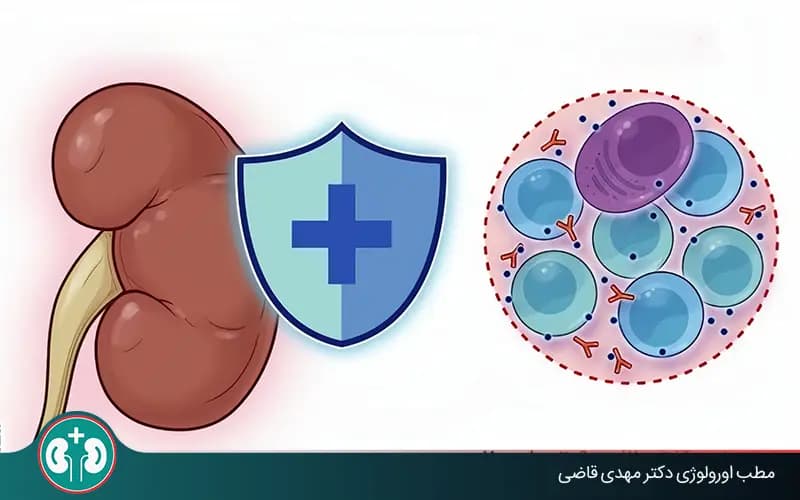
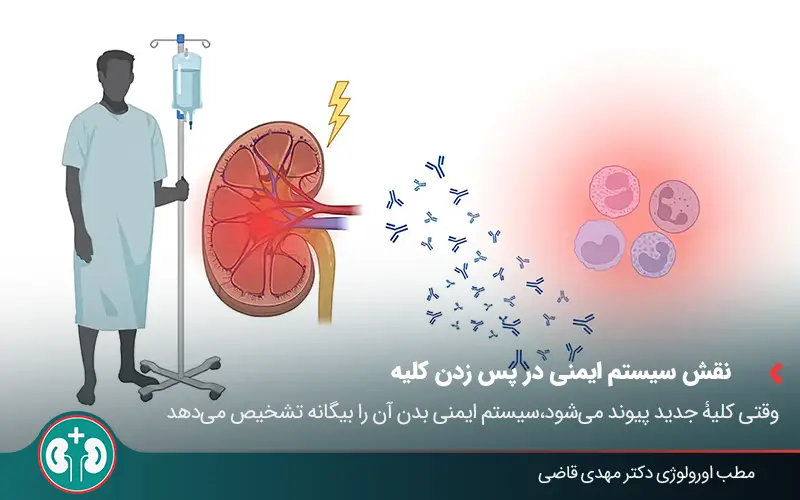
Kidney rejection occurs when the immune system recognizes the transplanted kidney as foreign and reacts against it. This reaction causes inflammation and impaired kidney function and is accompanied by signs of kidney rejection.
If the process of kidney transplant rejection is not controlled, the organ's function declines and the risk of kidney failure eventually rises.
Appointments related to Kidney and ureteral stone treatment: ESWL, laser and PCNL Kidney stone lithotripsy in Mashhad
Open the public booking path to review times and related information.
Book appointment
Kidney transplant rejection is usually seen in two main patterns: acute rejection, which happens quickly and suddenly, and chronic rejection, which develops slowly and gradually.
Understanding the difference between these two patterns helps you recognize signs of kidney rejection sooner and receive treatment on time. For this reason, we have prepared the table below to show the differences between acute and chronic kidney transplant rejection:
Feature | Acute kidney transplant rejection | Chronic kidney transplant rejection |
|---|---|---|
Signs | Fever, swelling, decreased urine output, pain at the kidney site | High blood pressure, protein in the urine, signs of reduced kidney function |
Time of onset | Days to weeks after surgery | Months to years after surgery |
Speed of change | Rapid and noticeable | Slow and gradual |
Lab changes | Sudden rise in creatinine | Gradual rise in creatinine |
Response to treatment | Usually controlled with immunosuppression | Often limited and incomplete |
Early symptoms and warning signs of kidney transplant rejection
Early recognition of kidney transplant rejection symptoms allows treatment to start quickly and helps prevent serious damage. These are common symptoms of kidney rejection:
Q&A — Kidney and ureteral stone treatment: ESWL, laser and PCNL Kidney stone lithotripsy in Mashhad
General questions are shown on the destination page after review.
Book appointment
Fever above 38 degrees Celsius;
Chills and feeling cold;
Decreased urine output or no urine output;
Swelling of the legs or around the eyes.
In rare cases, symptoms such as nausea and vomiting, severe headache, shortness of breath or chest pain, fatigue, and a general feeling of being unwell may also occur.
Fever and chills after kidney transplant surgery
When the immune system recognizes the transplanted kidney as unfamiliar, the body's defense reaction causes inflammation in the kidney tissue.
This inflammation is usually accompanied by fever above 38 degrees Celsius and chills, and it is one of the most important warnings of possible transplant rejection. Seeing these symptoms requires urgent evaluation by a urologist.
Pain at the surgical site
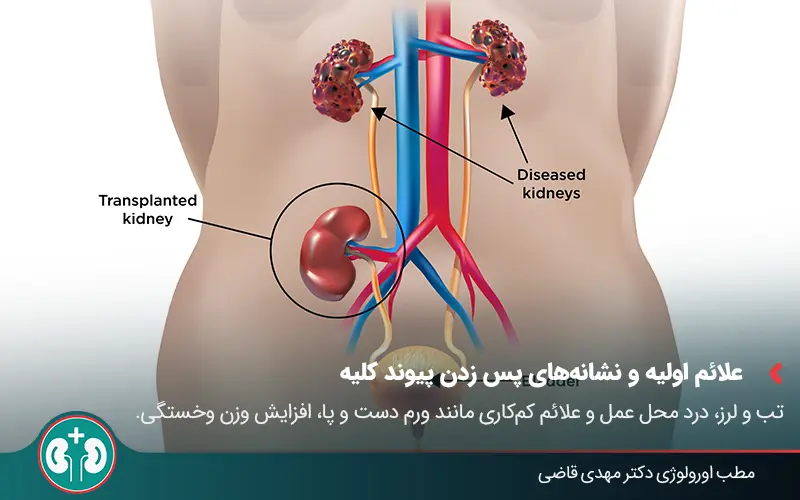
Pain, pressure, or discomfort in the area where the transplanted kidney is located may be due to inflammation and possible kidney transplant rejection. This pain is usually new, worsening, and different from ordinary postoperative pain, and it should be taken seriously as a warning sign.
Signs of reduced kidney function
Sometimes, before the kidney is fully rejected, reduced kidney function shows itself through the following signs:
Unusual fatigue and weakness: because waste products are cleared less effectively and toxins build up in the blood.
Swelling of the legs or hands: because the kidney cannot remove excess fluid well.
Increased blood pressure: poor kidney function disrupts blood pressure regulation.
Sudden weight gain: usually due to fluid buildup in the body.
Changes in blood tests: a rise in creatinine or urea because the kidney cannot filter the blood properly.
Causes of kidney transplant rejection
Kidney transplant rejection has several causes, the most important of which is the patient's immune system. Many other factors can also trigger the immune system in some way and lead to rejection. We review all of these below.
The role of the immune system in kidney rejection
The immune system works to defend the body against germs and targets anything it sees as non-self. When a new kidney is transplanted, the body recognizes it as foreign and activates an immune response. This reaction happens through the two factors below:
T cells become activated, enter the kidney tissue, and cause inflammation.
Antibodies are produced, attach to cells on the surfaces of kidney blood vessels, and cause damage.
For this reason, doctors emphasize that regular testing and exact use of immunosuppressive medications are the two main factors in preventing kidney transplant rejection.
Not taking immunosuppressive medications regularly
The most common reason for late acute rejection of a transplanted kidney is not taking anti-rejection medications, or immunosuppressants, regularly. When blood levels of medications such as tacrolimus or cyclosporine fall, the risk of the immune system attacking the transplanted kidney increases.
Immune-triggering viral infections
Some viral infections, such as CMV and BK virus, can stimulate the immune system when they reactivate in the body and increase the risk of kidney transplant rejection.
Unhealthy lifestyle
Smoking, a high-salt and high-fat diet, excess weight, and low physical activity do not directly cause kidney rejection by themselves, but these factors can lead to problems such as high blood pressure, diabetes, cardiovascular disease, and chronic inflammation in the body, placing extra strain on the kidney.
Blood or tissue incompatibility
The greater the difference between the donor's and recipient's blood and tissue, the higher the chance of kidney transplant rejection. For this reason, before transplantation, blood type and tissue compatibility are checked with blood tests so a kidney with the closest possible match is selected and the chance of rejection is lower.
Transplant from a deceased donor
A kidney taken from a deceased person has usually been kept outside the body for some time. The longer this period is, the more kidney tissue can be injured and the higher the risk of rejection becomes.
History of previous transplant or medication problems
If a person has previously had transplant rejection, if the new kidney does not work well immediately after surgery, or if blood levels of immunosuppressive medications fluctuate too much, the chance of another rejection episode will be higher.
Methods for diagnosing and evaluating kidney rejection
After transplantation, doctors are always concerned that the new kidney is working properly and has no signs of rejection. For this reason, there is a defined process that starts with the simplest checks and moves to more specialized steps if needed:
1. Blood test and creatinine: checking kidney function and identifying a possible problem;
2. Repeat testing: distinguishing a kidney problem from temporary factors or infection;
3. Monitoring immunosuppressive medications: making sure medication levels are appropriate to prevent rejection;
4. Kidney ultrasound: evaluating blood flow, the urine pathway, and the kidney's appearance;
5. Kidney biopsy: accurate and definitive diagnosis when signs of rejection are present.
Blood test and creatinine

The first and most important way to evaluate kidney function is a creatinine test after kidney transplantation. As explained in the previous sections, creatinine is a substance produced by muscle activity, and the kidneys should remove it from the blood.
When the transplanted kidney does not work properly, the creatinine level in the blood rises. For this reason, doctors check the creatinine number after kidney transplantation at every visit.
Changes in this number can be the first sign of rejection. The table below shows normal and warning ranges for creatinine in the blood:
Status | Approximate creatinine level | Explanation |
|---|---|---|
Normal | About 0.7 to 1.3 (in men); about 0.6 to 1.1 (in women) | Indicates healthy kidney function. |
Warning | Between 1.5 and 2 | Requires closer evaluation; it may be due to dehydration, infection, or medication. |
Concerning | Above 2, or a steady increase over several consecutive tests | May be a sign of rejection or serious kidney injury and usually requires ultrasound or biopsy. |
Kidney ultrasound
Doppler kidney ultrasound uses sound waves to create a detailed image of the kidney. The doctor uses these images to assess kidney size, blood flow, and signs of inflammation or blockage.
Doppler kidney ultrasound is painless, does not put the person at risk, and is usually performed like a simple, quick examination.
Kidney biopsy
If Doppler ultrasound and initial tests cannot show the exact cause of the problem, the doctor uses a kidney biopsy. In this procedure, a small sample of kidney tissue is removed with a thin needle and examined under a microscope.
Biopsy is the most accurate method for diagnosing rejection because doctors can see tissue and cellular changes directly. It is done under fully controlled conditions with local anesthesia, and the patient usually goes home the same day.

Treatment of rejection in a transplanted kidney
Treatment of rejection in a transplanted kidney is usually a combination of medications, hospital care, and close monitoring. When the body shows signs of rejection, doctors usually prescribe the following treatment pathway for the patient:
1. Changing the dose or adding an immunosuppressive medication: calming the immune system and preventing kidney damage;
2. Hospital admission and IV treatment: rapid control of kidney status and real-time monitoring in moderate to severe cases;
3. Blood test and repeat biopsy: evaluating the effect of treatment and making sure kidney function is improving.
Immunosuppressive medications and dose adjustment
A key part of treating rejection in a transplanted kidney is taking immunosuppressive medications. These medications control the immune system so it does not attack the new kidney.
The type and amount of medication change depending on each patient's situation, such as age, the condition of the transplanted kidney, and antibody levels, but a combination of several medications is usually prescribed. The table below lists some common medications and the usual dose category for each:
Drug class | Example medication |
Corticosteroids | Prednisolone, methylprednisolone |
Calcineurin inhibitors | Cyclosporine, tacrolimus (Source) |
Antimetabolites | Mycophenolate mofetil, azathioprine |
Antibodies (injectable) | Thymoglobulin, basiliximab |
Urgent measures in acute rejection
Sometimes, despite taking immunosuppressive medications, kidney rejection is not controlled and the patient enters acute kidney transplant rejection. This is an emergency, and if it is not treated quickly, it can lead to loss of the kidney.
Signs such as rising creatinine, decreased or absent urine output, swelling, or fever can warn of this condition. In this situation, the following urgent measures are needed:
hospital admission to start treatment quickly;
high-dose corticosteroid injection to suppress inflammation;
checking immunosuppressive medication levels and adjusting their doses carefully;
using stronger medications if there is no response to initial treatment;
daily monitoring of blood tests and urine output to assess the treatment response;
kidney biopsy to determine the exact cause of transplant rejection;
plasmapheresis or intravenous immunoglobulin infusion to reduce antibodies.

Preventing kidney rejection and care tips
After kidney transplantation, the main work has only just begun. Preventing kidney rejection is not limited to medication; it is a combination of a healthy lifestyle, adherence to the medication regimen, and regular medical visits.
Based on what we discussed in this article, the most important steps for preventing kidney rejection are:
Regular use of immunosuppressive medications: exact adherence to medication timing and dose to prevent kidney rejection.
Follow-up visits and periodic tests: checking kidney function with blood tests, urine tests, and ultrasound to identify problems early.
Summary
Kidney transplant rejection is a process that can endanger kidney function if it is not diagnosed on time. Recognizing early symptoms such as fever and chills, decreased urine output, swelling, or pain in the transplant area is the key to early diagnosis of this complication.
Regular creatinine monitoring after kidney transplantation is also one of the most reliable ways to follow kidney health, because a rise in creatinine can be the first warning sign.
Urology specialists use methods such as blood tests, ultrasound, and, when needed, kidney biopsy to diagnose kidney rejection.
If rejection occurs, rapid treatment with immunosuppressive medications, corticosteroid injection, or methods such as plasmapheresis can save the kidney. However, the best strategy is always prevention: taking medications regularly, testing consistently, and maintaining a healthy lifestyle.
Frequently Asked Questions
Actions & related links
Doctors for this topic in Mashhad
See all doctors: Best Urologists in Mashhad




About the author

Urologic Surgeon
دکتر مهدی قاضی, Urologic Surgeon in Mashhad. Articles on this site are written and reviewed under the supervision of the Urology Building's physicians.
View profile & bookRelated articles
All articlesWhat Is Polycystic Kidney Disease? (Fetal and Adult PKD)
دکتر مهدی قاضی · June 26, 2026
What Is a Renal Cortical Cyst? Symptoms, Diagnosis, and Treatment
دکتر مهدی قاضی · June 26, 2026
Kidney Transplant: Cost, Blood Type Compatibility, and Surgical Method
دکتر مهدی قاضی · June 26, 2026
What Is Pyelonephritis? Kidney Infection Symptoms, Diagnosis, and Treatment
دکتر مهدی قاضی · June 26, 2026
Comments
0 comments
No comments yet. Be the first to share your thoughts.