
 Tap to zoom
What Is Hypospadias? Symptoms, Diagnosis, and Treatment
Hypospadias is a congenital condition in boys in which the urethral opening is not at the tip of the penis. Learn about symptoms, diagnosis, treatment, surgery, and recovery.
- نویسنده
- دکتر مهدی قاضی
- Published on
- June 26, 2026
- Reading time
- 5 min read
- Last updated
- Updated: September 4, 2026
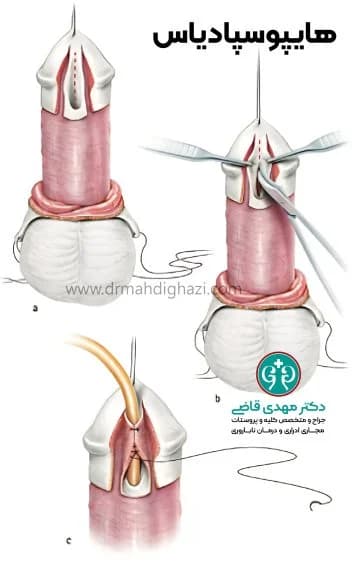
Hypospadias is a congenital anomaly in boys in which the urethra does not open at the tip of the penis. The urethral opening may be located anywhere along the underside of the penis, which can lead to problems with urination and future sexual function.
Hypospadias is relatively common and is seen in about 1 in 200 newborn boys.
Having this condition does not mean the child also has other congenital defects.
Types of Hypospadias
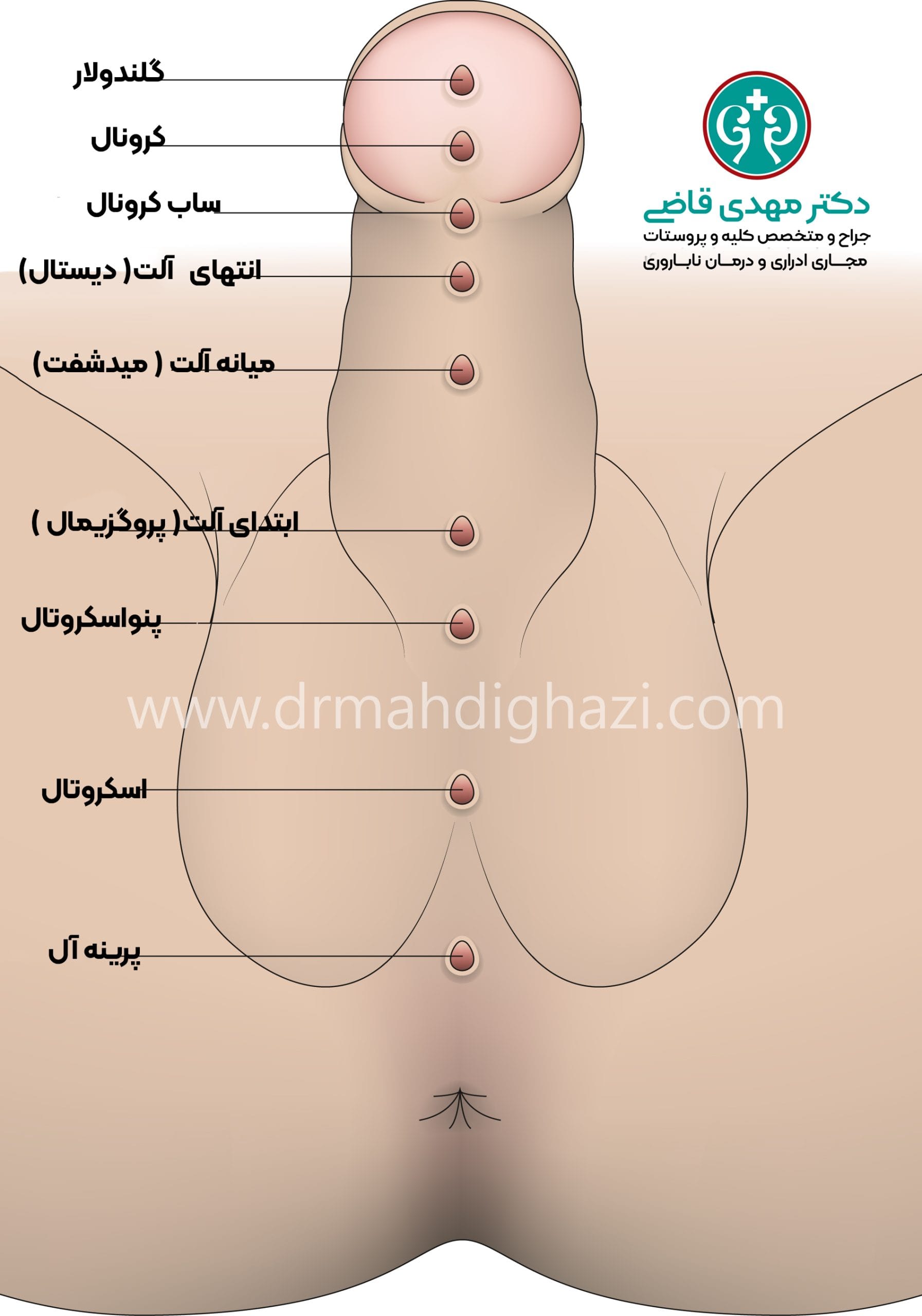
Hypospadias is generally divided into three categories based on the location of the urethral opening:
Distal: the urethral opening is near the tip of the penis (the most common type).
Proximal: the urethral opening is at the base of the penis or even below the scrotum.
Midshaft: the urethral opening is between the two types above.
In some cases, hypospadias is also accompanied by a downward curvature of the penis during erection (penile chordee).
Complications of Hypospadias
In cases where the urethral opening is close to the tip of the penis but lower than normal, this condition may be left untreated.
If left untreated, other types of hypospadias can lead to problems with urination, sexual function, and self-esteem.
However, with timely surgery, most boys with hypospadias can have a normal and healthy life in the future.
Causes
Hypospadias may be caused by fetal hormonal abnormalities.
Key stages in penis formation occur between weeks 9 and 12 of pregnancy.
During this period, male hormones signal the body to form the urethra, penile skin, and the foreskin around the glans.
Diagnosis
Hypospadias is often noticed at birth; not only is the urethra in the wrong place, but the foreskin is often not fully formed on the underside.
This is sometimes called “congenital circumcision.”
About 8 in 100 boys with hypospadias may also have one testicle that has not fully descended into the scrotum and may need surgery to bring it down.
Treatment
Hypospadias can cause several problems and complications for affected people during childhood and adulthood.
These complications may include:
Erection problems: up to 15 percent of boys with hypospadias have downward curvature of the penis. If the curvature is severe, it can cause problems with sexual intercourse in adulthood.
Problems with urination: in some cases, the urethral opening is larger, and in others it is very small. Some openings may have a flap of skin beyond the meatus that affects urine flow. In some boys, urine sprays sideways or downward, while others need to sit for a long time to urinate. Urination can cause discomfort, and splashing urine can irritate nearby skin.
Appearance of the penis: the foreskin, which is not fully formed, usually has an abnormal appearance. Studies show that boys with unrepaired hypospadias may experience reduced self-esteem.
Today, most pediatric urologists recommend correcting all forms of hypospadias except very minor cases. In most cases, the benefits of repair far outweigh the risks.
Hypospadias is corrected with surgery. The goal of any hypospadias surgery is to create a straight, normal-looking penis with a urethral opening near the tip.
Surgery is usually performed between 6 and 18 months of age. In some cases, more than one operation may be needed to repair the penis. The operation generally includes 4 steps:
Straightening the penile shaft and correcting any curvature, if present.
Creating a new urethra in the head of the penis to complete the missing part of the urethra.
Positioning the urethral meatus (urethral opening) at the head of the penis.
Circumcising or reconstructing the skin of the glans.
Hypospadias repair is usually a surgery that, depending on the type, takes between 90 minutes and 3 hours. For distal hypospadias, surgery takes about 90 minutes, and for proximal hypospadias it can take up to 3 hours.
When proximal hypospadias is associated with severe penile curvature, one surgery may not be enough and multiple surgical stages may be needed. In these cases, the surgeon must first correct the penile curvature and then reconstruct the urethra in later surgeries.
Surgeons recommend that hypospadias surgery be performed between 6 and 12 months of age. However, if this timing is not suitable, the surgery can be performed at any age, even in adulthood.
If the penis is small, the physician may recommend testosterone hormone therapy before surgery to increase penile size.
The goal of hypospadias surgery is to create a permanent, lasting repair that remains for life.
Postoperative Care
Many pediatric urologists believe that routine office visits are not necessary after the first few months because the likelihood of later problems is very low. Others believe boys should be monitored throughout childhood and until after puberty.
Hypospadias surgical wounds usually do not require special care to heal. The surgeon teaches the family how to care for the wound and provides instructions about bathing and changing diapers.
Many surgeons leave a catheter in place for a few days after surgery so urine does not come into contact with the surgical site. While the catheter is in place, an antibiotic is often prescribed.
If the child has a catheter, urine may be allowed to drain into the diaper. The diaper can be changed as usual.
If the child is older, the catheter may be connected to a bag.
Catheters are often kept in place for 5 days to 2 weeks.
Younger boys appear to have less restlessness after repair.
Complications of Hypospadias Surgery
Complications of distal hypospadias repair in boys occur in fewer than 1 in 10 cases. Problems occur more often after proximal hypospadias repair.
The most common problem after surgery is formation of an opening (“fistula”) elsewhere on the penis (leakage from the surgical site or somewhere near it).
A narrowing may also develop at the urethral meatus, which can interfere with urination.
After surgery, parents should keep the following points in mind:
If the child complains of urine leakage or a narrow urine stream after hypospadias repair, they should see a pediatric urologist.
Many complications appear in the first few months after surgery, but fistulas or strictures may not show up until years later.
If the surgery fails and urethral repair is unsuccessful, repeat surgery can be performed 6 months after the previous operation.
Unhealthy scarred and adherent tissues from previous surgeries can be removed during repeat surgery. Healthy skin can be taken from part of the penis or from other areas of the body (often from inside the cheek) and used to repair the previous surgical site. This operation is called urethroplasty with a mucosal skin graft.
Recovery Time
Wound healing after hypospadias repair begins quickly, but it may take months to heal completely. Swelling and bruising may be present at first and usually improve within a few weeks.
Frequently Asked Questions
Actions & related links
Doctors for this topic in Mashhad
See all doctors: Best Men's Genital Health Specialists in Mashhad




About the author

Urologic Surgeon
دکتر مهدی قاضی, Urologic Surgeon in Mashhad. Articles on this site are written and reviewed under the supervision of the Urology Building's physicians.
View profile & bookRelated articles
All articlesWhat Is Polycystic Kidney Disease? (Fetal and Adult PKD)
دکتر مهدی قاضی · June 26, 2026
What Is a Renal Cortical Cyst? Symptoms, Diagnosis, and Treatment
دکتر مهدی قاضی · June 26, 2026
Kidney Transplant: Cost, Blood Type Compatibility, and Surgical Method
دکتر مهدی قاضی · June 26, 2026
What Is Pyelonephritis? Kidney Infection Symptoms, Diagnosis, and Treatment
دکتر مهدی قاضی · June 26, 2026
Comments
22 comments